
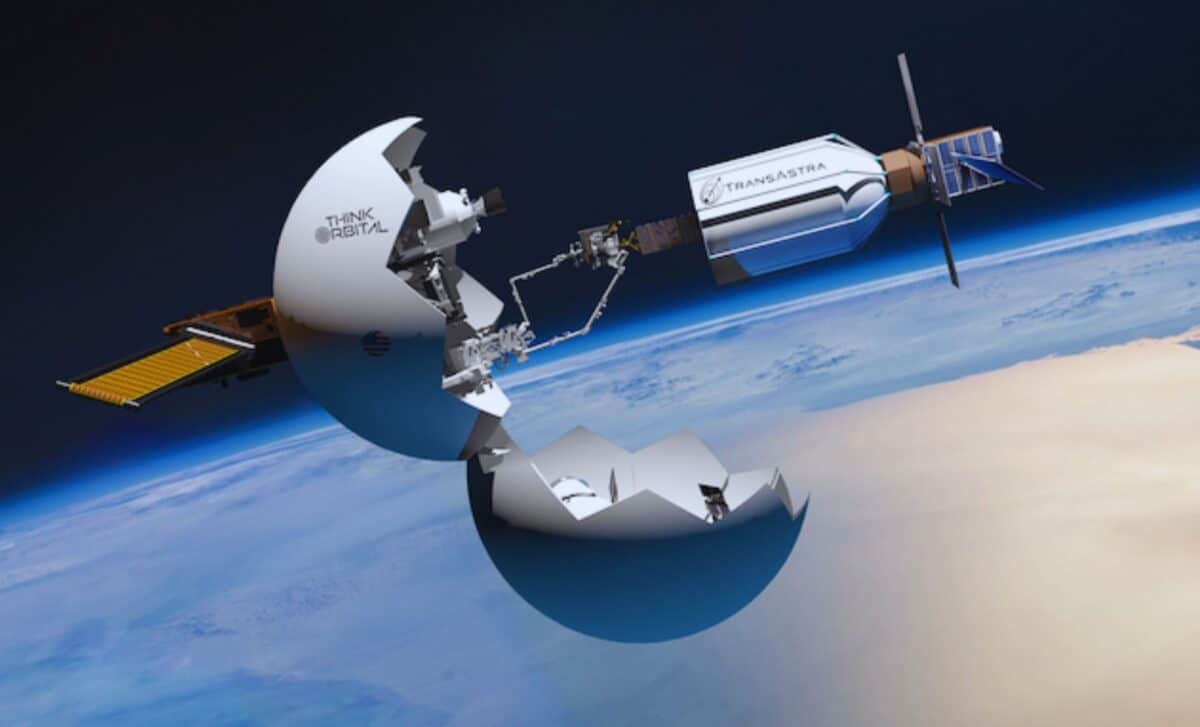
An American startup has come up with a surprisingly simple tool to solve one of space’s most complex challenges.TransAstra, based in California, has developed a giant inflatable bag that can trap anything from small pieces of orbital debris to house-sized asteroids. Tested recently aboard the International Space Station, the so-called Capture Bag is now being scaled up for future missions, with its first asteroid retrieval operation planned for 2028.
Clean up the increasing amount of space junk that clutters Earth’s orbit, and kick-start a new era of asteroid mining. According to CNN, TransAstra’s approach focuses on affordability and adaptability, two qualities that make its bag a potentially viable alternative to robotic arms or complex mechanical grappling systems.
A Flexible Concept Put to the Test Aboard the ISS
In October, TransAstra completed an initial test of the Capture Bag on the International Space Station. The prototype, roughly a meter across, was deployed in the airlock to see how it performed under microgravity and vacuum conditions. No object was captured, this was a test of form and function, not a full demonstration, but the deployment went smoothly.
The test unit was flown into orbit aboard a Falcon 9 rocket and handed off to astronauts aboard the station. According to TransAstra’s founder Joel Sercel:
“We went from a sketch on a whiteboard to delivered hardware for the flight demonstration in seven months — in the space business, that’s unheard of.” The bag’s material, a mix of kevlar and aluminum, makes it both lightweight and durable, and, crucially, adaptable to objects of different shapes.
The next step is already underway. A 10-meter version of the Capture Bag is now in development, financed by $5 million in funding, half of it from NASA. The plan is to test it first on space junk. The bag will latch onto defunct satellites drifting in unused orbits and drag them out of the way. Only once the system proves reliable will it be used for asteroid retrieval.
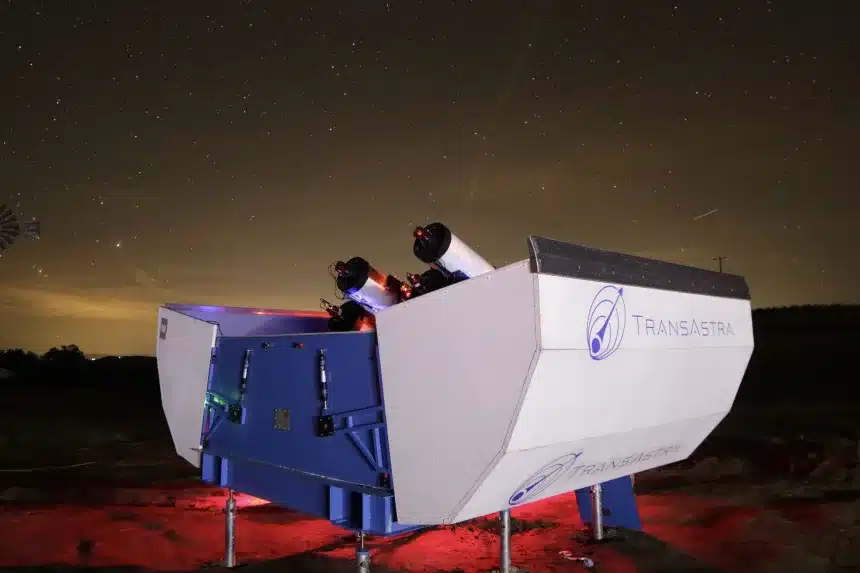 A Sutter telescope array configuration. Credit: TransAstra
Using a Custom Telescope Network
TransAstra has set up a network of specialized telescopes across California, Arizona, and Australia, with another site planned for Spain. These telescopes, called Sutter, are designed specifically to spot small near-Earth asteroids that follow stable orbits similar to our planet.
Sercel explained that the company is focusing on a population of asteroids that drift past Earth at a relatively close distance“just a few billion kilometers.”. In line with CNN‘s report, TransAstra has already identified hundreds of viable candidates, and it intends to retrieve the first one by 2028.
The aim isn’t to haul asteroid materials back to Earth. As Sercel noted in the interview, “It doesn’t make economic sense.” Instead, the minerals would be used directly in space or support deep-space missions. This would dramatically cut costs compared to launching components from Earth.
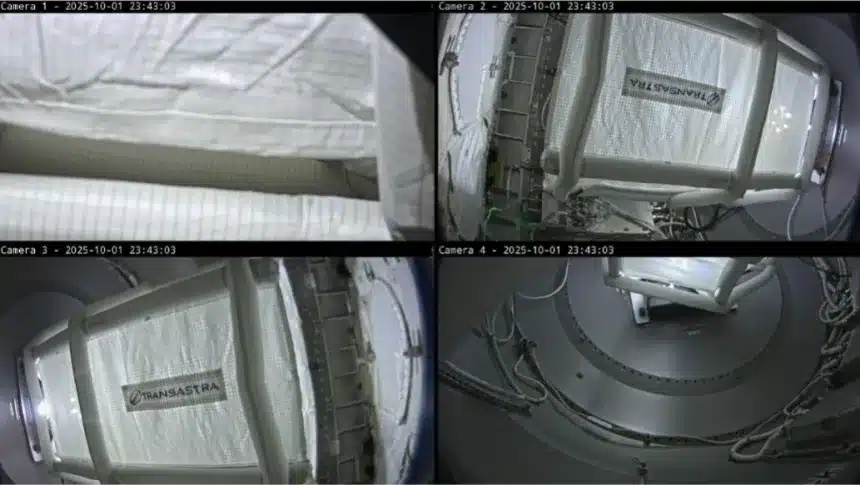 TransAstra’s capture bag was onboard the ISS and was fully deployed in the Bishop Airlock chamber of Voyager Technologies. Credit: TransAstra
Asteroid Mining May Start With Debris Removal
TransAstra’s big goal is asteroid mining, but for now, the focus is on space junk. Their inflatable bag will first be used to catch dead satellites, still floating up there and causing problems.
“That 10-meter capture bag will be big enough to find satellites that are in graveyard orbits but might be causing navigational issues. It will capture them and move them to a safer place. That’s an important mission,” Sercel explained.
Some researchers are cautiously optimistic. Eleonora Botta, from the University at Buffalo, thinks the bag is a smart idea because it can handle objects of all shapes and spins—but she points out that scaling it up and deploying it in orbit won’t be easy. John Crassidis, also from Buffalo, likes the approach, especially the telescope system, but says aiming for an asteroid mission by 2028 might be pushing it. His main concern: will they find enough asteroids to make it worth the cost?
Other companies have tried and failed, Planetary Resources, Deep Space Industries, and more recently Astroforge, which lost contact with its Odin spacecraft right after launch. Still, TransAstra has more funding, solid partners, and a clear roadmap.