
For centuries, scientists have wondered about the true structure of the Moon’s interior. Now, after years of research, a groundbreaking study has provided clarity. Published in Nature, this study reveals that the Moon’s core is solid and composed of a material density similar to iron. This discovery has important implications for understanding both the Moon’s history and its magnetic field’s mysterious decline.
Unveiling the Inner Moon: A Solid Core Revealed
Until recently, the composition of the Moon’s core was a topic of intense debate. Was it solid or molten? While some theories suggested a molten interior, others proposed that the Moon’s core might be solid, similar to Earth’s. In May 2023, a team led by astronomer Arthur Briaud of the French National Centre for Scientific Research (CNRS) published findings in Nature that have decisively settled the argument. Their research shows that the Moon indeed has a solid inner core, confirming a structure very similar to that of Earth, with an outer fluid core and an inner solid core.
The discovery came after extensive data collection from seismic waves, lunar laser-ranging experiments, and space missions, which allowed the team to model the core’s structure accurately. The team found that the solid core has a density of approximately 7,822 kilograms per cubic meter, closely matching the density of iron. This solid core spans a radius of about 258 kilometers (160 miles), while the surrounding fluid outer core extends to a radius of about 362 kilometers (225 miles). These findings not only confirm previous hypotheses but also shed light on the Moon’s complex evolutionary history.
The Moon’s Magnetic History: A Key to Its Past
The study has provided more than just insights into the Moon’s interior. It also offers a deeper understanding of its once-powerful magnetic field. Arthur Briaud and his team write,
“Our results question the evolution of the Moon’s magnetic field thanks to its demonstration of the existence of the inner core and support a global mantle overturn scenario that brings substantial insights on the timeline of the lunar bombardment in the first billion years of the Solar System.”
This magnetic field, which existed early in the Moon’s history, began to fade around 3.2 billion years ago, and scientists have long wondered why.
The research suggests that the Moon’s core dynamics were likely responsible for generating its magnetic field in the past. However, as the core began to cool and solidify, convection slowed, which could explain why the magnetic field gradually dissipated. This provides new perspectives on how and why the Moon’s magnetic field disappeared, making the study crucial for understanding both the Moon and Earth’s early history.
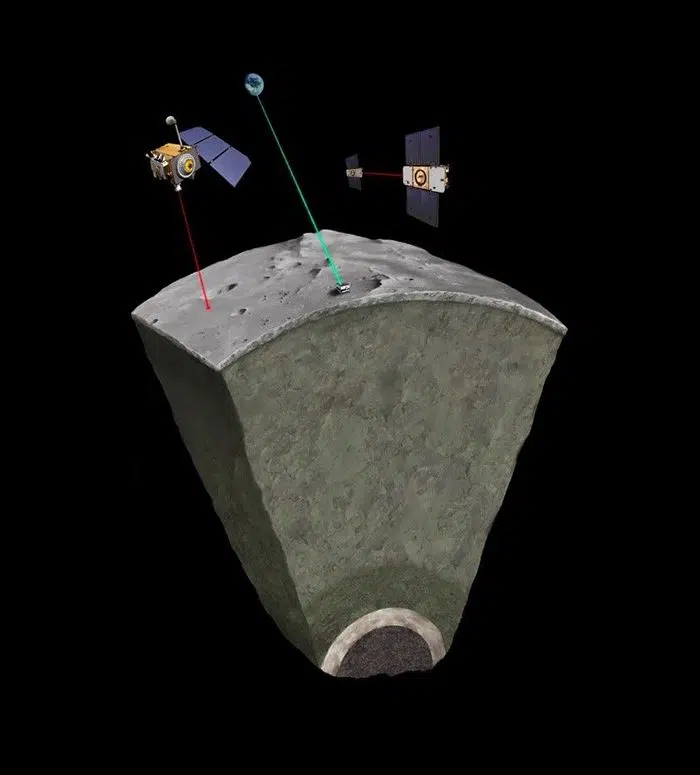 Artist’s impression of different instruments measuring the properties of the Moon to reveal its core. (Géoazur/Nicolas Sarter)
Implications for Lunar Evolution: How the Core Shapes the Moon’s Future
The recent study doesn’t just reshape our understanding of the Moon’s past; it also opens the door to new insights about its future. One of the most fascinating aspects of the study is the concept of “mantle overturn,” which suggests that denser materials inside the Moon sink toward the core while lighter materials rise. This internal process could have significant implications for the composition and behavior of the Moon’s volcanic regions.
By modeling this overturn activity, Briaud and his team are able to explain the presence of certain elements in volcanic areas on the Moon’s surface. These findings support earlier theories that volcanic activity on the Moon was influenced by deep internal processes, offering further evidence that the Moon’s interior was once far more active than it appears today.