

Google has previewed Code Wiki, an AI project that aims to document code in a repository and keep it up to date by regenerating the content after every code change.
The preview has documentation for hundreds of open source projects. Coming soon is an extension to Gemini CLI, Google’s AI agent, that will run on internal repositories, though there is no word yet about pricing.
The official post has only brief details of how Code Wiki works, leaving it to developers to explore the preview version to figure out what it can do.
A Hacker News comment from Omar Shams, founder of Mutable.ai, states that Code Wiki is a rebuild of a previous project called Auto Wiki, which his company developed before it was acquired by Google.
Code Wiki is focused on documenting the code in a repository, which must not be confused with documenting the output of that code. We looked, for example, at what the service has generated for Microsoft’s ASP.NET Core web platform. Microsoft has comprehensive documentation for using ASP.NET Core, but documentation for contributors to the project is not so good, so Code Wiki’s efforts could be useful.
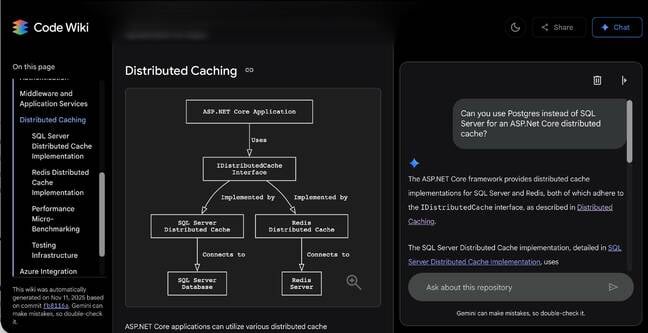
Code Wiki explains ASP.NET code for distributed caching
There is also a chat user interface in Code Wiki, which lets you ask questions about the codebase. We asked whether Postgres could be used instead of SQL Server for an ASP.NET Core distributed cache. Gemini said that “there is no mention of direct support or an out-of-the-box implementation for PostgreSQL.”
Microsoft’s official docs, though, state that “Azure Database for PostgreSQL can be used as a distributed cache backing store via the IDistributedCache interface.” Gemini is half right, in that only SQL Server and Redis implementations are in the repository, but this is perhaps a case where a knowledgeable human would give a better answer.
Google says that reading existing code is among the “biggest, most expensive bottlenecks in software development.” It may well feel like that for a new developer joining a team. The open question, though, is whether AI-generated documentation is a good solution. Developer views vary. “Repo-wide documentation really feels like the last thing I’d want AI to touch. It doesn’t really have the context size to piece together the architecture of an entire code base, and that’s a problem that’s not really solved by lots of tool calls,” said one, in response to the launch.
Another looked at the generated documentation for the Vue JavaScript framework, being familiar with it. “It doesn’t look too bad,” they said, but “it’s still very much an ‘educated guess’ kind of documentation that’s full of LLM-isms. It oscillates between being too vague and too specific all the time, and it is very verbose, being one fifth the length of the relevant code itself.” Another issue is that Code Wiki did not make clear that the repository vuejs/vue is obsolete and went end of life two years ago; though there is also a separate Code Wiki entry for the current vuejs/core.
We must note that Code Wiki is not a wiki, since the essence of a wiki is that it is collaborative and open to amendment, not a large wodge of auto-generated text and diagrams.
A key concern though is that AI-generated documentation is not authoritative, unlike reading and understanding the code. Code Wiki contains the disclaimer, “Gemini can make mistakes, so double-check it.”
The idea of regenerating documentation when code changes has pros and cons. Keeping it up to date is a good thing, but changing too much could be confusing. “Does anything persist? If I could be in the middle of reading it, and the next day it’s completely different, that’s a huge waste of my time,” said another comment.
Google is not the first to attempt this kind of project. Devin’s DeepWiki is a similar concept that also provides documentation for open source repositories, and is already available for private repositories.®