
 BBC
BBC

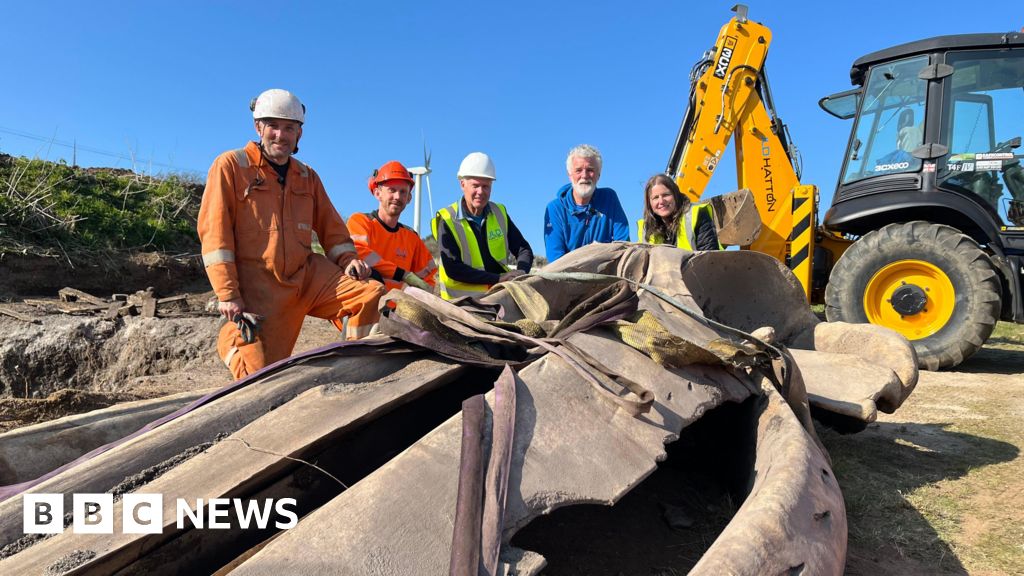
The skull, which was buried in Falmouth, is the length of a minibus
The two-tonne head of a whale that died after stranding in Cornwall has been excavated in a 10-hour mission, five years after its burial.
As the local community had previously attempted to rescue the fin whale in 2020, a decision was made to keep part of it so it could eventually be displayed as a memorial.
Scientist Robbie McDonald said he buried the skull on University of Exeter land in Falmouth to help prepare the bones for study and display, as it is the most natural way to clean them.
“Hopefully we can learn something about the marine environment that it came from but ultimately it will be a nice thing for people of Cornwall to remember this animal,” he said.
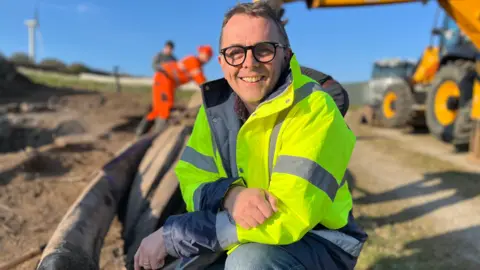
Professor Robbie McDonald buried the head of a fin whale in 2020 and was there five years later when scientists dug up the decomposed remains
The 20m (65ft) whale stranded in Parbean Cove at the mouth of the Helford river, and the species is the second largest animal on Earth, after the blue whale.
After gaining permission from the landowner – the Duchy of Cornwall – academics were able to take the whale’s head for scientific purposes.
The head was then buried on grounds at the university’s Cornwall campus in Penryn, without many people being aware of the burial.
“It’s fantastic we really didn’t know how it was going to go not having seen it for five years,” explained Prof McDonald.
“There were a few touch and go moments where just the sheer weight of it can fracture the skull.
“There’s a few nicks and a few dings but nothing we can’t handle, so I’m delighted and it’s come out really clean too.”
The story of the whale has been made into a BBC podcast, you can listen to all six episodes of The Whale: Secrets of a Stranding on the BBC Sounds app.
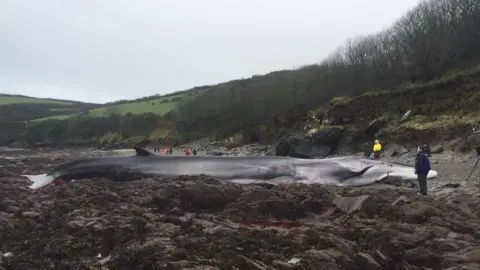
The young female fin whale stranded at Parbean Cove in 2020 and despite the best efforts of locals it later died
An industrial vacuum machine, normally used to excavate buried utility cables, was used to help remove the soil from around the head which was then craned out of a 2m-deep (6.5ft) hole on university grounds.
Dave Hatton, who runs a plant hire firm, helped bury and then dig up the whale.
He said: “It was a fair old weight, much harder to get it out of the ground than putting it in.
“I’ve been asked to help dispose of whales before with my digger but doing this is something a bit different isn’t it?”
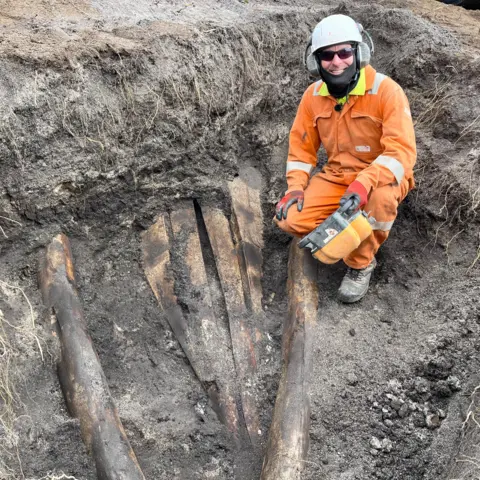
Paul White usually excavates live electricity and utility cables – this was his first whale
Paul White usually excavates live electricity and utility cables but on this job the former Royal Marine needed to get his head around the anatomy of a whale.
He admitted he had done a bit of online research “not how to excavate a whale but to learn about the whale’s bone structure because I knew I was coming down here and I wanted to know roughly what I was coming against when I start excavating the ground”.
Mr White was operating the vacuum excavator which sucked up the soil from around the skull to avoid any potential damage that digging could cause.
“This machine is usually for live electricity cables so that’s how we treated it, really gentle like,” he said.
“I was pretty convinced it would break though when we tried to lift it.”
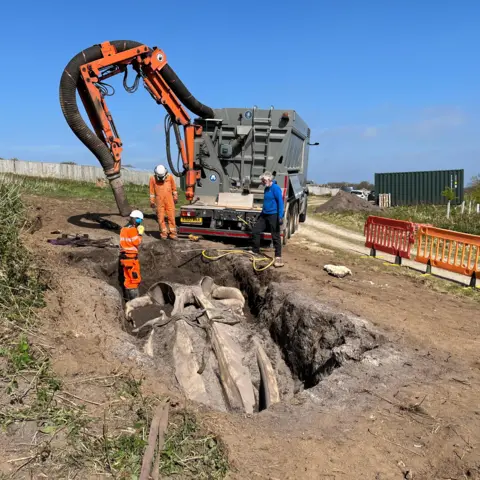
Part of the research on the bones aims to see whether the process of decomposition in the soil cleaned them of any remaining tissue
Usually whale carcasses are disposed of by the landowner but scientists, who hold a licence from Natural England, are allowed to take animal bones for scientific and educational purposes if permission is granted.
“There is so much to be done to improve the state of the natural environment,” Prof McDonald added.
“There’s a big global commitment to preserve and effectively manage about 30% of the sea by 2030 and we’ve got a long way to go.”
He said the whale’s skull was a “gargantuan reminder of what we can do to improve the marine environment”.
Part of the research on the bones would also be to see whether the process of decomposition in the soil had cleaned them of any remaining tissue, he added.
The excavation comes after another fin whale stranded on the Cornish coast on Monday.