


Paul Nicholson
Head of Investment Strategy

Stephen Grissing
Investment Strategist

Scott McElhinney
Investment Strategist

Conor Murtagh
Investment Associate
Global equities were mixed for the week as concerns regarding frothy valuations and elevated scrutiny related to artificial intelligence spending continued to drive a rotation out of growth stocks which have been responsible for the majority of returns this year. In more positive news, the longest ever US government shutdown ended on Wednesday evening when President Trump signed a spending bill, keeping the government funded to January 30th. Economic data remained a talking point as White House representatives noted October jobs and inflation data may never be released. In the Eurozone, Q3 GDP grew 0.2%, beating consensus estimates of 0.1% for the bloc. Weaker-than expected UK labour market and growth data prompted traders to increase bets that the Bank of England will move to cut rates in December. Unemployment in the 3 months to September rose to 5% whilst growth slowed to just 0.1% for the third quarter. Elsewhere, Brazilian inflation slowed to 4.68% in October and Chinese official indicators signal a slowing economy entering the 4th quarter.
Last week’s highlights

ADP Employment Change Weekly (11/11) – Private employers cut an average of 11,250 jobs per week in the 4 weeks ending October 25th.
US MBA 30YR Mortgage Rate (12/11) – Average contract interest rate on 30-year mortgages with conforming loan balances edged higher to 6.34%.

Eurozone Q3 GDP (14/11) – Eurozone expanded 0.2% in Q3. On an annual basis, Eurozone GDP rose 1.4%.
German Inflation (12/11) – German inflation moderated to 2.3% in October, in line with consensus estimates and down from 2.4% in September.

UK Unemployment Rate (11/11) – Rose to 5%, the highest level in a decade excluding the pandemic period, economists were expecting 4.9%.
UK Q3 GDP (13/11) – Economic growth slowed to 0.1%, compared to 0.3% in Q2 of this year. Bank of England economists were expecting a gain of 0.2%.

Brazil Inflation (11/11) – Slowed more than expected in October, consumer prices rose 0.09% to 4.68%, down from a 0.48% increase in September.
China Industrial Production (13/11) – Industrial output expanded 4.9% in October, slowing from 6.5% recorded in September and below estimates of 5.5%.
Looking ahead, with the resumption of the US Government, investors are hoping to receive critical economic data on employment, inflation and other economic signposts. September Nonfarm Payrolls (NFP) are due to be released on Thursday by the Bureau of Labour Statistics whilst we get Federal Open Market Committee (FOMC) minutes on Wednesday. In the UK, inflation figures will be released on Wednesday and retail sales figures on Friday. Investors will receive Japan Q3 GDP figures on Monday and inflation figures on Friday.
What’s on the radar
FOMC Minutes (19/11)
September Nonfarm Payrolls (20/11)
Existing Home Sales (20/11)
German HCOB Manufacturing PMI (21/11)
Euro Area Consumer Confidence (20/11)
UK Inflation (19/11)
UK Retail Sales (21/11)
Japan Q3 GDP (17/11) & Inflation (21/11)
Canada Inflation (17/11)
Reserve Bank of Australia Meeting Minutes (18/11)
Chart of the moment – If you can’t beat them, join them
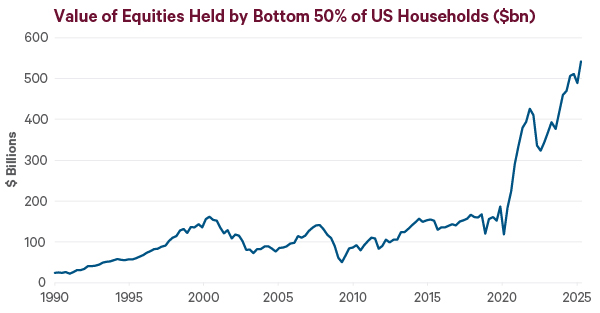
Source: Board of Governors of the Federal Reserve System. Note: The bottom 50% of households refers to the 1st to 50th wealth percentiles in the US.
If you would like to stay up to date on the latest macro information, subscribe to this newsletter to receive it straight to your inbox every Monday.
Warning: The information in this article is not a recommendation or investment research. It does not purport to be financial advice and does not take into account the investment objectives, knowledge and experience or financial situation of any particular person. There is no guarantee that by putting a financial or investment plan in place, you will meet your objectives. You should speak to your adviser, in the context of your own personal circumstances, prior to making any financial or investment decision.
Warning: Forecasts are not a reliable indicator of future performance.
Warning: Past performance is not a reliable guide to future performance. The value of your investment may go down as well as up.