
Protecting the forest
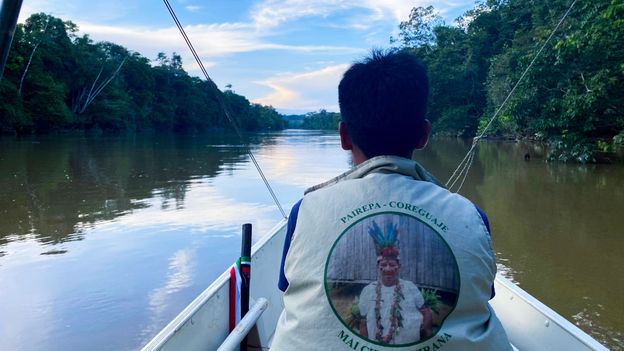
Studies have shown that indigenous territories in the Amazon suffer less deforestation and remain better conserved than surrounding lands. That stewardship has become crucial as the planet heats up. Indigenous guards, constantly patrolling the rainforest, are vital in the efforts to preserve the Amazon’s role as one of the planet’s greatest carbon sinks, a function already imperilled by accelerating forest loss.
“By being present and watching over their territories, indigenous peoples have succeeded in protecting the forests,” says Julia Miranda, a Colombian Congresswoman who directed Colombia’s national parks for 16 years. “Public security forces can’t stay permanently; they come in for operations or patrols and then leave. Instead, indigenous peoples remain. Their presence is constant, not occasional.”
More like this:
• Why pink dolphins are the ‘thieves’ of the Amazon
• The ‘dark earth’ revealing the Amazon’s secrets
• Ecuador’s all-female Amazon patrol
In Jansasoy’s own language, Inga, his title is wasikama – meaning, a guardian of the home. He is also the coordinator of the Indigenous Guard in the department of Putumayo, and as part of his job, he has trained dozens of guards. He has travelled to other communities in Peru and Ecuador to teach first aid, river rescue, disaster response and fire prevention. Guards have also begun forging conservation pacts with their peers across regions. Along Putumayo, upstream communities like Villagarzón, where Jansasoy lives, agreed to keep the waters clean, while downstream communities safeguard the fish swimming upriver and protect animals like tapirs and deer from poaching.
When he goes on patrol, he carries his staff draped in rainbow-colored ribbons and a backpack with a hammock and enough food for up to 20 days in the jungle. On his phone, he still keeps a photo of the rainbow he saw that morning the Amazon guard was created.