
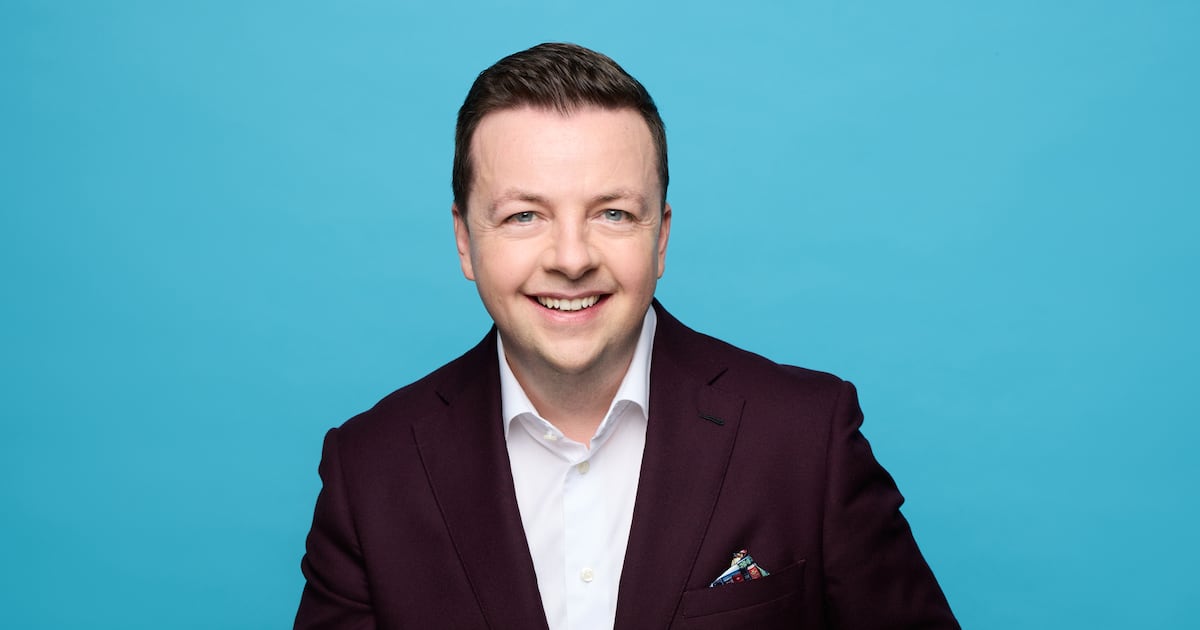
Of all the tributes paid to Paschal Donohoe after his abrupt resignation as minister for finance, perhaps the most heartfelt comes from Oliver Callan (RTÉ Radio 1, weekdays).
As he contemplates Donohoe’s “semi, sort-of, nearly bombshell”, Callan’s mood is, if not exactly bereft, then at least wistful: turns out it’s not just the Coalition that has been left high and dry by the minister hightailing it to the World Bank.
“He’s been such a great voice for Callan’s Kicks for so many years, I’m half-devastated,” the host says, sounding wholly sorry at the prospect of no longer being able to lampoon Donohoe’s distinctive tones in his weekly satirical series.
Minor as this setback may be, it’s the closest thing to a cloud on the horizon for Callan, on the face of things anyway. He is, after all, one of the big winners of RTÉ’s great Radio 1 shake-up.
While other presenters at the station have been shunted sideways or deemed surplus to requirements, his programme has been doubled in length and pushed up the schedule to a more prominent – and civilised – 11am slot. (The latter development is a particular win for Callan, given he once almost slept out his show last year.)
Little wonder, then, that any melancholy about Donohoe’s move quickly gives way to a jolly overview of his career.
With apparent sincerity, Callan describes the former minister as “the towering intellect of Fine Gael”, albeit one whom some colleagues have seemingly regarded as “a wee bit scabby on nights out”: not standing your round appears to be a more egregious sin in such circles than not housing your population.
Where Callan previously provided the cheeky hors d’oeuvre before Claire Byrne’s more substantial main course, he now has to provide the big-name ballast
The same breezy air pervades Callan’s interviews, even when the subject matter is less cheery.
The host is palpably charmed by Gregory Maguire, whose novel Wicked is now a Hollywood blockbuster; the American author recalls, playfully but honestly, how his ancestry, religion and the death of his mother during childbirth affected him for years: “It does help to be Irish Catholic if you prefer to be guilty for your whole life long.”
Similarly, the actor Risteárd Cooper alternates between fond memories of his late mother and jocular anecdotes about the Après Match comedy team.
And while an impressionist asking another impressionist to do his most popular impression might sound like time-collapsing self-indulgence, Cooper’s mimicking of Gay Byrne is pitch-perfect.
 Paschal Donohoe’s last interview
It’s all a bit of a romp, with Callan projecting the same irreverent energy and emotional awareness that marked the earlier iteration of his show. Yet, at this early stage anyway, the weight of expectation of the new slot seems to be telling on Callan, however subtly.
For one thing, sustaining a relaxed air while delivering absorbing content is a greater challenge over two hours, as the host is well aware. When the broadcaster and former Ireland rugby player Tommy Bowe congratulates Callan on his longer running time, he drily responds: “We have to really stretch this out now.”
His conversations certainly seem to be longer than before. This is fine when talking to the likes of Cooper, Maguire and Leon Diop, founder of the Black and Irish advocacy group, who talks about his mixed-race heritage with honesty on Wednesday. But it may be an issue when, inevitably, the host has to spin out chats with less compelling guests.
Also, where Callan previously provided the cheeky hors d’oeuvre before Claire Byrne’s more substantial main course, he now has to provide the big-name ballast after the comprehensive current-affairs coverage of the newly preceding Today with David McCullagh (RTÉ Radio 1, weekdays).
After a good first week as host, McCullagh continues to settle in nicely, bringing deft questioning and healthy scepticism to Wednesday’s interview with the departing Donohoe. The former minister is adamant that he’s leaving only because of the “once-in-a-lifetime opportunity” of his new gig; having served four taoisigh, he claims he never had a burning desire for the top job.
He’s less convincing when asked if he’s bailing out before the economic tide turns. Citing his fiscal record in response, he notes that Ireland has gone from budget deficit to surplus under his watch, but McCullagh is dubious. “If you strip out corporation tax, it’s deficit,” the host shoots back. Donohoe navigates such questions calmly and politely, but it’s unlikely he’ll miss the ritual grillings of political life. McCullagh, meanwhile, has started his new role in assured style.
Donohoe’s exit is also discussed on The Late Debate (RTÉ Radio 1, Tuesday-Thursday), as Cormac Ó hEadhra returns for a second stint as host of the nocturnal panel show. Having been unceremoniously bumped from the Drivetime slot he capably hosted with Sarah McInerney – who remains conspicuously absent from the new Radio 1 roster – Ó hEadhra resumes business at his old bailiwick in typically bracing style. (He’s also back presenting the eponymous discussion show Saturday with Cormac Ó hEadhra. In all, it’s a straight swap with the new Drivetime host Colm Ó Mongáin.)
Ministerial departures notwithstanding, the most contentious topic on Tuesday’s programme is, surprise surprise, immigration. As Ministers make tougher noises on the issue, the Fianna Fáil Senator Fiona O’Loughlin insists her party hasn’t changed its line, though there’s initially silence when Ó hEadhra asks if panellists are against a harder line on migration.
The Independent Senator Eileen Flynn then attacks Government policy for othering refugees – as a Traveller, she says, she knows what this feels like – as well as favouring Ukrainian migrants over other international-protection applicants. “From day one, the Government put white refugees up on a pedestal,” she says.
The host does his bit to sustain the robust atmosphere, asking O’Loughlin if tougher Government language is “answering to the far right” and mischievously suggesting that the Sinn Féin TD Donnchadh Ó Laoghaire has remained “very quiet” throughout the debate. As often the case on The Late Debate, it’s not always enlightening, but with Ó hEadhra at the wheel it’s entertaining. Whatever his true feelings, he doesn’t sound too devastated to be back at his old job.
Moment of the week
Another addition to the revamped Radio 1 line-up, Inside Sport (weekdays) spends much of the week basking in the Republic of Ireland’s dramatic Fifa World Cup qualifier victories over Portugal and Hungary.
RTÉ’s soccer correspondent Tony Donoghue relives his postmatch interview with the Budapest hat-trick hero Troy Parrott while Marie Crowe, the programme’s host, speaks to the defender Dara O’Shea, focusing on the Irish player’s role in Ronaldo’s red card in the Portugal game.
“The game’s the game. I was doing whatever I could for my country,” O’Shea says of his reaction to the Portuguese superstar’s elbowing foul on him. He then adds, with a knowing chuckle, “The less I say the better, maybe.”
Indeed. Wiser to let the results do the talking.