

Investors are in a quandary over the US market. The largest economy in the world is home to many a poster-child success story for artificial intelligence — but much of the market mood this year has been apprehension that the AI bubble could be about to pop.
Fears of a large correction have troubled investors and prompted a sell-off of tech stocks amid concerns of sky-high valuations and massive spending on data centres and chips.
Last week was a rollercoaster ride for the US tech markets. They were boosted temporarily when Nvidia reported better than expected results, with its share price climbing more than 5 per cent in early trading on Thursday. The tech-heavy Nasdaq Composite rose almost 2.5 per cent and the S&P 500 jumped 1.8 per cent.
• What you can learn from Warren Buffett’s goodbye letter
But the boom was short-lived. By the end of the day Nasdaq closed 2.2 per cent lower and the S&P 500 dropped 1.6 per cent as investors struggled to shake off jitters over lofty company valuations.
Laith Khalaf from the investment service AJ Bell said: “Talk of a stock market bubble is everywhere right now, and for good reason. Valuations in the US stock market are sky-high and the enormous technology companies sitting atop the S&P 500 are venturing into an unpredictable AI future, burning through tens of billions of shareholder dollars.”
The fallout from a large correction in US tech would be global. “Its performance has been so outstanding that the sector now makes up a big slice of US and global tracker funds, and those funds themselves will very likely have higher weightings in investor portfolios because they have done so well,” Khalaf said.
Many will be unaware of just how exposed they are to an AI bubble through ready-made tracker funds that they hold in self-invested personal pensions and Isas — and also workplace pensions.
The star players of the AI boom are largely concentrated in a cluster of mega stocks which feature prominently in the typical portfolio of a retail investor. Jason Hollands from the wealth manager Evelyn Partners said that the Magnificent Seven tech stocks, including Nvidia, Alphabet and Amazon, and the tech giant Broadcom make up more than 37 per cent of the market value of the S&P 500 and 26 per cent of the MSCI World Index.
“Exposure to these companies is further compounded by the fact that passive investing — which involves replicating an index at low cost — has become a very significant part of the way that people invest these days, both when it comes to retail investors choosing funds for their Isas and Sipps, but also within workplace pension schemes,” Hollands said.
He said the typical UK workplace defined contribution pension scheme would have between 60 to 80 per cent invested in equities closely aligned to global indices — of which 65 per cent to 75 per cent would be linked to the US market.
“The AI-linked goliaths will be a very meaningful chunk of this. Nvidia has $4.4 trillion market cap, twice the size of the entire UK stock market, and will be most people’s largest underlying stock in their pension,” Hollands said.
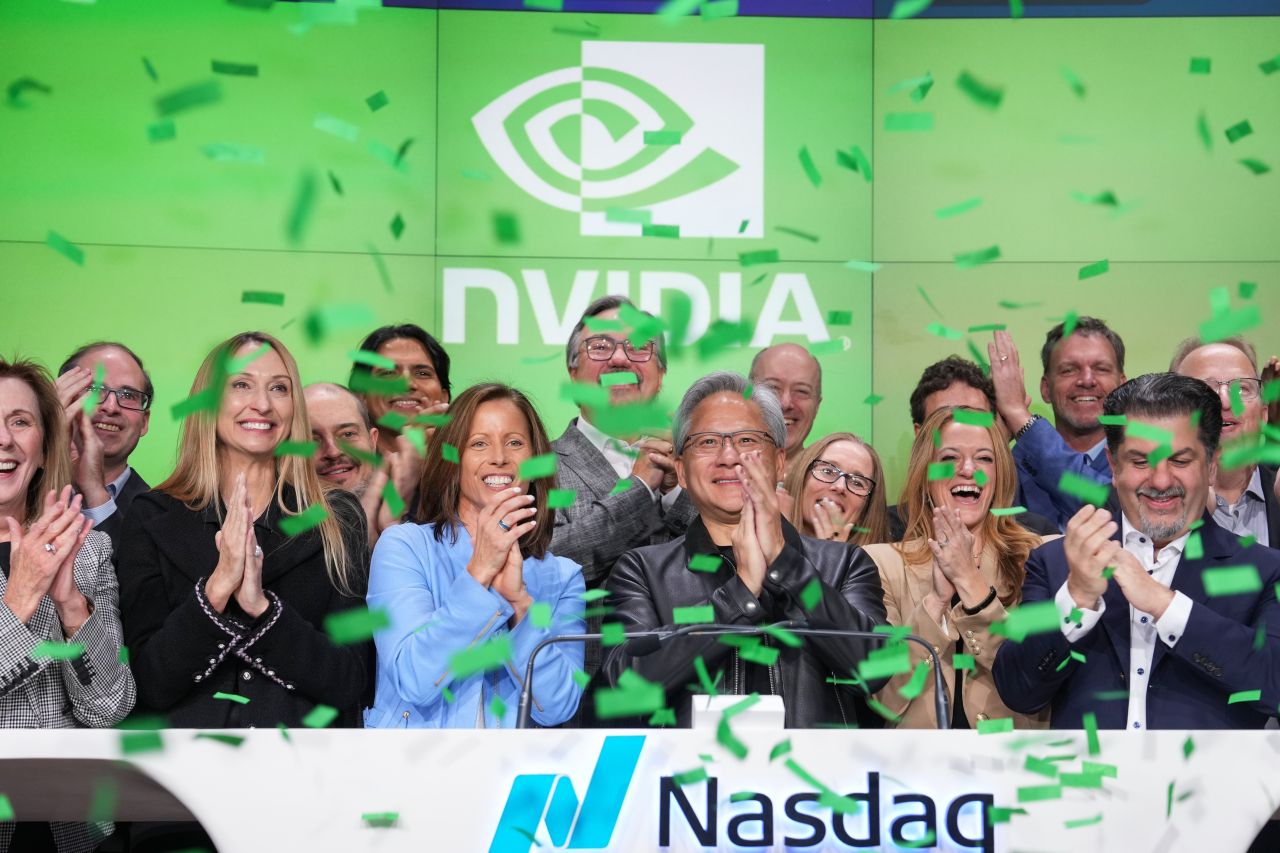
“Nvidia has $4.4 trillion market cap, twice the size of the entire UK stock market”
NASDAQ
When will the bubble pop?
It is impossible to time the market, and any attempt to guess when a correction will come could leave you worse off in the long run.
Hollands said: “Fears of an AI bubble have been fermenting for a while. But bubbles can balloon for quite some time before they finally burst.
“Second guessing the top of a market is extremely difficult to get right. Rather than try and make a big call as to whether the time is right to completely bale out, the best course of action is to review your existing investments and consider rebalancing these if you find you are too heavily exposed to US equities and AI-linked stocks in particular.”
Khalaf agrees. “It may be that the US technology sector continues to do well, so you shouldn’t throw the AI baby out with the bathwater, but it’s definitely a good point at which to take stock of where your exposure is, and make sure you’re comfortable with it,” he said.
The dotcom bubble, to which some experts have compared the AI boom, ran from 1995 to March 2000. It eventually burst when prices crashed and many overvalued internet companies went bust.
Khalaf said: “No one should need reminding of what a bubble bursting can do to your wealth. An investor in the S&P 500 in March 2000 saw a £10,000 investment wither to just £6,000 over the next three years. An investor in the tech-orientated Nasdaq 100 would have been left holding less than£3,000 at the end of that period.
“It’s hard to pinpoint precisely how much of this dire period for stock market returns can be laid at the door of the dotcom bubble bursting, seeing as the fallout was exacerbated in 2001 by the World Trade Center attacks and the Enron scandal.”
The markets also suffered some big corrections in the five years before the dotcom bubble finally popped. The NASDAQ Composite index dropped more than 10 per cent on three occasions in that period, in May to July 1996, February to April 1997 and October to December 1997. The market also dropped almost 30 per cent between July and October 1998, before rebounding before the crash in early 2000.
Hollands said: “AI investing mania began three years ago, so the question in many ways is are we at the equivalent stage of 1997 or 1999? AI infrastructure is seeing explosive growth in capital spending, but these phases typically last over multiple years, so we may still be in the foothills rather than nearing the summit.”
How can investors protect themselves?
Diversification and time in the market are the foundations of investing — and they will shield most investors from permanent catastrophic losses. The parting message of Warren Buffett, who last week sent his final annual letter to shareholders at his US-based investment giant Berkshire Hathaway, could be well timed: keep calm and stay invested.
There is a risk in being too cautious in uncertain times. In the 20 years to the end of 2024, seven of the market’s ten best days occurred within two weeks of the ten worst days, according to data from the investment company JP Morgan Asset Management. In a nutshell: investors enjoyed the largest returns in the aftermath of some of the biggest crashes.
• FTSE 100 looks attractive to those who fear an AI bubble
Khalaf said: “Looking back to the dotcom boom and bust, there were risks to both over-investing and under-investing, and they are more finely balanced than you might think.
“That is by no means to underplay the risk of being exposed to frothy assets during a bubble, but the cost of not participating in the upside also needs to be considered.”
Hollands said investors should have diversity in their portfolios, in asset classes other than shares, such as gold, infrastructure and short-dated government bonds, but also geographically. He said: “Ironically, given all the attention on AI, the ‘boring’ UK FTSE 100 has delivered a total return of 21 per cent so far this year in pounds, way ahead of the 8 per cent pound return on the S&P 500, where UK investors will have endured currency losses.
“European, emerging markets and Japanese equities have all handsomely beaten the US market this year.”
Khalaf said there was no magic number for how much should be held in the US compared with other parts of the world in a portfolio. He said: “One approach, but not the only one, is to weight your portfolio equally between the five main regions of the world: US, UK, Europe, Japan and emerging markets.
“That way your risk is spread across the globe, but there may be times when you significantly underperform the global stock market, and you will need to rebalance regularly if you want to maintain equal weightings.”
Choosing an active global fund, where your money is invested by a manager, rather than a passive fund, which tracks a specific market index, could also help to mitigate risk, although it will come with higher investment fees.
The average active global fund has about 10 per cent less held in the US than the typical global passive fund, according to research by AJ Bell.
“By investing in active global funds you are leaving the problem of regional allocation to the manager, although some funds will have higher weightings to the US than others,” Khalaf said.