
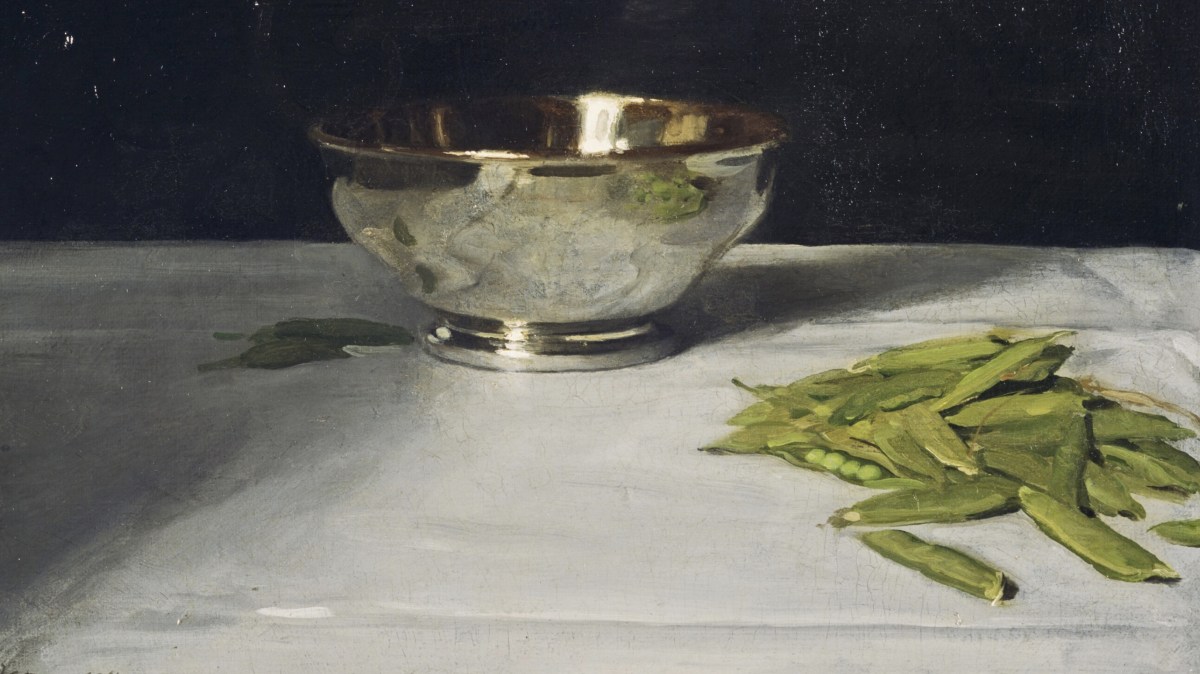
I could spend an entire afternoon with The Lustre Bowl with Green Peas (1911). I love the contrast of verdant veg and greyish tablecloth. The single open pod, its pearly inhabitants huddled in a row. The bright-white gleams of light reflected on the polished silver. No one brings inanimate objects to life quite like William Nicholson.
But there’s more to this modern British artist than pears and poppies and pewter as this rich and varied display at Pallant House Gallery in Chichester shows. The first major exhibition devoted to Nicholson in 20 years, it brings together 150 works — still lifes, portraits, landscapes, book illustrations, graphic woodcuts — and offers a wide-angle view of a prolific and versatile artist.
Before he began painting in earnest, he was a printmaker, producing brilliant spare poster designs in the 1890s with his brother-in-law James Pryde: Hamlet with Yorick’s skull, Don Quixote on his horse.

Rose Lustre (1920)
PRIVATE COLLECTION C/O HAZLITT HOLLAND-HIBBERT

Snow in the Horseshoe (1927)
PRIVATE COLLECTION COURTESY OF HAZLITT HOLLAND – HIBBERT
In 1897 he was commissioned by the publisher William Heinemann to produce a series of alphabetical prints, a who’s who of Victorian society: there’s D for Dandy and V for Villain. Apparently, E for Executioner was later replaced with E for Earl to make the set more child-friendly.
After 1900 he turned to portraiture, first family members, then commissions. His tender images of children — a neat counterpart to Caroline Walker’s dazzling parenting paintings on display in the rooms below — are sensitive without being sentimental.
He painted his first child, Ben, buttoned in a bulky coat at about six, and his dewy-faced daughter Nancy meeting our gaze in an ostrich-feather hat. Rosy of Winchelsea (1901) shows a friend’s daughter looking down over the town, the pale wiggle of river echoed in her golden braids.
• Read more art reviews, guides and interviews
People enliven the small landscapes Nicholson went on to paint following his success as a portraitist, first in the Sussex Downs (where he lived with his first wife, Mabel Pryde, who died in 1918), and later in Wiltshire (where he lived with his second wife, Edie Stuart Wortley).
A keen walker, he traced the rolling hills and craggy coastline, portable paintbox tucked under his arm. Tiny figures comb the beach beneath a vast and luminous sky in Cliffs at Rottingdean (c 1911), and pick their way between birch trees in A Glade Near Midhurst (1937), a sun-dappled woodland scene.
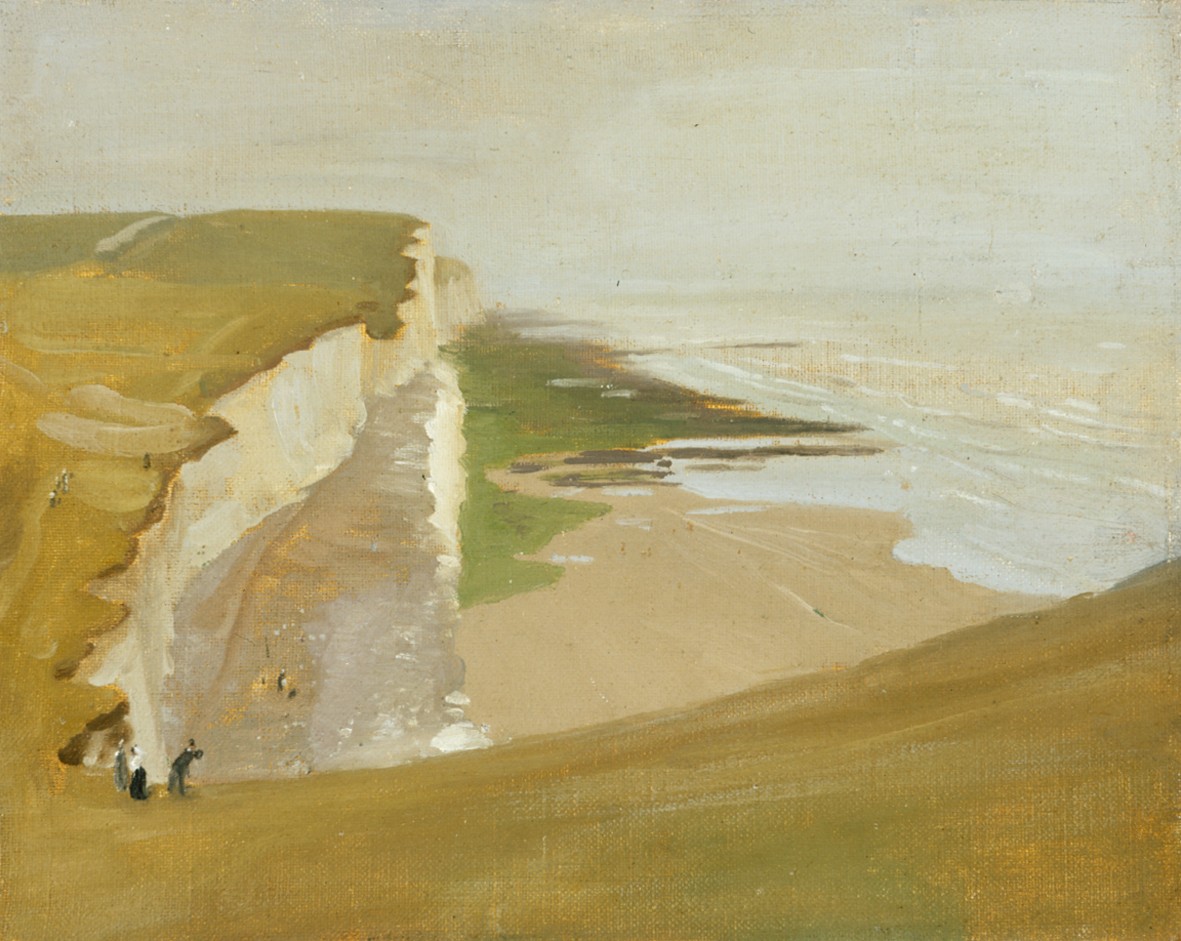
Cliffs at Rottingdean (c 1911)
SOUTHAMPTON CITY ART GALLERY

A Glade Near Midhurst (1937)
© DESMOND BANKS
Oh, but the pears and poppies and pewter! In 1920 Nicholson painted the celebrated horticulturist Gertrude Jekyll, who, aged 77, preferred to garden during the day and pose after dark.
Here she is relaxing in an armchair, bespectacled, hard-working hands brought together in front of her chest, and displayed beside her, her gardening boots, well-worn, arranged on a wooden shelf. While he waited for the sun to set, Nicholson painted a portrait of the boots, paying as close attention to the tangle of laces and the way one toe had peeled away from the sole as he later did to his sitter’s careworn face.
★★★★☆
Pallant House Gallery, Chichester, to May 10, 2026, pallant.org.uk