
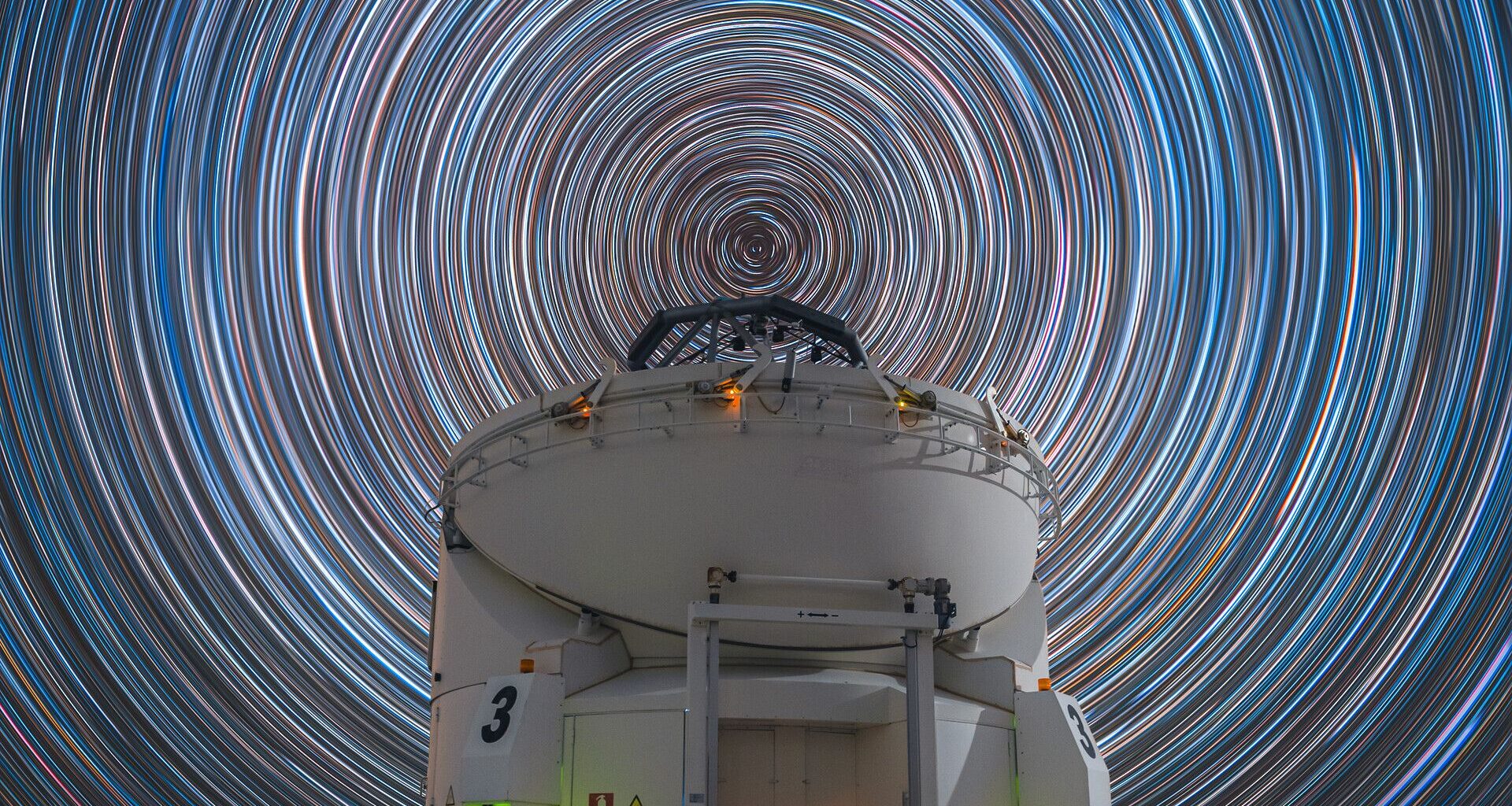
For Chilean astrophotographer Osvaldo Castillo, the night sky above the European Southern Observatory‘s (ESO) Paranal Observatory held a breathtaking sight.
“I couldn’t believe I was photographing a circumpolar startrail in Paranal; without a doubt, one of the most incredible experiences I’ve had as a photographer,” said Castillo in a recent ESO article.
Best picks for you
What is it?
Star trails are the visible imprint of Earth’s rotation. As our planet spins around its axis, the stars appear to sweep across the sky in long, circular arcs. When a camera takes repeated long-exposure images over hours and the frames are later stacked together, these arcs become luminous trails revealing the circular (apparent) path of the stars.
The exact pattern depends on where the photographer is located on Earth. In the Southern Hemisphere, the stars appear to circle the south celestial pole, an extension of Earth’s south rotational axis into the sky. In Castillo’s photograph, that pole forms the central point around which every trail curves.
Where is it?
This image was taken at the Paranal facility in the Atacama Desert in Chile.

Earth’s rotation helps create vivid star trails in long exposure images. (Image credit: O. Castillo/ESO)Why is it amazing?
Producing such an image requires extraordinary patience, precision and technical skill. Long-exposure star trail photography demands hundreds of individual frames, each taken over minutes or hours. A small mistake in alignment can distort the final result, and motion in the foreground can complicate the stacking process.
These challenges are heightened at observatories, where telescopes constantly reposition to track celestial objects. To overcome this, Castillo needed to photograph the foreground and background separately, ensuring the telescope remained crisp while the star trails formed perfect arcs behind it.
In total, he captured almost 300 images. “You can’t see the result immediately,” he explained in a statement. “Fortunately, the calculation and orientation to the South were accurate.” The payoff is evident: a gorgeously composed starwheel set against one of the world’s premier astronomical sites.
Want to learn more?
You can learn more about Paranal observatory and astrophotography.