
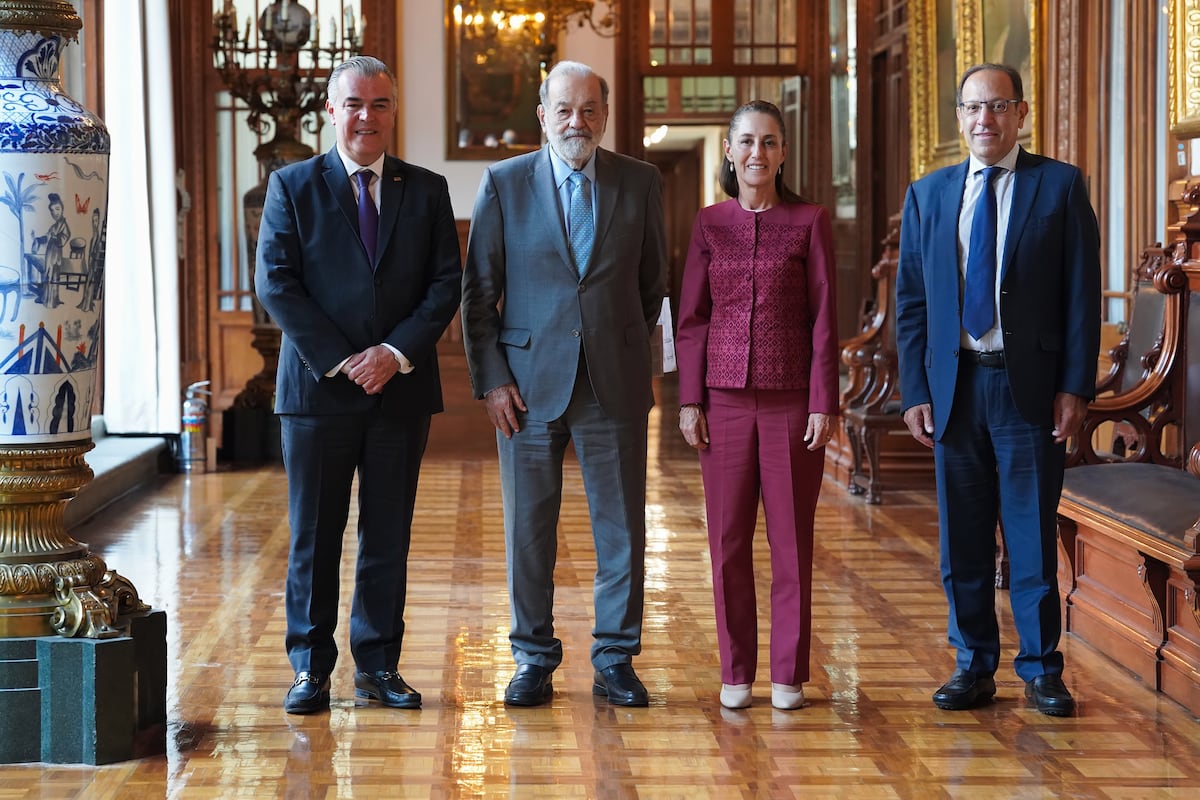
Mexican President Claudia Sheinbaum is accelerating efforts to forge a “grand national agreement” with the business sector to revive an economy showing clear signs of weakness. Despite a “cool head” approach to the United States and the Mexico Plan, the country’s gross domestic product (GDP) fell by 0.3% due to a decline in industrial activity and decreases in consumption, as well as in public and private investment. With these warning signs, the president is urgently seeking an emergency plan with the private sector to reactivate joint ventures in infrastructure, housing construction, and connectivity. In line with this plan, Sheinbaum met this Monday at the National Palace with the country’s wealthiest man, Mexican tycoon Carlos Slim. For more than two hours, the president and the owner of the telecom América Móvil discussed, behind closed doors, the main obstacles to stimulating investment in the country. Following the meeting, which was also attended by the president of the Business Coordinating Council (CCE), Francisco Cervantes, Sheinbaum briefly reported on her social media that the meeting addressed the “good forecasts” for the economy in 2025 and 2026.
Slim, whose fortune exceeds $115 billion, has visited President Sheinbaum at the National Palace at least three times since she took office. In these previous meetings, they discussed the future of trade between Mexico and the United States, the USMCA, and investment opportunities. After speaking with the Mexican magnate, Sheinbaum met with two banking leaders, HSBC CEO Michael Roberts and HSBC Mexico CEO Jorge Arce. Roberts later stated on social media that they discussed the significant opportunities facing the Latin American country. “We talked about the important opportunities ahead for Mexico: a vibrant economy, excellent connectivity and global integration, and how HSBC can continue to drive Mexico’s growth,” he wrote.
Just over a year into her term, economic policy has become Sheinbaum’s Achilles’ heel. With no tax reform on the horizon, the 10.1 trillion peso budget approved for next year has fallen short, forcing the mayor to seek a third way forward in partnership with the private sector. This plan, according to sources close to the President’s office, will be announced next year. Sheinbaum’s team has been doing the same in strategic cities like Monterrey, where they have met with business groups in the construction and housing sectors for the same purpose.
The Mexican government’s far-reaching strategy involves creating an Infrastructure Investment for Wellbeing Law, which the Morena majority in Congress is poised to approve before December 15. Meanwhile, legislators and Finance Minister Édgar Amador are finalizing the details with business leaders. This Wednesday, they will hold a closed-door meeting with bankers to outline the terms of the new legislation, which seeks collaboration between the government and the private sector to finance infrastructure projects with social objectives that are also profitable. This law would repeal the public-private partnership (PPP) laws passed during the administration of Enrique Peña Nieto.
This legislation will allow the government, through private investment, to draw on investment funds, savings, and loans to activate Sheinbaum’s master plan, which aims to fulfill her promise of reaching 29% of GDP invested in infrastructure by 2030. Alfonso Ramírez Cuéllar, deputy coordinator of Morena in the Mexican Congress and a close ally of the president, is behind this initiative. “We want to mobilize millions of dollars in resources, from economic assets held in banking institutions such as loans, retirement savings accounts, and investment funds,” he explains. The goal is to achieve “a national mobilization to launch a countercyclical program that will allow us to fulfill one of the most important objectives, which is to grow the economy, injecting significant capital into the construction industry, housing, and the construction of communications and connectivity infrastructure,” he concludes.
Despite the resilience of Mexican exports and the implementation of Plan México, the outlook for the Mexican economy this year remains uncertain. While foreign direct investment reached a peak of nearly $41 billion in the first nine months of the year, local companies and the public sector have been tightening their lending portfolios this year. According to official figures, gross fixed investment in the country—which includes spending on facilities, machinery, and equipment—fell by 9% in August compared to the same month in 2024, its largest contraction since 2021. Within this category, spending on construction contracted by 7% year-on-year, while spending on machinery and equipment declined by more than 10%. With this latest drop, this type of productive investment has extended its downward trend, marking a full year of negative growth.
The reduction in public and private spending, the stagnation of oil production, and the lingering uncertainty surrounding U.S. tariff policy are some of the latent risks that continue to threaten the Mexican economy. In a recent analysis, Grupo Financiero Banamex acknowledged that, while uncertainty remains high, it has decreased somewhat and there is an overall improvement compared to the mood that prevailed in the first half of the year, which should allow for a gradual recovery of private investment and employment in Mexico. “The shift in monetary policy stance, from restrictive to neutral, will also contribute to the gradual recovery of consumption and investment.” In line with these new circumstances, the bank lowered its GDP growth forecast for the country this year from 0.4% to 0.2%.
Sign up for our weekly newsletter to get more English-language news coverage from EL PAÍS USA Edition