
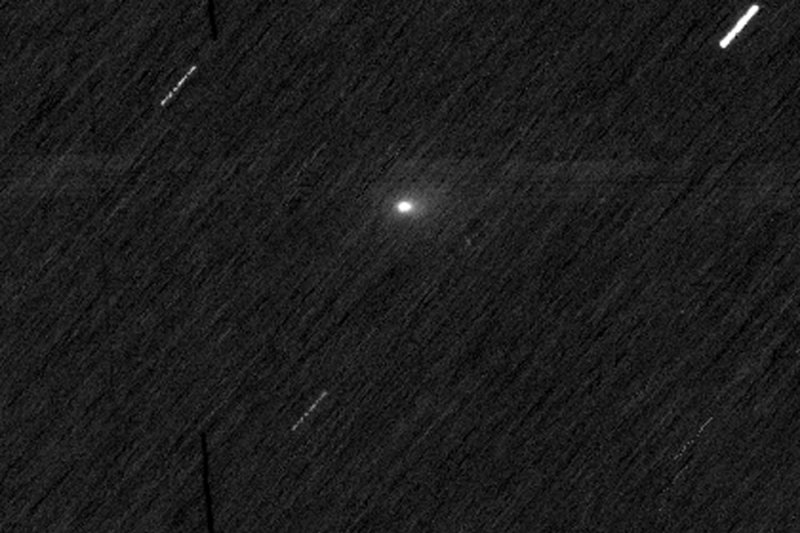
The non-gravitational acceleration of the interstellar object 3I/ATLAS is regularly updated by Davide Farnoccia on NASA’s JPL Horizons website.
On October 30, 2025, the radial acceleration component A1—normalized at a heliocentric distance of 1 au—was listed as 1.6×10⁻⁶ au per day². By November 24, the value had decreased by a factor of four to 4×10⁻⁷ au per day², said an article published by the online publishing platform Medium, News.Az reports.
At that time, I pointed out here that the minimum perijove distance of 3I/ATLAS during its encounter with Jupiter on March 16, 2026 is forecasted to be 53.445 (+/- 0.06) million kilometers, identical within one standard deviation to Jupiter’s Hill radius at the perijopve time, 53.502 million kilometers. Interior to that radius, Jupiter’s gravity dominates over the Sun’s tide. Any small satellite deposited outside this radius will be removed from Jupiter by the Sun’s gravity.
Surprised by the unexpected match between the perijove distance of 3I/ATLAS and the Hill radius of Jupiter on March 16, 2026, I emailed Davide my report here about this unlikely coincidence. There was no response to my email. However, within a couple of days the listed A1 on NASA’s JPL Horizons website here was revised downward by a factor of 6 to a value of 6.8×10^{-8} au per day squared, with a new model for the radial dependence of the non-gravitational acceleration. The new model uses an inverse square dependence on distance from the Sun: 1/r², as appropriate for the sublimation of carbon dioxide (CO2) ice interior to a heliocentric distance of 5 au. This new model replaces the steeper radial dependence associated with the previous model used by NASA’s JPL Horizons — suitable for the sublimation of water (H20) ice based on work by Brian Marsden and collaborators, as described here and here.
Given these revisions, the new JPL Horizons forecast for the perijove distance of 3I/ATLAS is now 53.587 (+/- 0.045) million kilometers, slightly outside the Hill radius on March 16, 2026. However, this forecast relies on a 1/r² model which uses past contributions from larger heliocentric distances to explain the measured deviation of 3I/ATLAS from its original gravitational path.
The new model of JPL Horizons is likely inadequate. There is strong evidence that 3I/ATLAS became brighter near perihelion than the smooth 1/r² model would predict. Correcting the radial dependence of the non-gravitational acceleration of 3I/ATLAS to accommodate this evidence is likely to bring the perijove distance back to agreement with the Hill radius value.
A steeper radial profile of the non-gravitational acceleration of 3I/ATLAS near perihelion than the 1/r² model is suggested by the evolution of the luminosity of 3I/ATLAS. Based on the image obtained by the Hubble Space Telescope on July 21, 2025 (and reported here), the luminosity is dominated by the coma and reflects the mass loss if the total amount of scattered sunlight is proportional to the coma mass. The luminosity evolution was reported in a new preprint here by Marshall Eubanks and collaborators. An earlier report by Qicheng Zhang and Karl Battams here suggested a steep luminosity profile of 1/r^{7.5} inside 2 au as 3I/ATLAS was making its way to the perihelion distance at 1.36 au on October 29, 2025. Adopting this steep radial dependence would change the expected perijove distance towards a closer agreement with Jupiter’s Hill radius.
The insistence of the Vatican on the Earth being at the center of the solar system did not change the orbit of the Earth around the Sun. For the same reason, the new model of JPL Horizons will not change the actual trajectory of 3I/ATLAS. We will know whether the perijove distance agrees with the Hill radius in the coming months thanks to data collected as 3I/ATLAS approaches its perijove on March 16, 2026. In particular, astrometric data from the spacecraft Juno, Juice or Psyche will be very useful for settling the issue.
Since 3I/ATLAS was hidden by the Sun from terrestrial telescopes during its perihelion passage — when it gained most of its non-gravitational acceleration, we might only have a tight constraint on the integrated drift of 3I/ATLAS from its gravitational path but not on its radial dependence close to perihelion.
If the rare coincidence between the perijove distance of 3I/ATLAS and the Hill radius will materialize, it might flag a technological signature. In that case, 3I/ATLAS could release technological devices as artificial satellites of Jupiter, potentially at Jupiter’s Lagrange points L1 and L2 on the Hill sphere — where orbital corrections and fuel requirements are minimal.
Within the diameter of Jupiter’s orbit around the Sun, the coincidence between the perijove distance and the Hill radius has a statistical likelihood smaller than 0.00004. In case the non-gravitational acceleration was needed to achieve this match, the rare coincidence will constitute the most remarkable anomaly of 3I/ATLAS so far in the list compiled here. The final verdict on this matter will eventually be posted on the JPL Horizons website, underlining the inescapable truth that science is always work in progress, not to be settled by the authority of NASA officials in press conferences.