
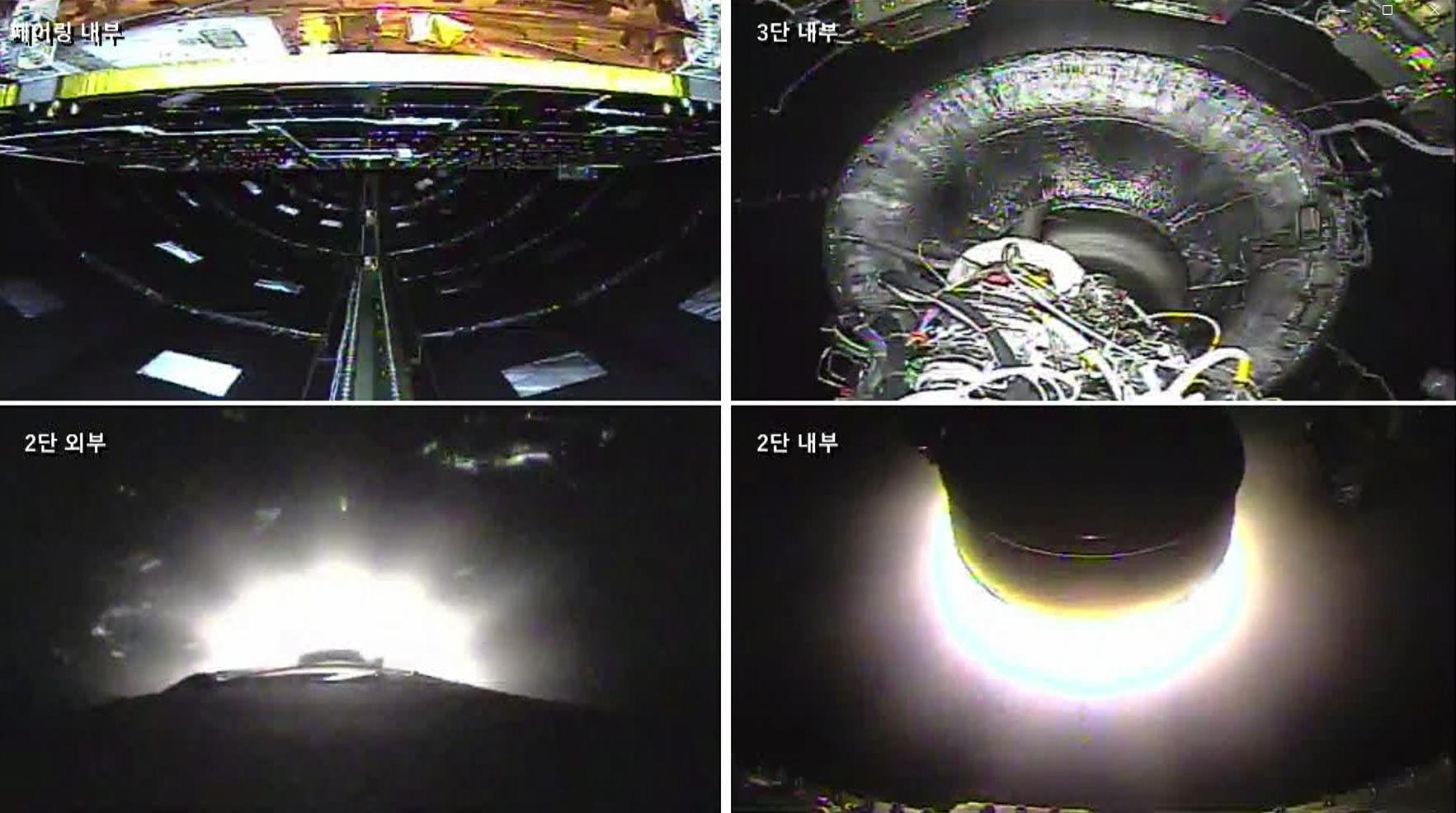
Images captured by cameras mounted on the Nuri rocket show the status of the launch vehicle during its mission, Thursday. Clockwise from top left, the images display the inside of the rocket’s fairing, the interior of the third stage, the exterior of the second stage and the interior of the second stage. Courtesy of Korea Aerospace Research Institute
The successful launch of Korea’s domestically developed Nuri space rocket on Thursday brought private companies’ technologies into the spotlight, signaling the emergence of space development as a commercial industry in Korea.
The Nuri successfully lifted off from the Naro Space Center in Goheung, South Jeolla Province, at 1:13 a.m., reaching its target altitude of 600 kilometers after 18 minutes and 25 seconds of flight. It deployed 13 payloads, including its main payload, the CAS500-3 satellite, and 12 cube satellites.
The Korea Aerospace Administration (KASA) said Thursday that the CAS500-3 satellite successfully established communication with ground stations and five cube satellites also completed initial contact. Communication attempts with the remaining satellites were scheduled to follow.
The latest mission, marking the fourth launch of a Nuri rocket, signals a major transition in Korea’s space ecosystem. Private companies Hanwha Aerospace and Korea Aerospace Industries (KAI) built the launch vehicle and main satellite, respectively, roles that were previously handled by the government’s Korea Aerospace Research Institute (KARI).
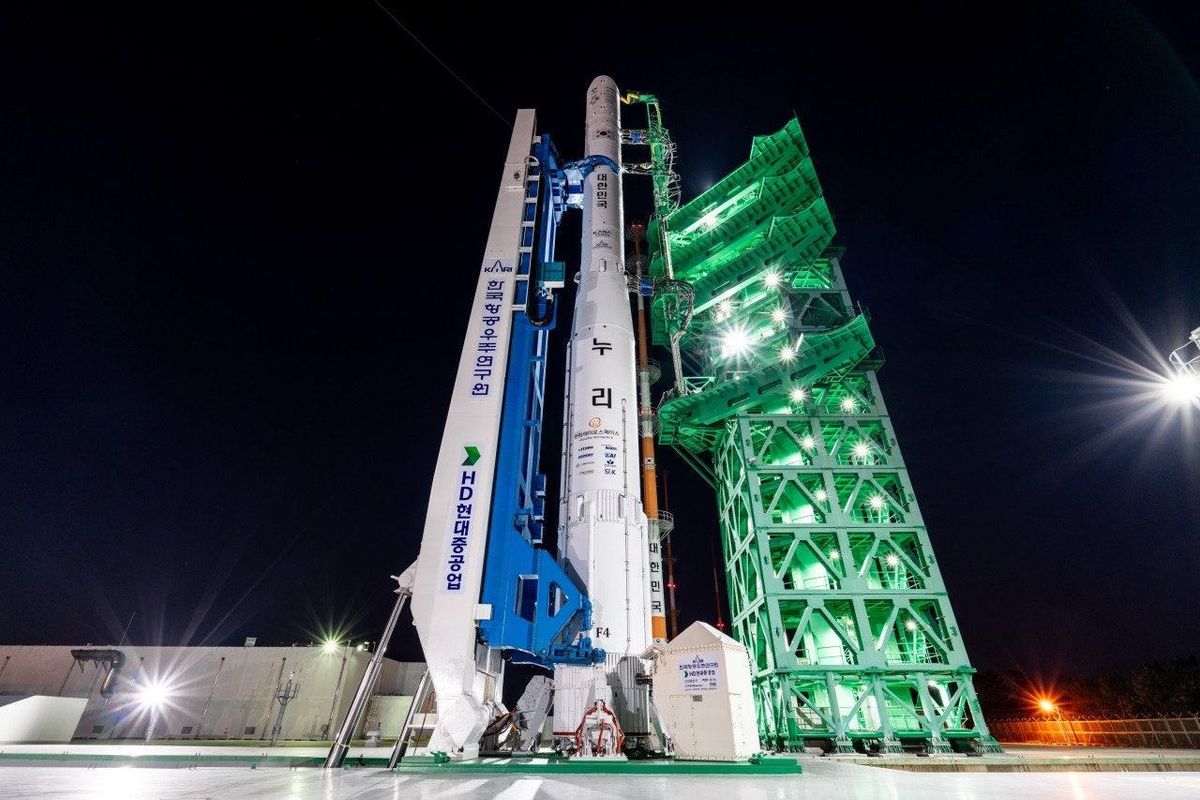
The Nuri rocket sits on the launch pad at the Naro Space Center in Goheung, South Jeolla Province, Wednesday. Courtesy of Korea Aerospace Research Institute
For the fourth launch, Hanwha Aerospace served as the system integrator overseeing more than 300 partner companies involved in building the rocket.
Hanwha Aerospace assembled all six liquid engines mounted on the Nuri rocket, including five 75-ton-class engines — the biggest rocket engines that Korea has developed — manufacturing them based on blueprints designed by KARI after a full technology transfer process.
Liquid engines generate thrust by combusting kerosene and liquid oxygen chilled to minus 183 degrees Celsius, requiring a high level of technical complexity in production. Each engine requires about 2,400 components and goes through 458 separate manufacturing processes.
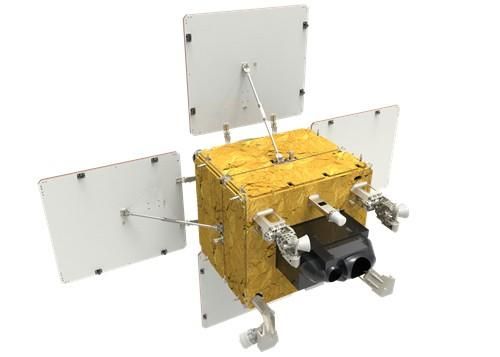
CAS500-3 satellite developed by Korea Aerospace Industries (KAI) / Courtesy of KAI
KAI independently developed the CAS500-3 using its own satellite platform technology. The satellite carries three instruments commissioned by different research institutes, enabling scientific missions including aurora observation, plasma magnetic field measurement and bioprinting research.
KAI plans to actively pursue satellite export opportunities with the medium-sized satellite platform, seeking to enter overseas markets including Latin America, the Middle East and Southeast Asia.
The company said the CAS500-3 was developed entirely with components not subject to the U.S. International Traffic in Arms Regulations, to support future overseas sales.
“The successful launch of the CAS500-3 will be a turning point for Korea’s private-led space industrialization,” a KAI official said. “As a leading space company, KAI will expand its services from advanced satellites to reusable launch vehicles.”
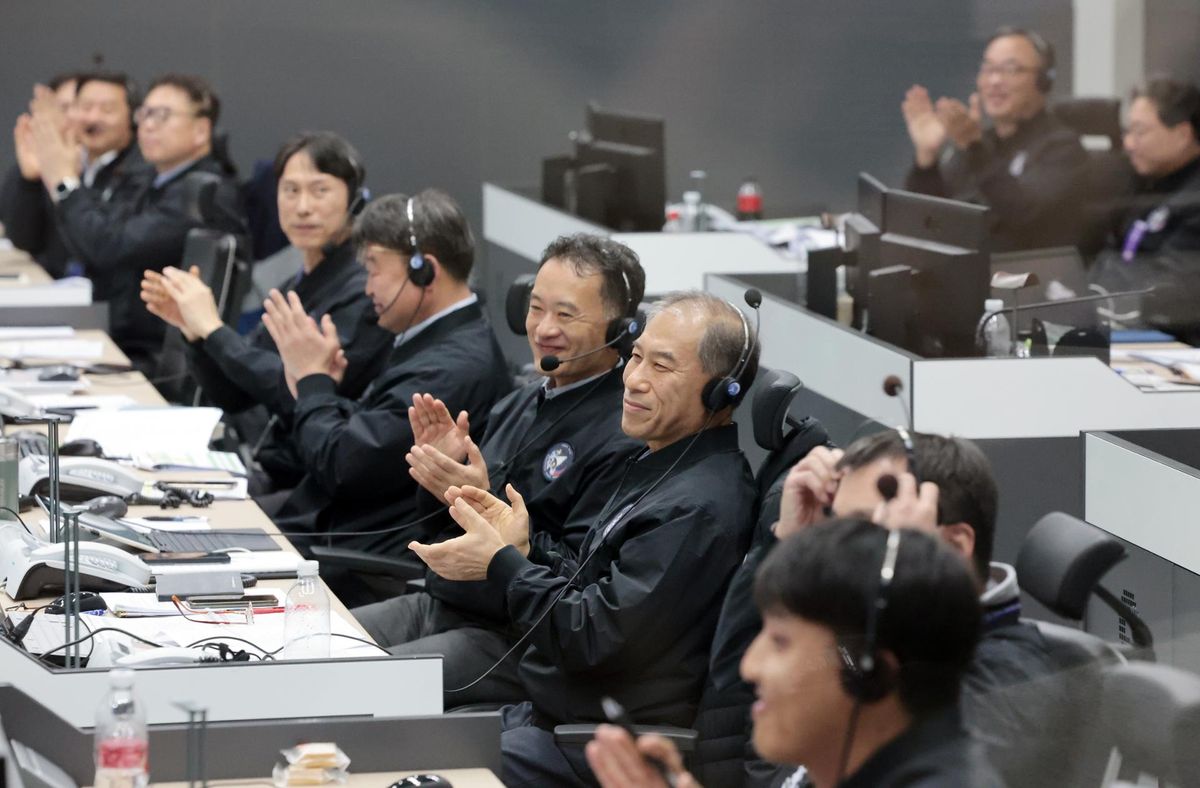
Officials applaud after the successful fourth launch of a Nuri rocket at the Naro Space Center in Goheung, South Jeolla Province, Thursday. Courtesy of Korea Aerospace Research Institute
HD Hyundai Heavy Industries took charge of the design, manufacturing, construction and operation of the launch pad system for all four Nuri rockets. The company independently developed and installed key facilities such as the mechanical ground support equipment, fuel ground support equipment and electrical ground support equipment.
The company said it has fully localized launch pad process technologies, laying the foundation for Korea to build and operate space launch infrastructure without relying on foreign technologies.
The latest launch has ushered in the era of commercial space development for Korea, but industry officials note that consistent and frequent launches are essential for the sustainability of the industry.
“The two-and-a-half-year gap between the latest launch and the third launch made it difficult to sustain the industrial ecosystem,” Hanwha Aerospace CEO Son Jae-il said after the launch. “Although we have been launching the Nuri rockets, we also have concerns for the next-generation launch vehicle … We will do our best to maintain launch capabilities.”
Industry officials say follow-up launches of Nuri rockets are essential for generating demand across the launch vehicle sector. Securing continuous demand is crucial to maintaining the production and supply chains involving more than 300 domestic companies that contributed to the program, particularly small and medium-sized firms.
Companies are now preparing for the fifth launch scheduled for June next year and the sixth in 2027. With the success of the fourth mission, the scope of participation by private firms is expected to expand.
Local space companies have expressed concerns that demand could decline, as plans beyond the sixth Nuri launch have not yet been finalized. KASA Administrator Yoon Young-bin said the agency plans to carry out the seventh launch in 2028 and aims to conduct at least one launch per year starting with the eighth mission.