
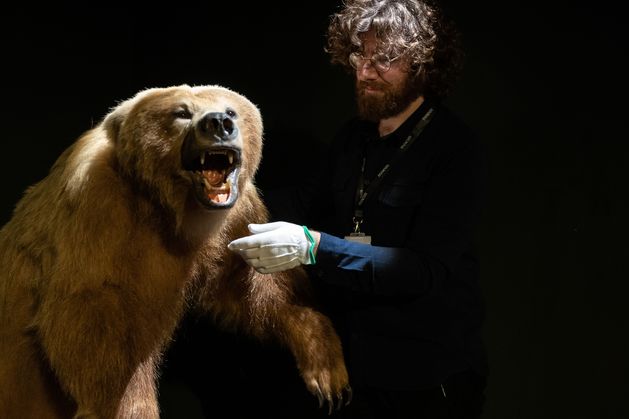
A brown bear has gone on temporary display in Turlough Park, where George Robert Fitzgerald once kept a pet bear in the late 18th century
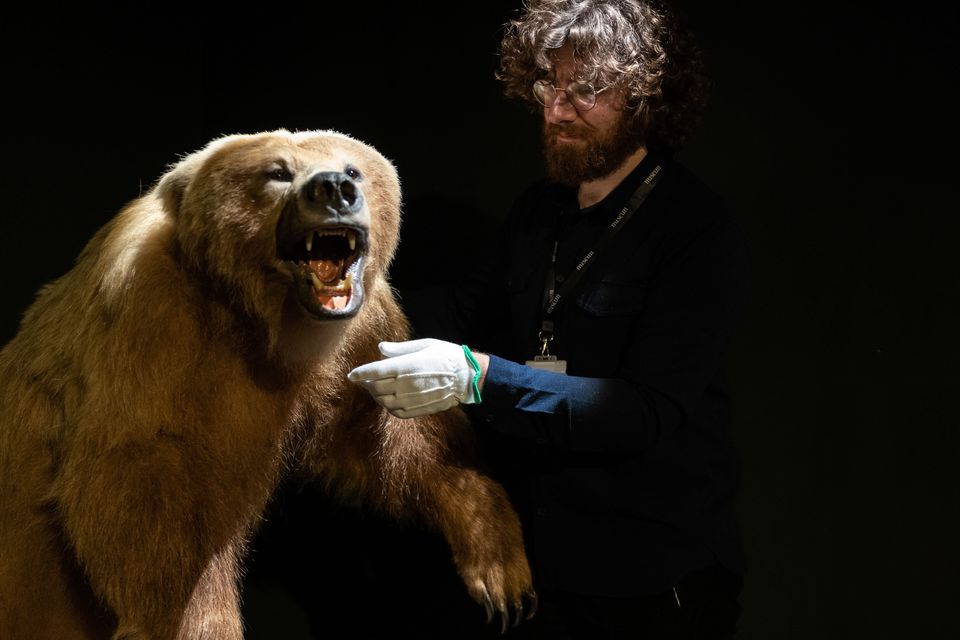
The bear which is on display in Castlebar.
A bear has returned to the historic estate of Turlough Park in Castlebar – more than 200 years after the infamous landlord, ‘Fighting Fitzgerald’, kept one here as a pet.
The brown bear, a female, is going on temporary display in the National Museum of Ireland as part of an ongoing exhibition, The Murmur of Bees – which explores bees and their important role in Ireland’s biodiversity.
Bears have long been associated with bees and honey, and one of the ancient Irish names for a bear is milchobur (honey-lover).
The bear, which is from the Museum’s Natural History Collection in Dublin, was officially unveiled today (Monday, 1 December).
Brown bears once roamed throughout Ireland but went extinct in the country thousands of years ago. However, some were occasionally brought to Ireland as exotic pets, circus performers or for blood sports.
In the late 18th century, George Robert Fitzgerald, also known as ‘Fighting Fitzgerald’, kept a pet bear at Turlough Park – the former ancestral home of the Fitzgerald family and now the site of the National Museum of Ireland.
Fitzgerald, who reportedly once chained his own father to the bear, was later convicted of conspiracy to murder his father’s attorney and was hanged in Castlebar in 1786.
“Fossils from Irish caves show that bears were present in Ireland for tens of thousands of years, from 40,000 years before present (BP) to 3,100 BP,” said Emma Murphy, a curator with the Natural History Division of the National Museum of Ireland.
“They lived here at most times when the country was free of ice, repopulating the area many times. The most recent date of 3,100 BP means that there was a time when early human settlers and bears co-existed on this island. Evidence of bears has been found in many counties, including Aillwee Cave, Co Clare; Castlepook Cave, Co Cork; and Poll na mBéar, Co Leitrim.”
The bear is on display on Level A of the exhibition galleries at the National Museum of Ireland in Turlough Park.
Admission is free, and no booking is required. Further details are available at www.museum.ie