
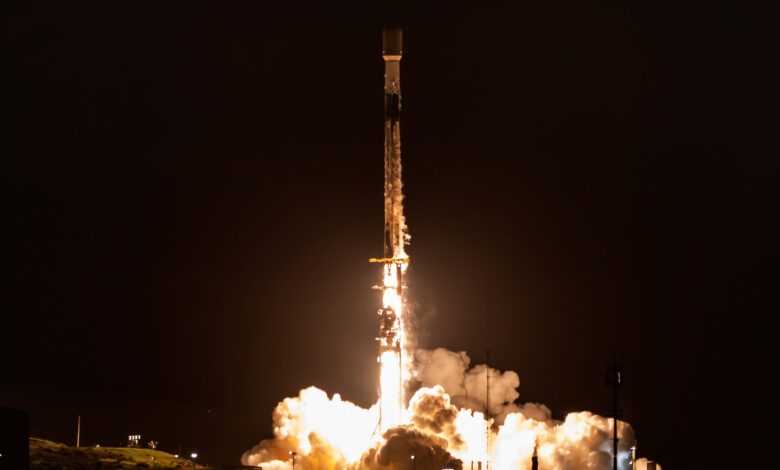
On the night of December 2, a Falcon 9 rocket launched from Vandenberg Space Force Base in California, delivering another batch of 27 Starlink satellites into low Earth orbit. The launch took place at 12:28 a.m. US Eastern Time (05:28 GMT, 9:28 p.m. local California time on December 1). This event marked SpaceX’s 60th launch from California in 2025, highlighting the growing pace of the company’s operations on the US West Coast.
The mission went smoothly: just over eight minutes after liftoff, the Falcon 9’s first stage made a soft landing on the autonomous drone ship ‘Of Course I Still Love You’ stationed in the Pacific Ocean. For this booster, designated B1081, it was already the twentieth flight—a milestone that not long ago seemed out of reach even for the most ambitious aerospace engineers.
Sixty-two minutes after launch, the rocket’s upper stage successfully deployed all 27 Starlink satellites into orbit. They join SpaceX’s already impressive network, which now numbers more than 9,000 satellites, providing internet access across the globe—even in the planet’s most remote regions.
Records and scale
This year has been a record-setter for SpaceX, not only in terms of launches from the California coast, but from other US spaceports as well. According to SpaceflightNow, the company has conducted 60 launches from Vandenberg alone in 2025. For comparison, on the East Coast, from pads at Cape Canaveral Space Force Station and Kennedy Space Center in Florida, 94 Falcon 9 missions have already launched during the same period.
In addition to its regular Starlink satellite launches, SpaceX is actively testing its massive Starship vehicle. As of 2025, five suborbital test flights have already been carried out from the Starbase site in Texas, demonstrating the company’s serious plans for deep space exploration and its preparations for future interplanetary missions.
Technology and Innovation
Each Falcon 9 launch is not only about delivering satellites but also showcases the rocket’s unique reusability. Thanks to this approach, SpaceX is able to significantly reduce the cost of space missions and increase their frequency. This time, the first stage successfully completed its twentieth landing, further proving the reliability and efficiency of the company’s reusable systems.
Starlink continues to expand its capabilities, bringing high-speed internet to some of the most remote locations on the planet. With every new launch, the network grows more robust and extensive, and the number of users worldwide keeps rising.
Global Prospects
SpaceX’s achievements in 2025 go beyond the United States. The company is actively expanding international partnerships, and its satellites are providing connectivity in dozens of countries. More launches are expected in the coming months, further strengthening Starlink’s position in the global telecommunications market.
At the same time, SpaceX continues to work on projects related to crewed flights and the exploration of the Moon and Mars. In the coming years, the company plans to launch thousands more satellites into orbit and to carry out the first commercial missions using the super-heavy Starship rocket.
In case you didn’t know, SpaceX is a private aerospace company founded by Elon Musk in 2002. It became the world’s first organization to successfully return a rocket booster to Earth for reuse. In addition to the Starlink program, SpaceX is developing crewed Dragon spacecraft and building the super-heavy Starship rocket for interplanetary travel. The company is known for its innovations and record-breaking pace in the space industry.