
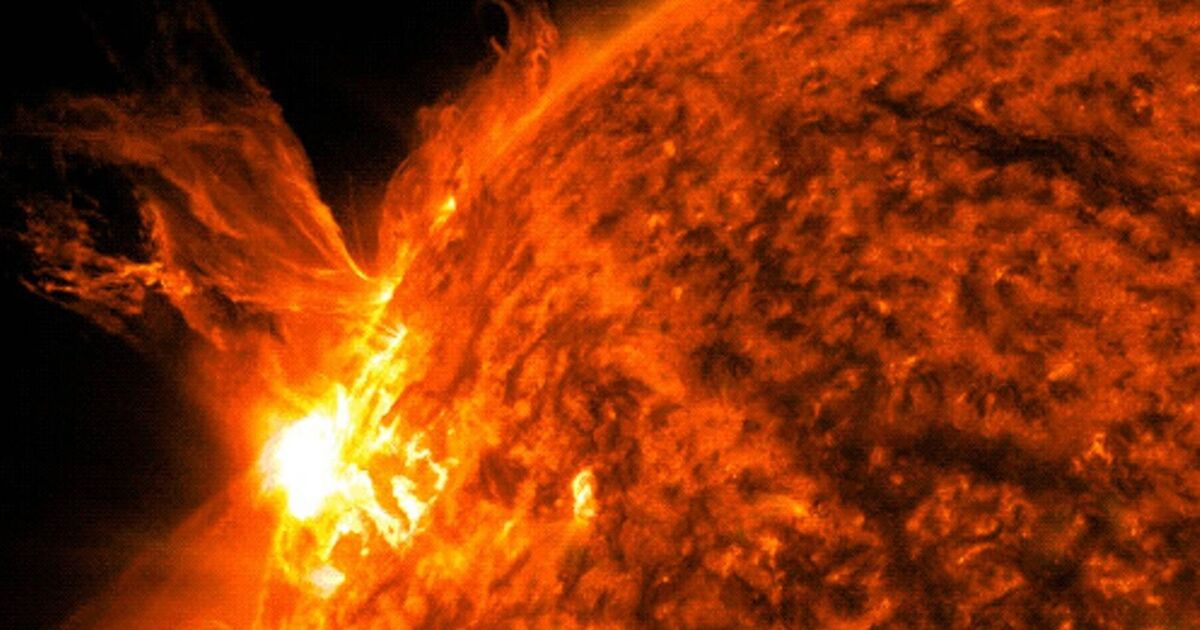
NASA has issued an alert as a powerful solar flare threatens to disrupt electrical power grids on Earth.
The US space agency announced yesterday that the intense bursts of energy are classified as X-class, the most severe category, following eruptions from the Sun on November 30.
Images of the event were captured by NASA’s Solar Dynamics Observatory spacecraft, which continuously watches the Sun.It comes after a telescope captured the exact moment a mysterious object hit the surface of the moon.
While powerful solar flares can create stunning aurora displays, they may also interfere with several critical services.
These eruptions are known to trigger coronal mass ejections (CME), massive explosions of plasma and magnetic fields that can generate geomagnetic storms when aimed at Earth.
NASA stated: “The Sun emitted a strong solar flare, peaking at 9:49 p.m. ET on Nov. 30, 2025. This flare is classified as an X1.9 flare. Flares and solar eruptions can impact radio communications, electric power grids, navigation signals, and pose risks to spacecraft and astronauts.”
The Met Office notes that geomagnetic storms can produce both physical and technological effects.
Physical impacts of geomagnetic storms
Geomagnetically induced currents (GICs) in power lines and pipelinesIncreased ionisation in the ionosphere, affecting radio signalsHeating of the thermosphere, which can expand and affect satellite orbits
Technological impacts of geomagnetic storms
Power grids, potentially causing blackouts during severe eventsGNSS and HF communications, including GPS signalsSatellites, through surface charging and increased dragSpacecraft operations, due to radiation and signal interference
The Met Office states: “Geomagnetic storms are triggered by bursts of solar wind, streams of charged particles, mainly electrons and protons, that flow outward from the Sun.
“These particles interact with the Earth’s magnetosphere, the protective magnetic bubble surrounding our planet.
“When a particularly strong burst of solar wind arrives, often from a coronal mass ejection (CME), it can disturb the magnetosphere, leading to a geomagnetic storm.
“These storms can travel from the Sun to Earth in as little as 18 hours, although they can take up to 96 hours to arrive. Once they reach Earth, their effects can last for several days.”
It comes after astronomers proposed blowing up a ‘city killer’ asteroid before it hits the Moon.