
Posted on December 3, 2025
Posted by John Scalzi
I never quite got Brian De Palma. An unquestionably talented director, he knew how to make a hit — see Carrie and the first Mission Impossible film — and if he was going to fail, he was going to do it on a scale so grand that people would write books about it (The Bonfire of the Vanities). He was brash, steeped in film lore, and more than happy to make sure you knew when he was showing off, which was often; what were Body Double and Blow Out other than him paying homage to, and then trying to one up, Hitchcock and Antonioni? The chutzpah! The actual brass balls on this guy!
Some people loved it (Pauline Kael, for one, seemed to eat it up, and who was going to argue with her), but I was, and, I have to say, still am, largely unimpressed. Scratch a De Palma film and you’ll very often find there’s no there there — it’s mostly just surface flash and thrill and some very intentional shock and subversion, all very mannered and very little with any resonance. Outside of Carrie — which made household names out of De Palma, Stephen King and Sissy Spacek all in one go — it’s debatable that De Palma ever made a truly classic movie, a world-beating piece of celluloid that is studied for its quality over its kitsch.
(And yes, my dudes, I see you standing up on a table full of cocaine, beating your chest over Scarface and telling me to say hello your little friend. Grand Guignol as it is, what it has going for it is excess. It’s a lot, and I found it tiring, and when Tony Montana finally ended up face down in the water, what I remember thinking was good, now I get to go home.)
So: Brian De Palma. Mostly, not for me! Maybe for you, fine, okay, you do you! But not for me!
Ahhhh, but then there’s The Untouchables. And suddenly, for length of this one single film, Brian De Palma is indeed very much for me.
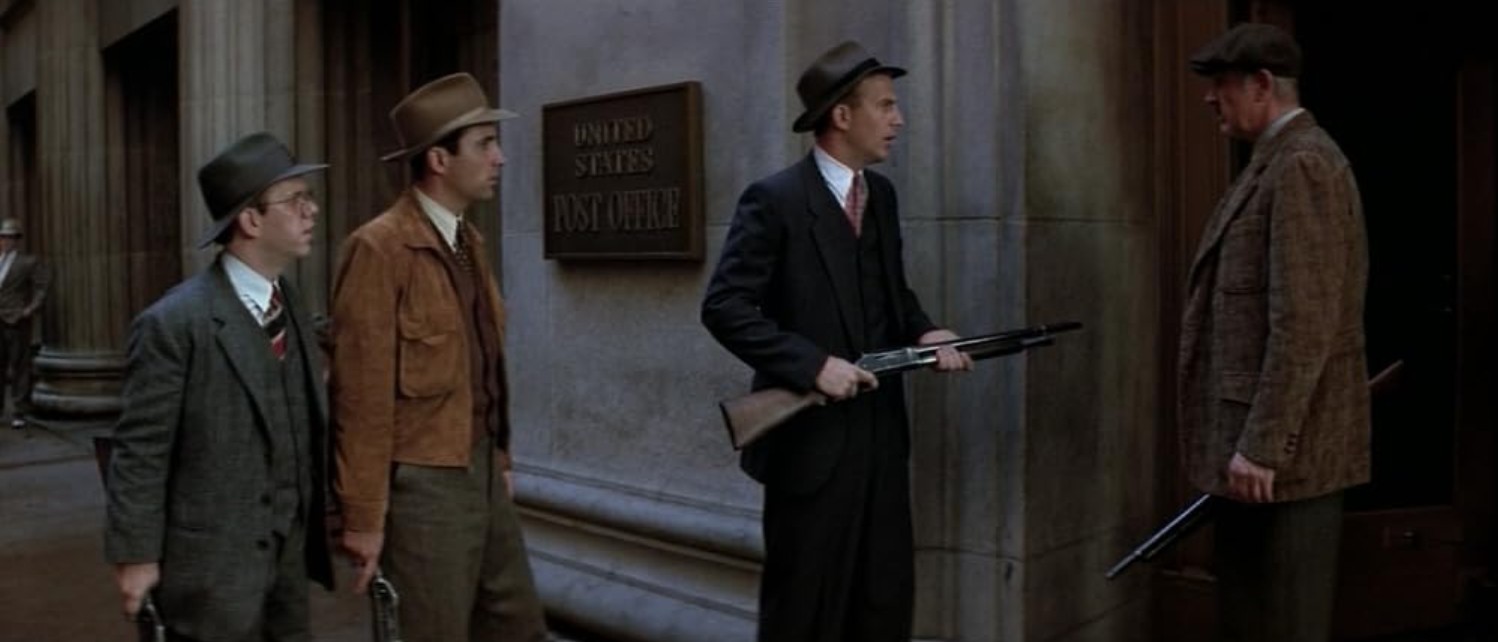
Come with me now to 1930 Chicago, smack dab in the middle of prohibition, and Treasury Officer Elliot Ness (Kevin Costner, stalwart) has come into town to take on the bootleggers and gangsters, two groups with, shall we say, a rather substantial overlap. Ness has little success at it until he comes across beat cop Jimmy Malone (Sean Connery, the most Scottish Irish cop ever), who knows where all the bodies are buried around town, and where the rum is being run. Together with their small and select team (Andy Garcia, in one of his first big roles, and Charles Martin Smith as comedy relief, until he isn’t), they take on Al Capone (Robert De Niro) the celebrated gangster who is loved by the press, despite the fact that he’ll happily blow up a kid or two if that’s what it takes to keep his grip on the town.
It’s a rich setting, and of course this film is not the first time the prohibition era had been essayed — heck, The Untouchables itself was an update of a late 50s TV series starring Robert Stack. The film was treading a path that had been trod upon many times before. This reappraisal and reinvention of film and television tropes was nothing new to De Palma, who had by this time had homaged directors and source material, including Scarface (originally a 1932 movie starring Paul Muni), and he would go on to retread Mission Impossible. The Untouchables, as a property and as a mode of storytelling, was old hat, both for De Palma or for the culture at large. So what is it that sets this movie apart?
Weirdly — no really, weirdly, because this is a film where one character bashes in the head of another character with a baseball bat — I think what makes this film work is restraint. Brian De Palma is Brain De Palma-ing himself all over this film, with all his stylistic tics and touches and his oh-look-do-you-see-how-I’m-referencing-Eisenstein-aren’t-I-so-very-clever-ness, but he’s doing it at about an 8, rather than an 11. Yes, there is that (rather famous) scene involving a baseball bat, but here’s the thing: what makes it shocking isn’t the assault, it’s the context. De Palma shows us enough of the assault (and the aftermath) to make the point, but, unlike, say, Scarface, there’s no lingering. De Palma gets in, gets what the scene needs, and gets out.
Now, I am going to accept there is skepticism for this thesis of mine. The Untouchables does not exactly skimp on the blood or the occasional shot of someone’s brains all over a window pane. This is a movie that rather handily earns it “R” rating. But my argument is that in these cases it’s not about quantity, it is about quality. Those brains on the window pane are actually in service to the story. They are just enough to fill in the scene, and then we’re moving on. For De Palma, for whom so much of his directorial style is basically more, of whatever it is, not just blood although certainly blood too, this sort of restraint in the service of story feels a little revolutionary. Turns out you can do a whole lot, if you’re not trying to bludgeon your audience into sensory overload.
De Palma didn’t have to drive his audience into sensory overload in no small part because the whole affair is just so incredibly handsomely mounted. The script, by David Mamet before his metaphorical cheese starting slipping off his metaphorical cracker, is sharp and pithy and melodramatic as hell. The set design offers up a version of Chicago that is a beautiful fable — 1930 Chicago didn’t look like this but how wonderful it would have been if it had. The wardrobe — the wardrobe! — is done by Georgio fucking Armani, and by God you can tell, everyone looks so ridiculously good. You can pause the movie at just about any point where there’s not blood being sprayed about, and it will look like a fashion shoot. It’s all so good that the terrific Ennio Morricone score is almost an afterthought. Almost.
And then there’s the cast. Sean Connery won an Oscar for his portrayal of a cop past his prime who decides to do the right thing, even if he knows how little good it will do, and as it’s the film’s only Oscar, it’s not unreasonable that this performance is what the film is remembered for. With that given, I will yet argue that this is Kevin Costner’s movie. It’s hard to remember on this side of Field of Dreams and Dances With Wolves and even Yellowstone, but this is the film that made Kevin Costner an actual star; before this he was playing corpses (The Big Chill, out of which he was mostly cut) and second bananas (Silverado).
In Elliot Ness, Costner found the character he’d carry forward: The compelling square, the do-right stiff you can’t actually take your eyes off of. He’d occasionally tilt off this character, mostly when Ron Shelton needed him to play a gone-to-seed sportsman, but it’s pretty clear that with The Untouchables, Costner learned how his bread would be buttered going forward. He went with it for a good long while.
As for De Niro as Al Capone; well, scenery is chewed, and the chewing is delicious.
The Untouchables is the one Brian De Palma movie I unreservedly love, and enjoy, and rewatch, but this is not to say it is a great film. Even Pauline Kael, famously a De Palma champion, understood this; she wrote that The Untouchables was “not a great movie; it’s too banal, too morally comfortable… But it’s a great audience movie — a wonderful potboiler.” This is exactly right. Not every film has to be great, sometimes “just really goddamned good” is good enough. It just needs every good thing in proportion, and for the director to understand when enough is enough.
For this one film, Brian De Palma seemed be content with just “enough.” It wouldn’t last, and that’s fine. It didn’t have to.
— JS
Like this:
Like Loading…