
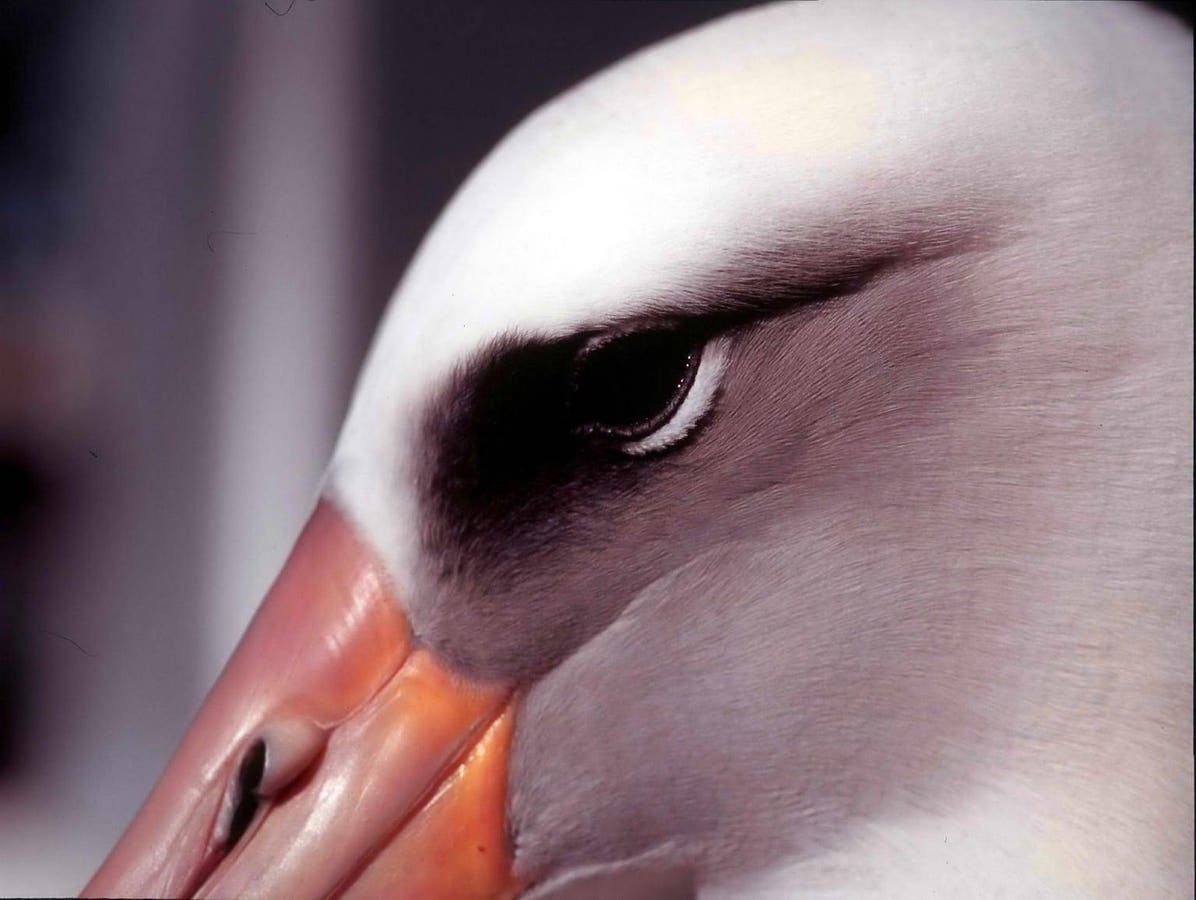
The world’s oldest known wild bird, Wisdom, the Laysan albatross, has returned to Midway Atoll National Wildlife Refuge to nest.
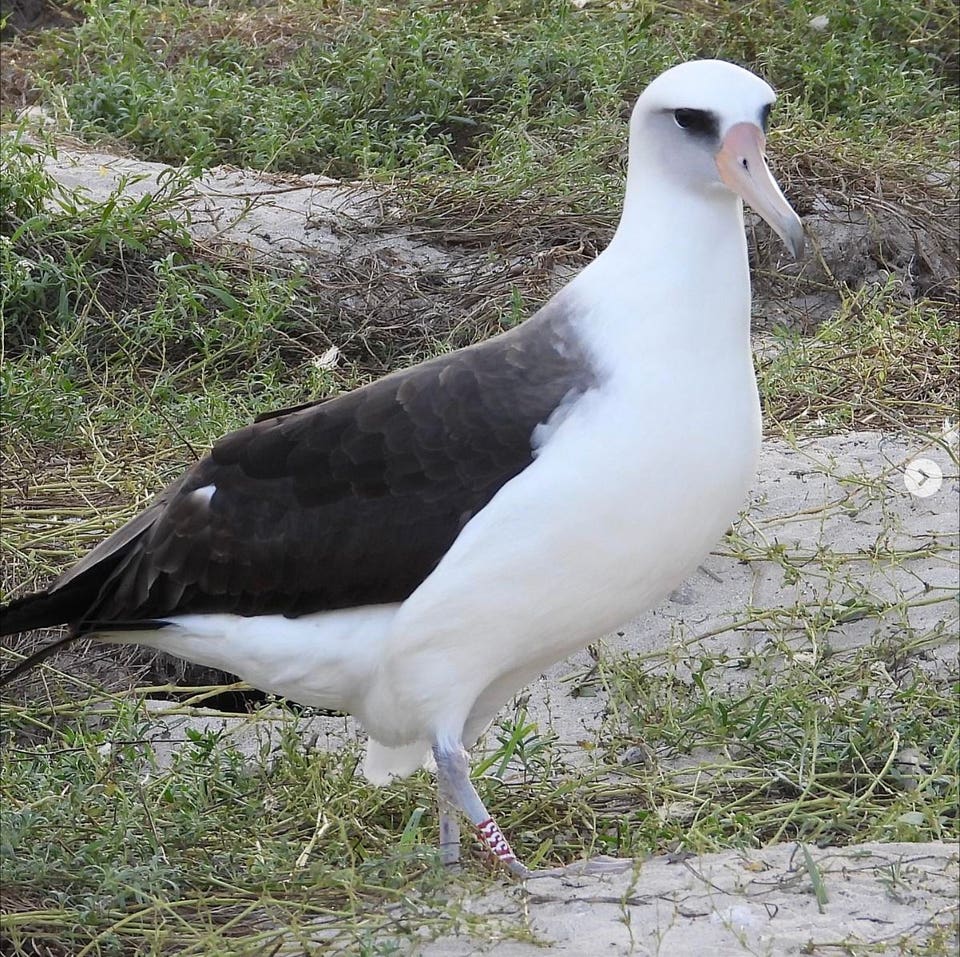
Wisdom the Laysan albatross (Phoebastria immutabilis) — band number Z333 — also known as the mōlī in Hawaiian language, has returned to her nest site on the sands of Midway Atoll National Wildlife Refuge. (Credit: Jon Plissner / USFWS / public domain)
Jon Plissner / USFWS via a Creative Commons license
Wisdom, the Laysan albatross (or mōlī in Hawaiian), Phoebastria immutabilis, has once again returned to Midway Atoll National Wildlife Refuge to nest. She was originally banded as she incubated an egg on 10 December 1956 by legendary bird biologist and USGS scientist Chandler Robbins. Since Laysan albatross don’t nest until they are at least 6 years old and may not successfully raise a chick until they are between the ages of 8 to 10 years, Wisdom is estimated to be at least 75 years old. This makes her the world’s oldest known wild bird. In her lifetime, scientists estimate that Wisdom has flown more than 3 million miles, laid 50-60 eggs, and fledged some 30 chicks.
“Last year, the second oldest known-age birds at Midway Atoll were just 47 years old,” said Wildlife Biologist Jon Plissner, who now works as a USFWS Supervisory Wildlife Biologist at Midway Atoll National Wildlife Refuge. “The Service observed a total of 18 Laysan albatrosses and one black-footed albatross that were 40+ years old. In 2022, we had a nesting black-footed albatross that was at least 63 years old; but it has not been seen since then, and there have not been any birds besides Wisdom older than 50 years since then.”
The Laysan albatross is a large seabird with a wingspan that reaches more than 6-and-a-half feet. Albatrosses are famous for their skill in riding the wind using a technique called dynamic soaring, where they soar above oceanic waves for hours – or even days – without flapping their wings. These seabirds are so adept at dynamic soaring that they are known to soar for literally years before touching land, and they can even sleep in flight.
Laysan albatrosses range over the North Pacific Ocean, from Japan to the Bering Sea and as far south as 15°N, in search of squid, crustaceans and fish that they pick from the ocean’s surface. Beautifully evolved to inhabit open oceans, research has found that the Laysan albatross’s dark gray upper parts and wings with a white underside increases soaring efficiency (read more here).
Unlike almost all of the 22 albatross species, which are recognized as being under some level of conservation concern, ranging from threatened to critically endangered, Laysan albatrosses are numerous. There are an estimated 1.5 million individual Laysan albatrosses, 70% of which nest colonially on Midway Atoll. The atoll, also known as Kuaihelani, consists of a trio of remote islands that lie in the Pacific Ocean, roughly midway between North America and Asia, hence its name. Midway Atoll is a small coral atoll, with an area of only 6.2 km2. It is a national wildlife sanctuary, especially for conserving endangered plants and animals, as well as providing homes for literally millions of seabirds, shorebirds, ducks, and a large variety of marine life. World War II buffs will also recognize this small speck of land as the home of many historical events.
Abandoned historic bomb-proof command post and power plant on Midway Atoll in background. Hundreds of colonially nesting albatross in foreground. (Credit: David Patte / USFWS / public domain.)
David Patte / USFWS / public domain
Throughout the decades, Wisdom has been remarkably faithful to her chosen nest site.
“Wisdom has laid an egg in nearly the same spot every year that she has nested on Midway Atoll National Wildlife Refuge,” Dr Plissner mentioned in email.
“On average, Laysan albatrosses nest approximately two out of every three years,” Dr Plissner explained in email, “but over the past decade, Wisdom has nested every year except when she lost her mate. It can then take several years before a bird finds a new mate and begins nesting again. Wisdom’s long-time mate failed to return in late 2021 and it took her until last year to find a new partner and begin nesting again.”
Until his sudden disappearance, Akeakamai was Wisdom’s long-term mate since 2006.
“She still showed up each year in the interim, perhaps initially hoping that her old mate would show up, and in late 2023 she began courting other suitors, settling on a new mate the following year.”
This year, Wisdom popped up on Midway Atoll earlier than usual, perhaps eager to get started on her task of raising another chick with her new mate, who has not yet been seen.
Is there some way to protect albatross from eating plastic pollution?
Although they are numerous, Laysan albatrosses face numerous threats from longline fishing, tsunamis, invasive plants and predation by dogs, rats and mice, and cats, and eating plastic trash floating around in the ocean. Isn’t there some way to prevent seabirds from eating plastic trash?
“There isn’t a way to keep birds from ingesting plastic. They pick it up while feeding at sea, mistaking it for food items,” Dr Plissner replied in email.
In fact, recent research has shown that plastic debris smells like food to albatrosses and a variety of other marine birds and animals because it releases the scent, dimethyl sulfide (DMS), due to algae and bacteria colonizing its surface as it floats through the ocean (ref). Algae release DMS when eaten by krill – a favorite food for many seabirds – and this sulfurous odor attracts marine birds and animals from miles away and deceives them into consuming plastic debris.
“Nearly every bird at Midway has ingested plastic as evidenced by necropsies and decayed remains of dead individuals and the contents of boluses (pellets) regurgitated by chicks,” Dr Plissner explained, adding that USFWS staff and volunteers are extremely careful of Wisdom and her chick. “We do not handle or even approach Wisdom at this point to avoid any possibility of causing stress.”
Dead Laysan Albatross with plastic on Sand Island of Midway Atoll. (Credit: Forest and Kim Starr / CC BY 3.0 US)
Forest and Kim Starr via a Creative Commons LicenseDid the recent tsunami affect Wisdom and other seabirds on Midway Atoll?
The recent tsunami originating near the Kamchatka peninsula due to the earthquake there six months or so ago was big news, globally, but I admit I was worried about the seabirds of Midway Atoll, which looked to be directly in the tsunami’s path. Did the tsunami harm Wisdom or any other seabirds residing on Midway Atoll?
“The tsunami arrived late in the albatross nesting season. Wisdom’s chick had died a few months earlier and she was already gone for the year,” Dr Plissner replied in email.
But other albatrosses on the atoll were not so lucky.
“We had been having an unusually long stretch of calm weather for that time of year, which caused many young birds to delay their departures from the atoll much later than usual,” Dr Plissner described the heartbreaking situation to me in email. “As they haven’t yet had experience with long flights, young birds are more dependent on the wind to help them develop their flying skills. Far more birds than usual remained on the islands, with large numbers moving to the coastlines, waiting for winds to set off on their seaward journeys for the next several years. A large number, and likely a majority, of these individuals had already died on the shores or were already severely weakened and destined to perish from starvation, as their parents had stopped returning to feed them weeks before.”
When the tsunami hit, many of the young birds were able to ride out the waves, but a number of them were washed inland and became entangled in debris. In the days following the arrival of the tsunami, USFWS staff found and freed roughly 100 trapped individuals.
“It’s uncertain how many birds that might have otherwise survived [but ended up perishing] as a result of the tsunami, but it’s unlikely that it was a significant proportion of fledging birds this year. Other seabirds affected included red-tailed tropicbirds and sooty terns that had chicks in the coastal strands of shrubs; however, many of the chicks were still present in the overwashed areas after the waves receded.”
Red-tailed tropicbird (Phaethon rubricauda), or koa’e’ula in Hawaiian, glides above Midway Atoll, which is home to this seabird’s largest nesting population in the Hawaiian archipelago. Midway Atoll National Wildlife Refuge and the Battle of Midway National Memorial are all part of the Papahānaumokuākea Marine National Monument, and are a sanctuary for millions of seabirds, shorebirds, and a variety of marine life. (Credit: Percy Ulsamer / USFWS volunteer / CC0)
Percy Ulsamer via a Creative Commons licenseHow are the conservation programs progressing on Midway Atoll?
Many of us are unaware that Midway Atoll, like all small tropical islands, has been under siege from a variety of invasive non-native plants and animals. Its landscape was highly modified by humans (of course) after they began settling on the remote island and growing their own favorite plants. Further adding to the biological disruptions, nearly 9,000 tons of topsoil were imported from Honolulu and Guam, which introduced unknown numbers of nonnative soil organisms, insects, and plants.
The first botanical survey was carried out by William A. Bryan in 1902, and it revealed only 13 plant species on Midway – all native. In contrast, the most recent botanical survey in 2015 by Forest and Kim Starr documented a whopping 199 species – 86% (172) of them were non-native. This onslaught of invasive plants transformed portions of Midway Atoll from an open sandy tropical savannah into something resembling Oʻahu, filled with forests of coconut palms, Cocos nucifera, ironwoods, Casuarina equisetifolia, and other plants, many of which made it difficult for the seabirds to nest, to land and take off.
Golden crown-beard (Verbesina encelioides), a nonnative invasive flowering plant on the South Beach of Sand Island, on Midway Atoll. (Credit: Forest and Kim Starr / CC BY 3.0 US)
Forest and Kim Starr via a Creative Commons license
But progress is being made in removing these invasive plants. For example, non-native ironwood trees have been completely removed from Eastern Island and also from parts of Sand Island, according to Dr Plissner.
“About 66 acres of Sand Island has been restored with native habitat, and two endangered plants now have thriving populations at the refuge.”
“Over several decades, staff at Midway Atoll have nearly eradicated the most detrimental invasive plant at the refuge – Golden Crownbeard, Verbesina encelioides. This invasive used to cover about 60% of the vegetated area of the refuge back in the early 90s,” Dr Plissner observed in email. “The eradication efforts have been highly successful, removing and controlling the spread of Verbesina in over 99% of the refuge, essentially eradicating it from Eastern and Spit Islands and allowing native species to again dominate the landscape.”
Endangered birds are also benefitting from these restoration efforts. For example, the endangered Laysan duck, Anas laysanensis, population is rapidly rebounding from a low point of 12 individuals, thanks to intensive conservation efforts.
Female Laysan duck (Anas laysanensis) with ducklings. (Credit: Jimmy Breeden / Public domain.)
Jimmy Breeden via a Creative Commons license
“The translocation of 42 endangered Laysan ducks to Midway in 2004 and 2005 has been a highly successful conservation program, leading to the refuge now supporting ~1,200 individuals (now the world’s largest population), despite annual outbreaks of avian botulism. Intensive efforts by refuge personnel to manage wetlands and treat sick ducks have been highly successful in preventing losses that would threaten the long-term persistence of the population.”
The Midway population of Laysan ducks were so successful that they began breeding at an earlier age and laying more eggs than birds on Laysan, demonstrating that, when abundant habitat and food are available, it is possible to rapidly recover critically endangered species.
I started this piece by sharing news about Wisdom, the wondrous Laysan albatross, her return to her nest site and by telling you a little about the world she lives in, so I’d like to end by talking about Wisdom and what her quiet example means to countless people around the world. In addition to her remarkable longevity, which provides scientists with invaluable information about wild bird populations, Wisdom’s exceptional story has captured global attention and is helping raise awareness about the looming threats that wild albatrosses and other seabirds are facing, particularly from plastic pollution, longline fishing and climate change. And yet, in spite of all these challenges, Wisdom is an international symbol of hope and resilience, and remains a powerful example of the critical importance of ongoing, dedicated wildlife conservation efforts.
© Copyright by GrrlScientist | hosted by Forbes | LinkTr.ee
Socials: Bluesky | CounterSocial | LinkedIn | Mastodon Science | Spoutible | SubStack | Threads | Tumblr | Twitter