

Platform engineering continues to be central to the success of software organizations. During KubeCon in November, we surveyed 219 platform engineers on what’s top of mind. The survey responses give a glimpse into where platform teams sit in the organization, who they serve and what they are prioritizing next.
Platform’s Primary Customer Is Still Developers
What Steve Ballmer said 25 years ago still holds true: “developers, developers, developers, developers, developers…developers.” If there’s one message that comes through loud and clear in survey responses it’s this: Platform engineering is still, above all, a developer product team.
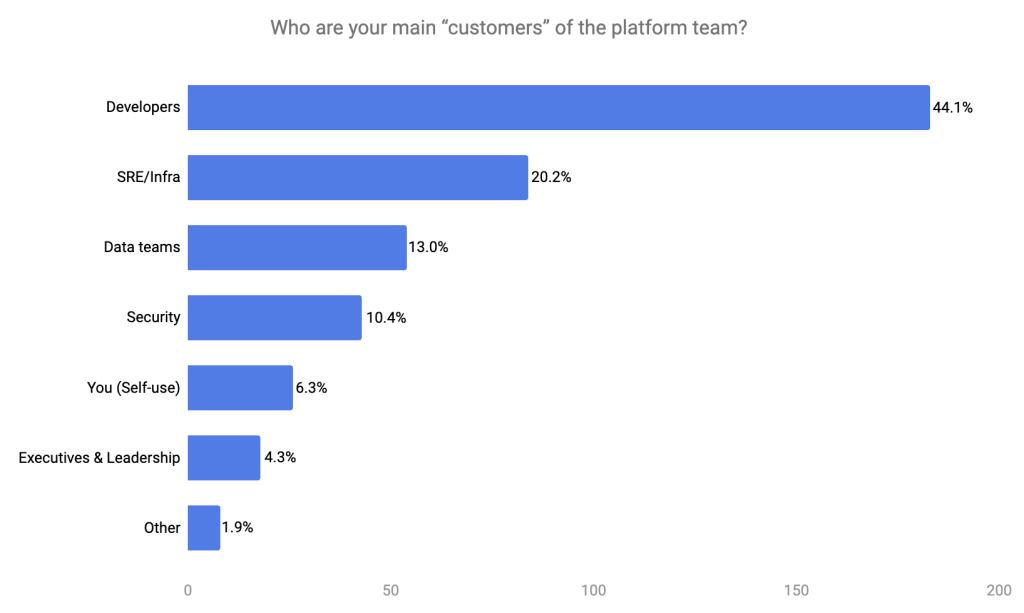
Drilling into the second two bullets: Even when the platform serves data, security or infrastructure directly, the shared outcome is still a faster, safer path to production for developers. This comes in the form of automating security tasks, database-focused operations and driving efficiencies throughout the broader software delivery life cycle (SDLC).
The mix of “customers” hints at a shift in how platform teams think about their raison d’être. The platform isn’t just a paved road for shipping code; it has become a shared internal product, one that must meet multiple disciplines without losing sight of developer outcomes. As those customer groups grow, so does the need for clear ownership, discoverability, guardrails and standards across services, infra, data assets and policies. All in the name of making sure the developer can more effectively do their primary job (ship great code).
AI Isn’t Quite Everywhere [Yet]
The survey shows AI is still nascent throughout many organizations. Though, AI has crossed the line from “interesting someday” to “we need this now.” In fact, nearly all respondents highlighted AI exploration as a top 2026 priority.
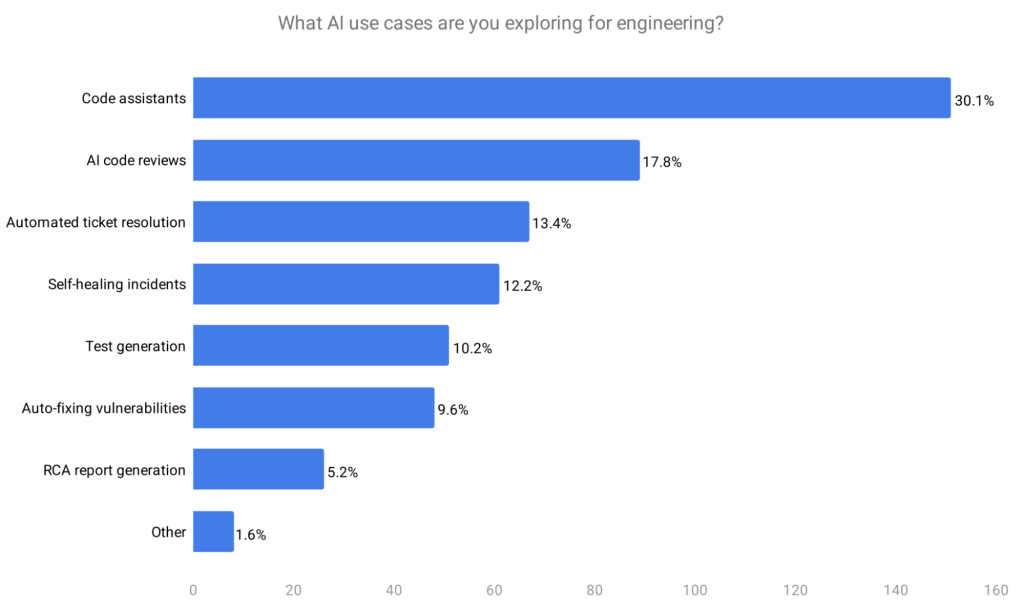
What are they trying first?
AI code assistants lead: 30.1% of platform teams are exploring how to use AI coding assistants to better enable developers in 2026.
Next wave: AI code reviews (17.8%) and automated ticket resolution (13.4%).
Reliability automation is rising: Self-healing incidents (12.2%), test generation (10.2%) and auto-fixing vulnerabilities (9.6%) show a hefty appetite for AI that reduces toil.
This pattern is evidence that teams are testing AI where it most directly elevates developer throughput and cuts operational drag. Organizations are thinking about a “better together” story for humans plus AI to develop compelling agentic engineering use cases. Over time, these experiments will push platform teams to standardize how AI tools are governed, integrated and measured.
IDPs Are Becoming the Operating Layer
IDPs are no longer an emerging concept, but adoption is uneven.
Nearly 60% of respondents report using an IDP today.
There is fragmentation in how IDPs are used. When asked how developer outcomes are measured, 43% of respondents stated they have no formalized system to collect feedback from engineering to identify friction points. Surveys are the most common way to measure developer success, followed by specific metrics and interviews.
What is interesting is that platform teams define their own success metrics based on developeroutcomes. Reduction of tickets created for DevOps/infra (16.5%) and Deployment Frequency (13.6%) are the top two KPIs platform teams hold themselves accountable to. Having an IDP is important to streamline this measurement and reduce tool sprawl; making the platform teams’ life easier which manifests for better developer outcomes.
Conclusion
IDPs remain a critical tool for modern engineering orgs: They streamline workflows and bring order to a chaotic SDLC. But in the AI era, delivery is even more chaotic and consequential. Without a platform layer that accounts for and enables AI-driven work, teams risk invisible bottlenecks, brittle automation, shadow AI exposure, and slower delivery.
The IDP is evolving to meet that moment. This evolution comes in the form of agentic engineering platforms (AEPs) that extend the portal into the AI segment of the SDLC, supporting not just code creation, but self-healing incidents, vulnerability remediation, agentic impact measurement and standards enforcement at scale.
YOUTUBE.COM/THENEWSTACK
Tech moves fast, don’t miss an episode. Subscribe to our YouTube
channel to stream all our podcasts, interviews, demos, and more.
SUBSCRIBE
Group
Created with Sketch.

John Crowley is a technical product marketing manager at Port, supporting the Engineering Intelligence solution. With a background in product management and strategy, he enjoys solving problems for technical users. Before joining Port, John worked on teams building cybersecurity and…
Read more from John Crowley