
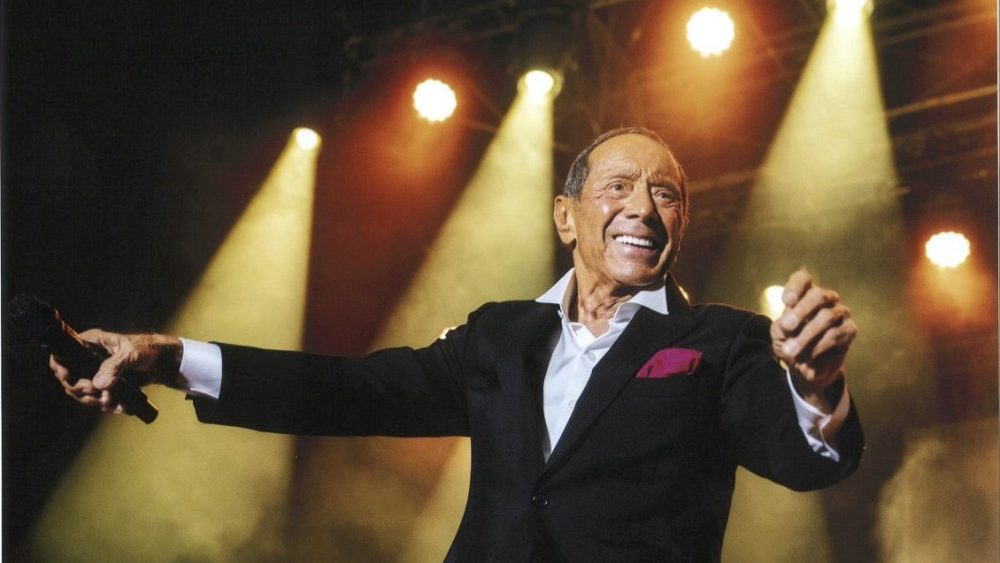
“I’m so young and you’re so old,” Paul Anka sang in the very first line of his very first hit, “Diana,” in 1958. It’s the kind of lyric you could seemingly only get away with when you’re 15, as Anka was at the time, and maybe not a minute later, or at least not much past the point when the goddess you’re singing to is not that much farther along into her teen years. Remarkably, Anka still has that debut smash in his concert sets today, and it’s a moment for a mass sing-along, not mass cringing — maybe partly out of irony, but also because, at 84, the singer really does seem young at heart, to borrow a phrase from his most legendary buddy.
This week sees the home-viewing premiere of an HBO Original documentary, “Paul Anka: His Way,” picked up by the cabler/streamer after a run on the festival circuit that included showings in the Toronto and Palm Springs fests. It’s a well-merited run through a life that included becoming a teen idol at 15, an unofficial initiation into junior Rat Pack membership before he was out of his teens, and dual careers not just as an entertainer in his own right but as a songwriter for others, from Buddy Holly (“It Doesn’t Matter Anymore”) to, of course, Frank Sinatra, with “My Way” — and Johnny Carson, with the instrumental “Tonight Show” theme. Anka may not quite count as the last of his generation of late ’50s/early ’60s hitmakers, but he’s almost certainly the last to be doing it this robustly, and still killing it on the road, as evidenced by the performance footage in the doc (and in his performance of “My Way” on Jimmy Kimmel’s show earlier this week).
Anka has more on the calendar, including a new album due out Feb. 13, “Inspirations of Life and Love” (already preceded by the singles “Let Me Try Again” and “Anytime”). He’s plotting his road dates for 2026, and in the meantime he will be honored by the Los Angeles Press Club with the org’s Legend award, presented this Sunday at the National Arts and Entertainment Journalism Awards. We’ll see whether that audience of ink-stained-wretch journos succumbs to “Puppy Love” and putting heads on another’s shoulders, as a young generation has lately been doing in TikTok clips set to his oldies. Variety spoke with him about his long career on the eve of the documentary’s release. (The following Q&A has been edited for length and clarity.)
Your documentary played at the Toronto and Palm Springs festivals, and now it’s found a home at HBO, which you must be happy about.
I’m very happy with it. It took a long time. It was a labor of love, and the timing was right and the team was right. I stayed away from it for a while. I turned down a lot of people. Now we’re inundated; everybody’s got a doc. But at this age, in this passage in my life, with the right people around me, I said, “You know, I’m gonna do it now.” Just as I’m doing with the Broadway show. We just signed up the writer today, and we’ve got backers, and it’ll be a year-and-a-half process, but we’re taking it to Broadway.
Oh — is that something you’ve wanted for a while, a Broadway musical?
Yeah. It’s rough terrain to be in, and I’ve stayed away from that too, because you don’t want to make a mistake there. But for about four or five years now, I’ve talked to different people, and haven’t felt I had the right team in place. Now we’ve just signed Rupert Holmes (as writer) yesterday, and we’ve got backers, in Canada and Primary Wave. Like everything else, it needs the right team to at least get a respectable way there with some dignity; otherwise you can get clobbered. But I’m ready to go with it now, and we hope to have something tangible in about a year and a half. … We haven’t told anybody. We’ve been holding this down until this week. So you’re the first one I’m telling.
Is there a throughline that you see as being the core story of the musical, for someone who might not know your story intimately?
Well, it’s gonna be this young kid from Canada who left home and got lucky, experienced the American dream at 15, and went from there. It’s like the documentary, in that there may be an assumption that if you’re successful, everybody’s looking at you, and it’s not true. You’ve got to check your ego at the door constantly and realize that in this eclectic world of media, people may know me by name, but they don’t know my story.
You work a lot…
I just got back from Mexico City a few days ago, and it’s baffling to me, even though I get it. I’m playing to 10,000 people in a stadium in Mexico City, and there’s a large dynamic that are young teenagers running around with albums, only because of TikTok. If you’d have told me 10 years ago, there’s a thing called TikTok, I would’ve told you you’re nuts. But I’ve kept up that international existence. … I don’t work 200 days a year anymore. I work when I want because we enjoy it and I’m able to do it and I’m healthy enough to do it. But other than that, it’s trying to live gracefully.
What is the number of dates you do a year?
On average, 70, between corporate and tours. It’s just not as heavy as it used to be, by my choice. But to still go out there to a strong fan base, why wouldn’t you? You stand still and they throw dirt on you… I’ve seen those guys (retiring) and they sit down and read a bunch of books and watch some television and then what else? No, it’s not what I do. If you’ve got your health, you’ve got to stay active in today’s world, where people are living longer.
You say in the documentary that one point of contention when your first marriage broke up was that she wanted for you to retire, and you make it pretty clear that’s the furthest thing from your mind, that you are still in love with show business, and you can’t even imagine that.
No. You know, we’re all individuals. We all come in and go out alone, and you’ve gotta live your life to the honesty that you think prevails in terms of your health and your capability. But I’ve been a creature like that since I was 15 years old. I’ve never stopped, and it’a served me well, frankly (health-wise), if you really monitor it properly.
You know, I started as a writer. I won awards at school. My dad said, “You gotta be a journalist.” I worked at the Ottawa Citizen as a cub reporter. Where were you gonna go in the ‘50s to learn to be a journalist? Only I got thrown out of a shorthand class. I didn’t like the teacher, she didn’t like me. And I was typing 70 words a minute, but to her it wasn’t enough. Point being: I started writing poems. I saw this girl I had a crush on, Diana — it wasn’t Shakespeare, but from a teenager’s heart.
And ever since, the gravitas and the necessity of existing as a writer was important to me, because back then I said, “I don’t know if I’m gonna last in this business.” I had this squeaky little voice, and it was cute and all of that, but that didn’t guarantee me a future. What did was the writing side of my life. So I honed that as a craft. I gave songs away that maybe I shouldn’t, but I did, and that’s been a very important part of my life up until even now, where I’m still writing and I’m very protective of the writing process and those that write. Why? Without that note and that word on it that makes it into that song, there’s no artist, there’s no record companies, there’s no shyster managers, there’s no lawyers… Without the song, like Shakespeare without the play, you have nothing. So the writing aspect of my life was always very important to me, and I respect those that are the creative force, because without a lot of them that do that, you don’t have a lot of that structure that you see. It wouldn’t exist.
But you could still write and even still record without doing concerts, which you seem to thrive on.
The romance I’ve got with this business is the fact that I find it unlike any other occupation. To still go out and play to thousands of people, and they give me back such great energy… Who in the hell would turn that down? You can’t give something up like that. It’s just not that kind of occupation. Because as a writer, there’s a black hole between you sitting in your room at your piano, your typewriter or your computer between you and your audience out there. You have no concept of how you’ve affected people, or what they’re embracing. It’s a little different with today’s technology — you’re gonna get feedback. But think of yesterday when we couldn’t. Point being, when I travel and I’m in front of people, that’s when I get what those songs mean to them. And it’s a fascinating dynamic of an occupation that I don’t see anywhere else. And it’s something that when you’re doing it well and you’re accepted, you wouldn’t give that up.
Now, I’m not gonna go do 320 days like I used to do. I’m sitting down now and I’m booking until next August, going, yes, yes; no, no, no. But I’m going to cross that black hole that separated me from them and find out what that music meant to those people. And it’s crazy — in Mexico, they’re singing every word, and I’m 84 years old, so I’m just loving it. The only time I feel my age is when I’m sick. Whenever I feel sick, I get a sense of what age is. Otherwise, I couldn’t care less.
You have Irving Azoff in the movie saying you have the vocal power of a 40- or 50-year-old guy, and that seems born out from the performance clips from recent years. Which is not always the case with some of the elder statesmen who are out there and we’re worried about whether they can pull it off or not, or whether they’re lip syncing, or this and that.
That’s right, that’s right. Let me simplify, and I know exactly where you’re going. When I started with the Rat Pack, I was the youngest kid to ever work Vegas. I learned things, what to do and what not to do, and I’m young, and I’m in awe of these guys. These guys were not rivals. These were guys that (Bobby) Darin and (Frankie) Avalon and I looked to and then looked at our lives and said, “Shit, we may not last. Where do we go from here? We want to be like those guys.”
So when I finally got there and I’m working with them, I’m a sponge, and I’m looking at these cool guys and the way they dressed, and they’re smoking and they’re drinking, and there’s women… Who do I give the money back to, right? But I made some choices back then that I was gonna learn my craft and learn to be comfortable on stage. And I wasn’t gonna become a drinker, I wasn’t gonna become a smoker, because I want to keep what I’ve got going. They already had it going. They’re twice my age, and they’ve done it and been there, but I said, “If I want to keep this going, I’ve got to stay healthy.” And I’ve lived my life like that right up until today. When I go to my doctors and my checkups, they say, “You’re a 45-, 50-year-old man.” But it’s not a fluke. You have to work at it, protect your voice and do certain things logically that benefit your health, because you pay later in life for the way you abused yourself earlier. Now that’s just my choice; I’m not judgmental about people. And people come to me and say, “What (strange thing) are you eating?” And I just tell ’em, it’s very simple. I gotta save the voice.
I will not go out on stage — and never have — and phone it in. I have to respect my audience and the consumers who look at us with all this crazy money, whether it’s us or guys dribbling a ball down the court, and you’ve got to be in shape to give them that night that they expect. I look at some of the guys — I won’t mention them —they’re lip syncing, they can’t walk, they’re phoning it in. Where’s your dignity? Where’s your respect for that audience that’s paying to see you, to give them what they’re expecting and not shortchange them? And that’s been my credo all my life. And when that ends, whenever it is, I’m ready. Listen, I’m gonna be around gracefully, and if I can’t sing or go on, I’m not gonna do it. I’ve been doing this 70 years already. I mean, I’m playing with the house’s money.
Going way back into those 70 years… You sort of traversed the Teen Idol era and the Las Vegas belter era, which, for most people, were two different things.
Totally.
And so you are looking at the Rat Pack, and seeing that as a more substantial thing you’re already seeing some of your contemporaries in the teen idol world fading away already. So at the time, how much of that was gravitating toward a musical style you loved more, and how much was just thinking that doing beach party movies, or whatever your peers were doing, was not good for longevity?
You gravitate, hopefully, toward growing within the concept of what you’re capable of doing. You know, what cards are on the table? What do you have, talent-wise or creatively, that you can do honestly, without getting into an area that you can’t function in, knowing that you have to grow?
When I was 17, I landed in France and I loved the culture; I spoke the language because of Canada. I go to a beautiful classical theater that’s been there forever, the Olympia, where a friend of mine was headlining, and on the bill were these four guys from England called the Beatles. And they were a cover band. [Laughs.] I couldn’t believe what I was seeing, but I liked it. And we get friendly; they come to see my show and we’re talking and I’m saying to them, and they’re saying to me, “We need to write, we want to publish.” I came home from Paris to New York, and I go to Normie Weiss and Sid Bernstein, who were my agents, and said, “There is this band in England, and they’re called Beatles.” Nobody wanted their records. If you remember the history of the Beatles, they wound up on a small label, Vee Jay. But in ’64, when my guys brought them over, they opened the floodgate to pop music.
Up until then, we were a group of little pioneers (doing music for young people), but we weren’t embraced or respected. People didn’t like us, other than our fans. But the Beatles opened the door to total acceptability from Madison Avenue all the way down the line, and it was all from the hard work and the time that they put in.
There is a fun clip in the documentary where you are singing on television and you’re actually singing a novelty song about the British invasion, naming off all the strange names of the acts coming over from England.
Yes, yes. I remember that.
Did you feel threatened by that or were you already thinking about different ways that you could keep your career afloat?
We were aware of the so-called British Invasion, and that they took us off the radio. So you had to rethink: OK, what am I gonna do? But I was already working Vegas, creating a great reputation as a young entertainer. I was still traveling all over the world. And I was enjoying the fact that they’d opened the doors to people looking at us differently. You know, I’d moved to Italy, started writing with Italian writers, and had the first million seller ever in the history of Italy. So I was learning, I was growing. And at the same time, I wasn’t a group. I couldn’t compete with all those British bands. But I didn’t feel threatened at all. I just realized, OK, I’m still gonna make records. How do we get on the radio when most of it’s British? But I never felt threatened whatsoever. Never. I thought it was great for the business, absolutely.
You had a flirtation with acting, with a role in “The Longest Day,” but after that and a lead role in “Look in Any Window,” you mostly just did one-off roles, sometimes playing yourself, on everything from “The Fall Guy” to…
I did “Kojak,” I did “Perry Mason,” I did a bunch of those shows, yeah…
So doing what amounted to cameos ultimately appealed to you more than trying to seriously continue your acting career?
I always just liked going on stage: “Ladies and gentlemen, Paul Anka!,” and you do an hour and a half. Not where you just sit around like that (in filmmaking). I’d always been curious. I wanted to get a taste of Broadway, so I filled in for Steve Lawrence on “What Makes Sammy Run?” for four weeks. That was tough. Film-wise, whenever I felt it, or there was a friend involved, I would do it. But to have a full dose of it, not at all, I did not want to do that. I was sitting around too much, and it was interfering with everything I wanted to do.
I mean, I enjoyed the “Longest Day” experience because it was one of a kind and today it’s revered as one of the greatest war films, and I was humbled to be in there with all these movie stars I idolized as a kid. The best experience from that was writing the theme for the film, which nobody wanted, frankly, and that’s a whole other story. When I finally convinced (producer Darryl F.) Zanuck by doing the demonstration record in New York and sending it to him, only then did he change his mind and say, “There’ll be music.” It was the only music in the film. That was a great experience. That and “The Tonight Show” were two big challenges for me that I almost didn’t have.
You say in the doc that, in the ‘70s, “My swagger is different. My vocal is different.” What changed for you then that you became a different kind of entertainer or personality?
Well, I got the mileage under my belt. Kids, family, moved to Nevada, lived a much more casual, country kind of life, horses, jeans, blah, blah, blah. That whole pile of mileage that was behind me gave me a good foundation and the “Having My Baby” happened when theoretically maybe it wasn’t supposed to happen. You know, I’ve had something on the charts every decade, and it’s just from sitting down and trying to do it. That was monumental because after, let’s say, something of a low in the ‘60s, things started to just get to another level at a mature age.
The turning point was when at 24 I wrote “My Way.” [Anka heard the melody on a French record, bought the rights and wrote new English-language lyrics as a theme song for Sinatra’s planned retirement.] “I don’t know where it came from. I was so young. I had a record company not happy about it because they wanted me to keep it. I’m saying, “Uh, ego check here. I’m 24, and he’s Frank Sinatra.” Giving songs away, that was my gravitas, and my plan was to never try to keep material for myself.
Here’s a question. What do you think is your biggest hit? “My Way” or the “Tonight Show” theme?
Oh, wow.
I have to think it would come down to being between those two, in terms of ubiquity.
You know, if you’re talking monetarily, it doesn’t matter. Your songs are like your children. You have different feelings for each of them.
You adapted the “Tonight Show” theme from an instrumental you’d already released as the B-side of a single in 1960, called “Toot Sweet (It’s Really Love).” By the time it got adapted as a TV theme, Johnny Carson’s name was on it, and the movie explains why.
The “Tonight Show” theme is a freak. I knew Johnny; I’d hired him and we got together because I ran into him again. He said je was gonna do this show for one, two years max; ha ha ha, 39 years later. But he needed a song, and one thing led to another and we’re on the air forever and we make a lot of money. And the only way I stayed on it… The band leader, as they said in the doc, didn’t want me to be a part of it. It was “this kid.” That’s all I ever heard, you know? Because I was younger than everybody. [The doc maintains there was a perceived threat, that if Anka was awarded the theme song, he might muscle in on other musical areas.] “I’m not letting him take over”… That was until I gave Johnny half of everything. [Carson is still credited as the co-writer of the instrumental, the price Anka paid for having it adopted as the theme.] But I didn’t care. I had half of something, and I was a kid.
But you look at “She’s a Lady” (a hit for Tom Jones), you look at “Put Your Head on My Shoulder,” a big, big earner. There’s different songs in their own ilk that have been important for me.
“My Way,” of course, is in its own genre. I will never write anything like that again, and I don’t want to. When I started writing with other people, they’d all say, “Let’s write a ‘My Way.’” And I’d say, “That’s not the way it works.” So of course it’s “My Way.” You know, I can’t compare 20 seconds of a catchy little lilt for “The Tonight Show” to “My Way.” There’s no comparison. If you said to me, “At your age now, Paul, what song would you write for yourself?,” I’d say, “I wouldn’t — I already wrote it; it’s ‘My Way.’” Part of me at 24 is in “My Way.” Not everything, because I was writing verbatim about a guy that I knew that always used to tease me about writing for him (Sinatra). I mean, there’s things in there I would never say normally. “I ate it up and you spit it out” — that’s Frank. I wouldn’t write that for anybody else.
And it began my belief in the universe that there’s something spiritually where we’re all connected, something in this universe that’s gifted all of us in one way or another. Because if you ask me how I wrote that song, I’d tell you, “I don’t know where that came from.” So it’s “My Way” [as the quintessential Anka hit]. But in the ‘50s, it’s “Put Your Head on My Shoulder.” In the early ‘70s, it’s Sammy Davis Jr., “I’m Not Anyone” … it’s stuff like that.
It’s nice that in the film they show so many different permutations of “My Way,” from Sid Vicious to Aretha Franklin. The Nina Simone version isn’t as well known; that’s amazing.
It’s great. The Gypsy Kings’ version is great. Listen to Aretha. I’ll tell you one you should listen to, maybe a touch before your radio listening time. Do you know who Brook Benton is? Listen to Brook Benton’s version of “My Way.” I’ve been blessed with some amazing singers. And the mileage of that song and how it’s touched so many people… And to have just Sinatra and Presley… I’m gonna do it on the Kimmel show Monday night. I’ve rarely done “My Way” on television. But those two guys alone for me made it.
There’s even a song about the song, which is a rare phenomenon. You might not know it, but the group Sparks had a wonderful song some years back called “When Do I Get to Sing ‘My Way,’” about somebody who’s kind of a loser entertainer…
No, who does it? Is it a parody?
Not, not a parody at all. It’s from the point of view of somebody who is like a failed entertainer who laments he has never gotten to the postion in life where he could credibly sing “My Way.”
Wow, I gotta check that out. Let me add to that. I don’t know if you know this. There was a story in the news a few years ago, and if you look it up today, you’ll find that that they know of at least half a dozen people that have been killed in the Philippines for singing “My Way” the wrong way. Did you know that? When we’re done, you look up how many people were shot at a karaoke bar for singing the song “My Way” out of tune. You won’t believe it. Documented police reports — shot dead for not singing it properly! [Laughs.]
That’s serious business.
Needless to say, I’m not going in a karaoke bar in the Philippines.
Although you certainly do pull off singing it yourself. I think you would survive there.
I think I would, yeah.
It’s interesting seeing some of the performance footage in the new film where you are singing your first hit, “Diana,” and we see footage of the crowd really singing loudly along with the line “I’m so young and you’re so old.” When you’re writing that at 15, you can’t imagine the future irony of performing that in your 80s, and telling a girl how old she is.
No, I couldn’t write “Diana” today. It would have to be, “I’m so old and you’re so young, but believe me, I’m still hung,” I don’t know, something like that. [Laughs.]
You’re still still releasing albums, of course, including one coming out in the new year. As far as the stuff from this century goes, you got a lot of mileage out of doing the swing versions of modern rock songs.
Oh, “Rock Swings” [in 2005], that was a challenge. People warned me I was gonna ruin my career. It was after producing the Michael Bublé album with David Foster [the self-titled “Michael Bublé” in 2003] that the record company said, “Do a swing album.” I said, “I’ve already done it. Who cares if I do this way? But I’ve got an idea. And look, if it doesn’t work, we’ll throw it out, but it’s gonna be different.” I went through about 150, 200 rock songs and landed on those and got an amazing group of people together, musicians and arrangers, and we took a shot. I heard, “Oh, the critics are gonna kill you.” But critics aren’t stupid; they know what quality is. I must tell you, trying to do that with those songs, it was something. The one that gave me the challenge was “Smells Like Teen Spirit,” by Nirvana. But I think we licked it.
It takes a second to recognize it as “Teen Spirit,” your version, when it comes on.
Yeah. Dave Grohl called me and he said, “Shit, man. I didn’t even know what the words were to that goddamn song until I heard your version.”
There have been so many wrinkles in your career, even in recent years, where you’ve been able to have something impact the chart every decade, whether it was a Doja Cat sample or interpretation or the Michael Jackson buried treasure stuff.
To have the last three Michael Jackson hits is something I’m real proud of. I’m pretty proud of that, right down to the Drake (single that made use of the Jackson recording). I never saw that coming. [After Jackson’s death, three songs that he had quietly co-written with Anka circa 1980 saw the light of day, starting with “This Is It” — which was credited as an Anka co-write only after the singer’s advisers pointed out it was one of his tunes — followed by “Love Never Felt So Good,” which had a Justin TImberlake duet vocal added, and Drake’s “Don’t Matter to Me,” which interpolated another shelved Jackson/Anka demo.]
Do you have a song that is a favorite that you think is maybe your most underrated?
It’s called “Do I Love You” (originally recorded by Anka in 1971). I had a No. 1 country hit with Donna Fargo. [Her cover version reached No. 1 on the Canadian chart and No. 2 on the Billboard U.S. country chart in 1977.) I also did a duet with it with Dolly Parton (in 2012). That’s the answer to that.
There’s obviously a very high consciousness of you to this day, but do you think the documentary will have any further effect, or is it for more for the people who already love you?
I could never answer that. I don’t know who it touches. I don’t know what needle it moves, and frankly, it doesn’t matter. I’m playing with the house’s money. And I’m gonna go to places where they’re gonna be sold out and I’m happy. It’s just another endeavor that I’ve chosen to partake in, and whatever comes from it, great. I’m not 22 years old waiting for a windfall. I’ve had all of that. I’m just existing. If it adds something… look, TikTok alone has added to the parameters, and I’m all for it. What it’s done for me with “Shoulder” and now “My Way” and “Puppy Love,” it’s unbelievable. Sometimes when I tour, I’ve got like 30% teenagers. It’s bizarre. So whatever happens with the doc and the other stuff, it’s just gravy on more gravy, you know?