
Mars is one of the most explored planets within our solar system by NASA. Its red soil and scattered boulder formations across its landscape have given scientists complete mapping confidence. Yet, in an interesting turn of events, details from a recent survey are shifting conversations about how well we do, in fact, know Mars.
Scientists discover an alien rock formation on Mars
NASA has explored the Martian surface for over half a century. Through those years, the red planet has often presented contradictions that stunned scientists. Although its landscape can appear still and dormant, years of exploration have revealed evidence of ancient activities like river deposits, decomposed minerals, and shifting winds.
The bulk of the research done on Mars has fueled confidence for scientists as they view Mars to be completely predictable. However, a recent discovery is soon causing them to retract that narrative. This observation was discovered during a routine examination of the planet via the Perseverance rover.
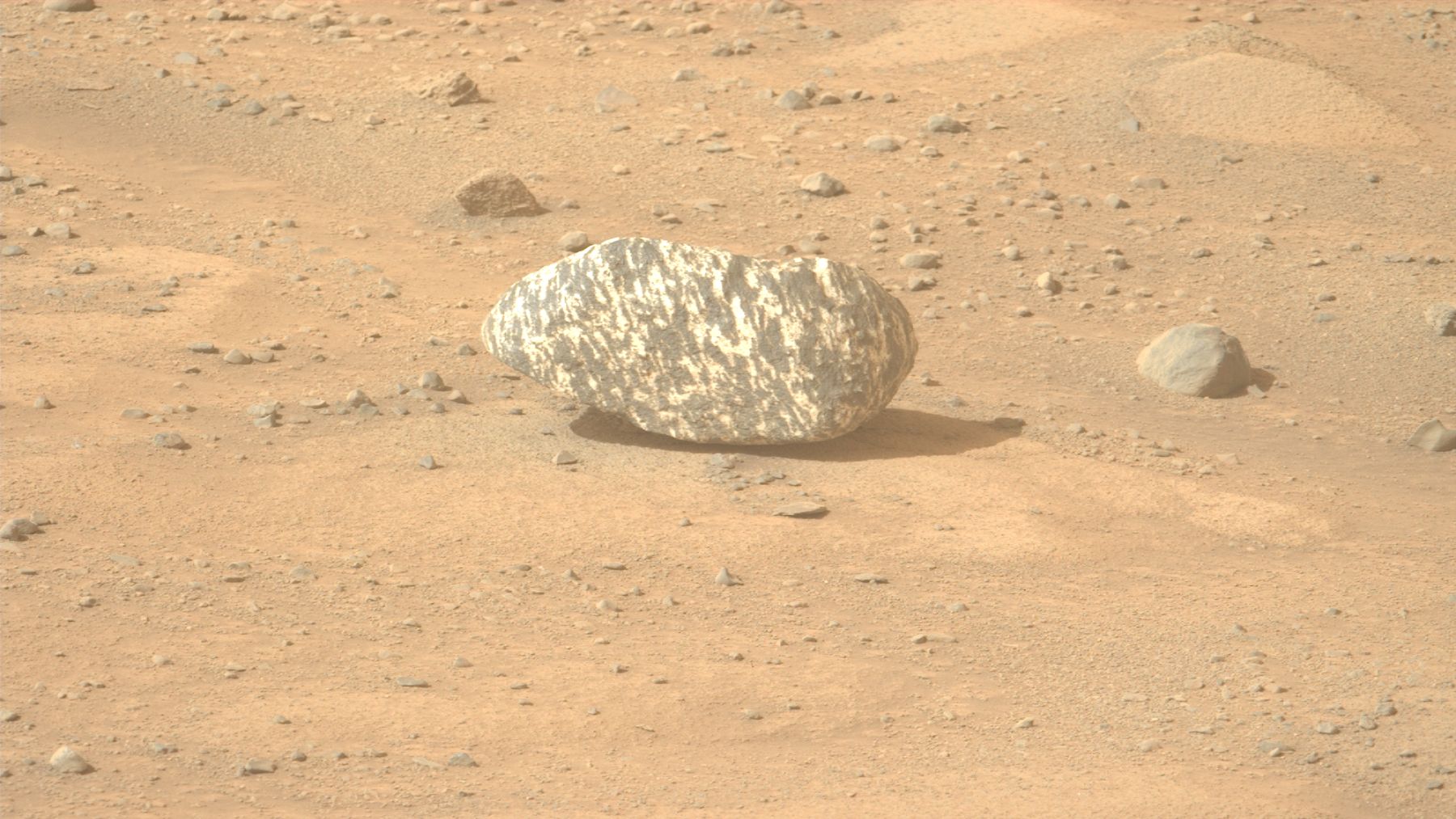
Apparently, the rover had captured the image of a rock formation. When scientists examined the image, there was no doubt that this rock formation was an anomaly and completely alien to the Martian surface. Out of curiosity, scientists decided to observe the environment where this image was taken; still, no match was made to uncover the alien rock.
NASA unravels the mystery behind the alien rock
The team of researchers who made the discovery was led by Candice Bedford. He is a mineralogist and a geochemist from Purdue University’s Planetary Science department. This rock formation was discovered on September 19 while the rover robot was exploring a region called Jezero. This rock is named Phippsaksla.
Phippsaksla has certain features that made it immediately stand out among other Martian rocks. It had a bright yellow appearance and a width that measured 31 inches, approximately 80 centimeters. However, upon an analysis of this rock formation, scientists found it to have a high concentration of iron and nickel, like this strange ancient mystery now found on Mars by NASA.
Finding that out was odd because those two elements were only discovered in meteorites. Although other rovers like Spirit, Opportunity, and Curiosity have found exotic rocks on Mars, this was the first time for the Perseverance rover. Following this discovery, NASA has begun examining Phippsaksla to determine its origin.
A breakthrough discovery rewriting what we know about meteorite impacts on Mars
NASA discovered this alien rock about two months ago. And because of how rare it is to find meteorites on Mars compared to Earth, scientists are now looking to explore certain questions. One such question begs to ask how often the red planet is struck by alien rocks and how the planet reacts to this impact.
How this discovery affects our perception of Mars
Scientists have often questioned how Mars collects materials across our solar system. From the previous exploration, scientists have gathered samples that suggest origins from foreign objects. However, with this discovery, scientists are open to the opportunity of studying various alien rocks, their evolution, origin, and impact on Mars.
In addition, this discovery has the potential to reshape future explorations on the Martian surface. Also, with much appreciation to advanced technologies, scientists can now carry out analyses that reveal precise information about future anomalies. Being able to study meteorites could explain how their impact surface.
Going forward, NASA’s Perseverance rover remains an important surveillance robot on Mars. In the space of 5 years, NASA has received various insights that suggest Mars to be a planet still influenced by its spatial environment. This yellow rock proves that, but beyond that, it reveals that Mar still has yet to face a ton of surprises, like this mysterious discovery on Mars by NASA veterans.