
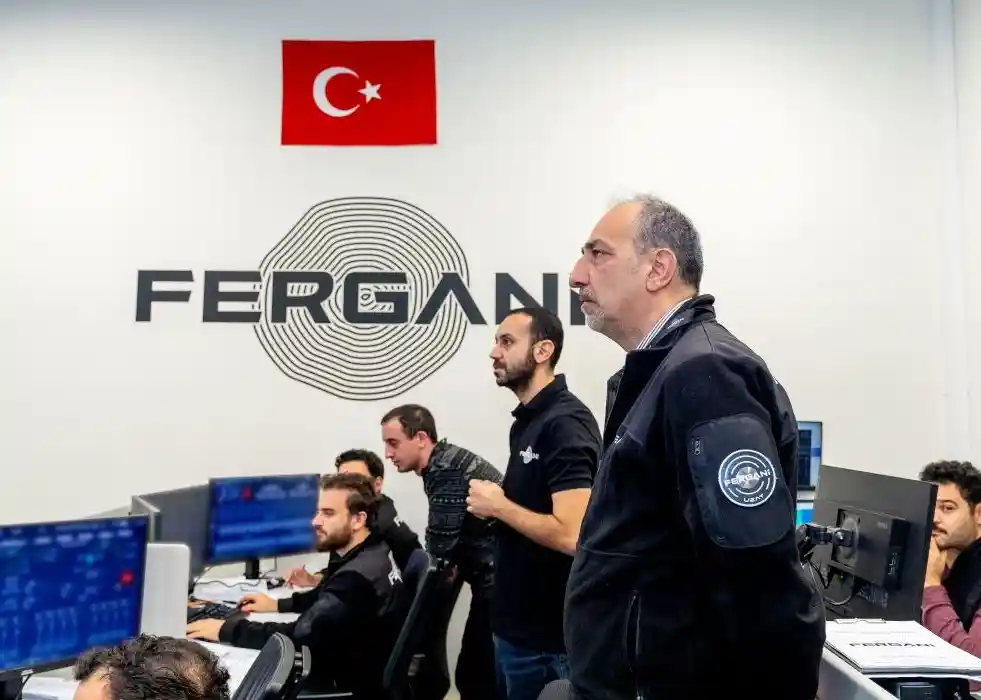
Türkiye’s first Orbital Transfer Vehicle (OTV), FGN-TUG-S01, developed indigenously by Fergani Space, has completed its most critical in-space manoeuvre. According to the company’s official press release, the vehicle ignited its hybrid rocket engine in orbit and executed a controlled transition to a higher elliptical orbit.
FGN-TUG-S01, developed by Fergani Space—founded by Baykar Chairman and CTO Selçuk Bayraktar—was launched aboard SpaceX’s Falcon 9 during the Transporter-15 rideshare mission on 28 November 2025 from Vandenberg Space Force Base in California. After completing in-orbit checks, the OTV carried out the ignition sequence central to its mission profile.

At 07:46 Türkiye time on 6 December 2025, the hybrid engine ignited and operated for 35 seconds. This manoeuvre shifted the spacecraft from a 530-kilometer circular orbit to an elliptical orbit with a 720-kilometer apogee. According to the company’s press release, the ignition represents the world’s first orbital firing of a hybrid rocket engine and the first in-space ignition of Türkiye’s domestically developed hybrid propulsion technology.
Following the orbit-raising manoeuvre, the mission advanced to its second task: CubeSat deployment. At 11:45, Fergani’s FRG-10D1 CubeSat separated from the OTV and entered its designated orbit, completing the payload delivery sequence.
FGN-TUG-S01 represents an important step toward Türkiye’s independent inter-orbital logistics capabilities. Its flight computer, avionics systems, power distribution units, and thermal control architecture were designed and manufactured in-house by Fergani engineers. The company states that the mission will serve as groundwork for scaling future satellite logistics operations.
The mission also lays the foundation for the planned Uluğ Bey Global Positioning System. Over the next five years, Fergani Space aims to launch more than 100 satellites to provide Türkiye and partner nations with independent positioning and space-logistics capabilities while advancing development of launch systems to achieve independent access to space.
The Uluğ Bey Global Positioning System, as outlined by Fergani Space, is envisioned as a satellite-based positioning, navigation, and timing (PNT) architecture designed to provide Türkiye and partner nations with independent access to precise geolocation services. Unlike current global systems such as the U.S. GPS, Europe’s Galileo, Russia’s GLONASS, or China’s BeiDou—all operated by major state actors—the Uluğ Bey initiative aims to build a regional-to-global constellation operated through a commercial-national hybrid model. If completed, the system would offer redundancy against foreign PNT dependencies, ensure sovereign availability during strategic contingencies, and potentially provide enhanced service tiers tailored to defence, civil aviation, and emerging autonomous platforms across friendly nations.
Author: Özgür Ekşi