
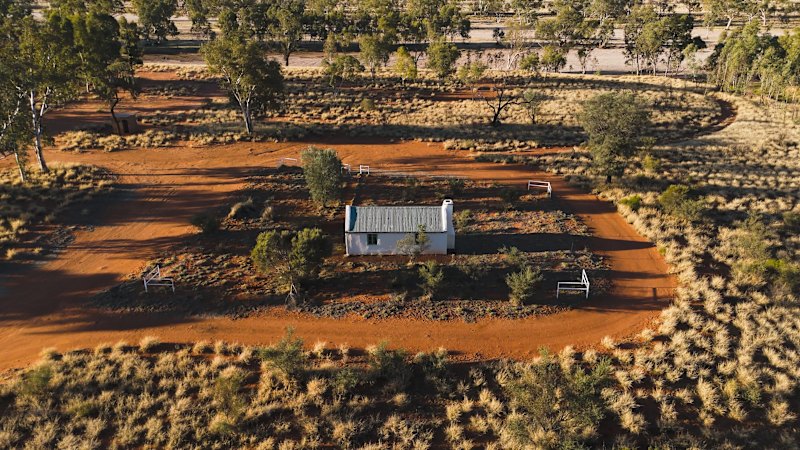
Namatjira’s image sits in one glass pane, cross-legged with a canvas in his lap amid scenes of ghost gums, grasses, and wildlife. An entire exhibition wall bears a decal of one of the artist’s iconic paintings. The frame itself is tiny—about six by three metres—a place the Namatjira family used only to sleep.
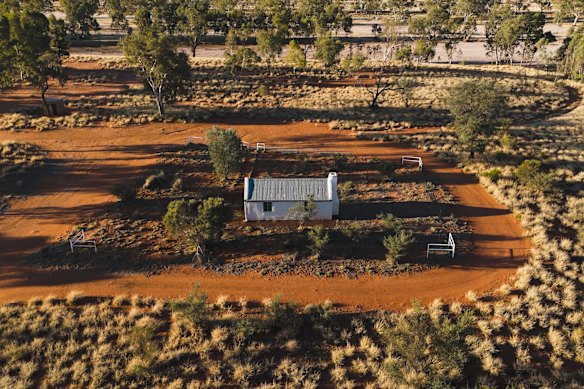
Albert Namatjira’s House on Lhara Pinta (Finke River), Ntaria (Hermannsburg). Credit: Reproduced with permission from Tjuwanpa Outstation Resource Centre.
Albert, the triennial’s artistic director, says the glass house “doesn’t sit on the landscape; it’s part of the landscape, which is one of the precious points that comes through Indigenous art and culture: the idea of belonging rather than ownership.”
“It’s stained-glass; it’s lit from the inside, so it has a pulsating breath to it,” he adds.
Namatjira pioneered the use of European-style watercolours to depict the Australian outback landscape and became the first Aboriginal person to be granted Australian citizenship. His success paved the way for the Hermannsburg School of art.
But the same world that praised his art blocked his attempts to purchase land, Albert says, which speaks to the kind of entrenched racism and white privilege Namatjira confronted in his lifetime.
Loading
Namatjira subsequently purchased land by the Finke River and remained there for much of the 1940s before leaving Hermannsburg for Sorry Business. In Aboriginal communities, families often move out when someone dies to observe a period of mourning.
During his final years, Namatjira lived with members of his extended family in shanties near Alice Springs before his premature death by heart attack in 1959. Out of respect, the house has not been occupied since.
During his research into Namatjira’s life, Albert uncovered polite letters from Namatjira to his mentor, Rex Battarbee, who organised Namatjira’s early exhibitions in Melbourne and Adelaide, requesting paper for family members to practise their art. Albert also discovered Namatjira dabbled in photography. Battarbee gave him three cameras they took on desert painting expeditions.
Namatjira’s use of European-style watercolours to depict the Australian outback landscape was initially celebrated as a symbol of assimilation, but as artistic tastes shifted, critics derided his work as superficial. Sentiment is now shifting back to Namatjira.
Loading
“Do we mark him down because of that, or do we actually mark him up given the fact he was so adaptable?” Albert asks. “His work is still grounded in thought and understanding of what it is like to be on Country.”
Albert says there is so much more still to tell of Namatjira’s life, and he wants to see the Namatjira home become more of a tourist destination.
“He is one of my heroes and someone I look up to for paving the way for a better life for us all.”