
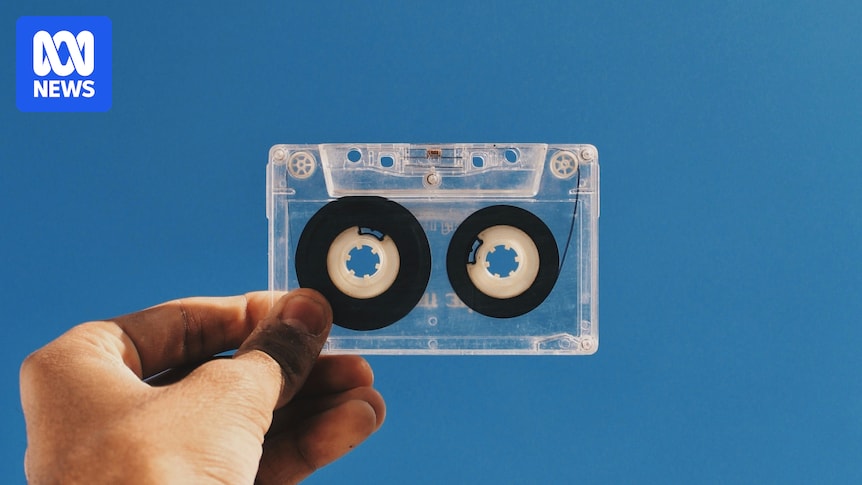
For a supposedly obsolete music format, audio cassette sales seem to be set on fast forward at the moment.
Cassettes are fragile, inconvenient, and relatively low-quality in terms of sound quality — yet we’re increasingly seeing them issued by major artists.
Is it a simple case of nostalgia?
Press play
The cassette format had its heyday during the mid-1980s, when tens of millions were sold each year.
However, the arrival of the compact disc (CDs) in the 1990s, and digital formats and streaming in the 2000s, consigned cassettes to museums, second-hand shops and landfill. The format was well and truly dead until the past decade, when it started to re-enter the mainstream.
According to the British Phonographic Industry, in 2022, cassette sales in the United Kingdom reached their highest level since 2003. We are seeing a similar trend in the United States, where cassette sales were up 204.7 per cent in the first quarter of this year (a total of 63,288 units).

Taylor Swift’s new album The Life of a Showgirl was released on cassette. (Supplied: Universal Music Group)
A number of major artists, including Taylor Swift, Billie Eilish, Lady Gaga, Charli XCX, the Weeknd, and Royel Otis, have all released material on cassette. Taylor Swift’s latest album, The Life of a Showgirl, is available in 18 versions across CDs, vinyl and cassettes.
Many news articles will tell you that a “cassette revival” is well underway. But is it?
I would argue that what we are seeing now is not a full-blown revival. After all, the unit sales still pale in comparison to the peak in the late 1990s, when some 83 million were reportedly sold in one year in the UK alone.
Instead, I see this as a form of rediscovery — or for young listeners, discovery.
Time to pause
Recorded music today is mostly heard through digital channels such as Spotify and social media.
Meanwhile, cassettes break and jam quite easily. Choosing a particular song might involve several minutes of fast forwarding or rewinding, which clogs the playback head and weakens the tape over time. The audio quality is low and comes with a background hiss.
Why resurrect this clunky old technology when everything you could want is a languid tap away on your phone?
Sterile flies take to the sky in Kangaroo Island eradication push
Analogue formats such as cassettes and vinyl are not prized for their sound, but for the tactility and sense of connection they provide. For some listeners, cassettes and LPs allow for a tangible connection with their favourite artist.
There is an old joke about vinyl records that people get into them for the expense and the inconvenience. The same could be said for cassette tapes: our renewed interest in them could be read as a questioning (if not rejection) of the blandly smooth, ubiquitous and inescapable digital world.
The joy of the cassette is its “thingness”, its “hereness” — as opposed to an intangible string of electrical impulses on a far-flung corporate-owned server.
The inconvenience and effort of using cassettes may even make for more focused listening — something the invisible, ethereal and “instantly there” flow of streaming does not demand of us.
People may also choose to buy cassettes for the nostalgia, for their “retro” cool aesthetic, to be able to own music (instead of streaming it), and to make cheap and quick recordings.
Mix tape mania
Cassettes did (and still do) have the whiff of the rebel about them. As researcher Mike Glennon explains, they give consumers the power to customise and “reconfigure recorded sound, thus inserting themselves into the production process”.
From the 1970s, blank cassettes were a cheap way for anyone to record anything. They offered limitless combinations and juxtapositions of music and sounds.
The mix tape became an art form, with carefully selected track sequences and handmade covers. Albums could even be chopped up and rearranged according to preference.
Consumers could also happily copy commercial vinyl and cassettes, as well as music from radio, TV and live gigs. In fact, the first single ever released on cassette, Bow Wow Wow’s C30, C60, C90, Go! (1980), extolled the joys and righteousness of home taping as a way of sticking it to the man — or in this case the music industry.
Unsurprisingly, the recording industry saw cassettes and home taping as a threat to its copyright-based income and struck back.
In 1981, the British Phonographic Industry launched its infamous “home taping is killing music” campaign. But the campaign’s somewhat pompous tone led to it being mercilessly mocked and largely ignored by the public.
A chance to rewind
The idea of the blank cassette as both a symbol of self-expression and freedom from corporate control continues to persist. And today, it is not only corporate control that consumers have to dodge, but also the dominance of digital streaming platforms.
Far from being just a pleasant yearning sensation, nostalgia for older technology is layered, complex and often political.
Cassettes are cheap and easy to make, so many artists past and present have used them as merchandise to sell or give away at gigs and fan events. For hardcore fans, they are solid tokens of their dedication — and many fans will buy multiple formats as a form of collecting.
Cassettes will not replace streaming services anytime soon, but that is not the point. What they offer is a way of listening that goes against the grain of the digital hegemony we find ourselves in. That is, until the tape snaps.
Peter Hoar is a senior lecturer at the School of Communications Studies, Auckland University of Technology. This piece first appeared on The Conversation.