
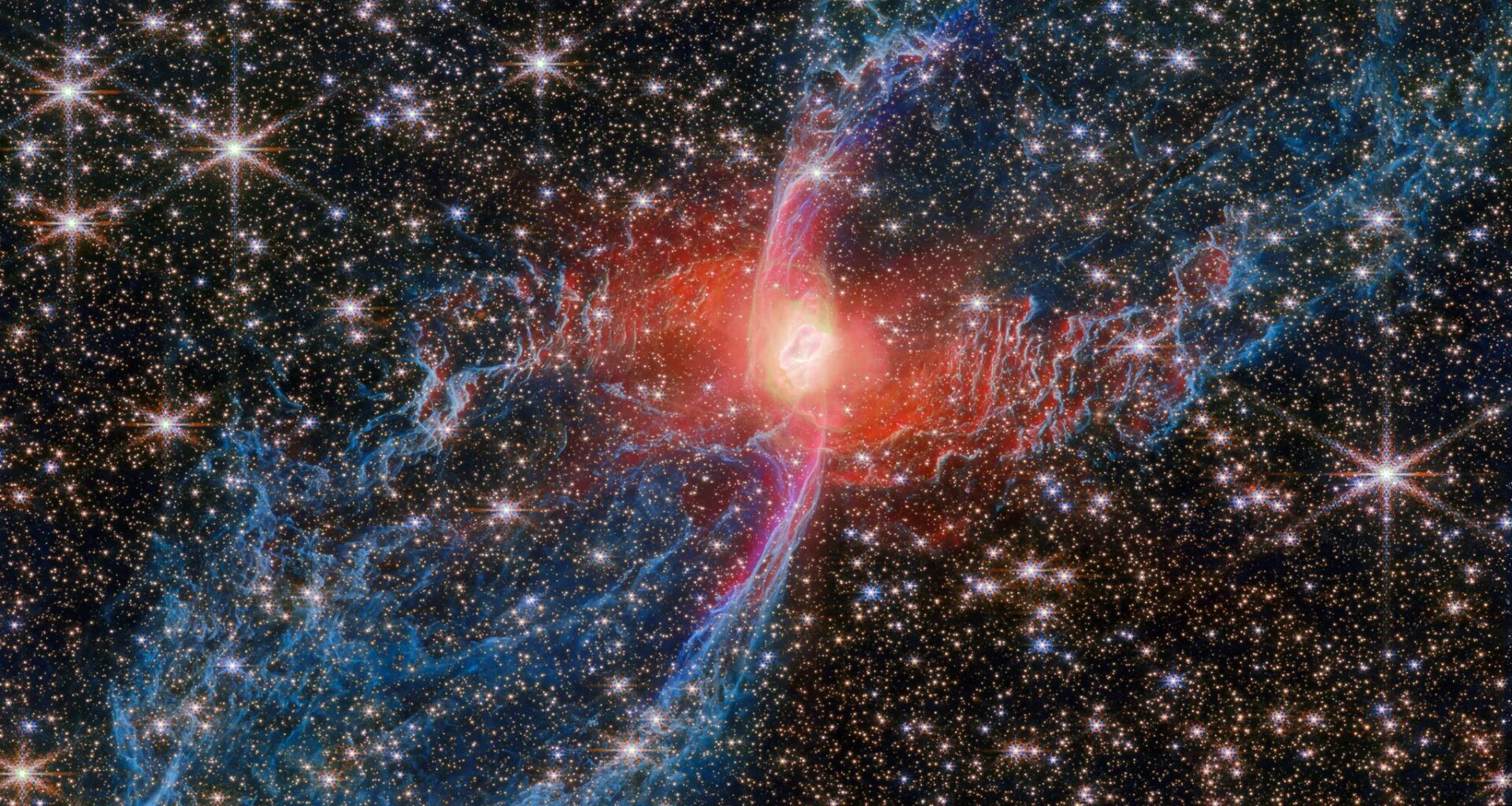
NASA has released a new James Webb Space Telescope image that shows features of the Red Spider Nebula in more detail than ever before. Webb used its Near-InfraRed Camera (NIRCam) to observe the object and record structures that had not been seen in full.
The nebula’s outstretched lobes form the “legs” that give it its name. For the first time, scientists can now view them across the entire image.
Blue Lobes Traced By Hydrogen Molecules
The lobes appear in blue in the NIRCam image. They are outlined by light from H₂ molecules, which contain two bonded hydrogen atoms. NASA explains, “These lobes are shown to be closed, bubble-like structures that each extend about 3 light-years.”
According to NASA, outflowing gas from the centre of the nebula has inflated these bubbles over thousands of years. This slow process has created the large, rounded shapes now visible in the new observation.
New High-Resolution Data For Future Study
NIRCam provided the high-resolution infrared data used for this investigation. NASA notes that the instrument supports “a wide variety of other analyses,” meaning the same dataset will also help researchers explore additional features of the nebula.
The telescope launched in 2021 as a major space science observatory and continues to reveal structures across the universe through its infrared instruments.
 Published by Kerry Harrison
Kerry’s been writing professionally for over 14 years, after graduating with a First Class Honours Degree in Multimedia Journalism from Canterbury Christ Church University. She joined Orbital Today in 2022. She covers everything from UK launch updates to how the wider space ecosystem is evolving. She enjoys digging into the detail and explaining complex topics in a way that feels straightforward. Before writing about space, Kerry spent years working with cybersecurity companies. She’s written a lot about threat intelligence, data protection, and how cyber and space are increasingly overlapping, whether that’s satellite security or national defence. With a strong background in tech writing, she’s used to making tricky, technical subjects more approachable. That mix of innovation, complexity, and real-world impact is what keeps her interested in the space sector.