
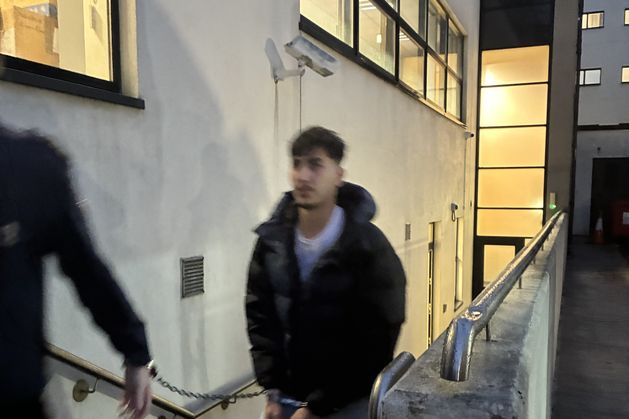
Mustafa Pacha (22) of Prospect Wood, Co Longford appeared at Wicklow Circuit Criminal Court for sentencing after pleading guilty to one count of harassment, which occurred between December 2022 and May 2023.
Detective Garda Sinéad Brosnahan told a sitting of Wicklow Circuit Criminal Court that the defendant met the victim, who was aged 16 at the time of the offence, while at the IPAS centre in Citywest, Dublin. Soon after meeting the victim, Mr Pacha allegedly became infatuated with her.
Both parties are from Afghanistan and had come to Ireland as refugees.
The victim later moved to a direct provision centre outside the jurisdiction. Mr Pacha, who was friendly with the injured party’s brother, tracked her down through social media and began contacting her.
Counsel for the prosecution, James Kelly BL, informed the court that communication began on December 2, 2022. After some contact, the victim began to feel pressure to share images of a sensitive nature with Mr Pacha.
The court was told that, given her background, she would ordinarily have worn a hijab, but in the images she was not wearing one.
Some images included photographs of her nude, with his name written on her body, including on her chest, in the form of the letter ‘M’ with a love heart. The marking was not a tattoo but a temporary, henna-type design.
The accused also shared nude photos of himself. When he sent a photograph of his face, she recognised him from Citywest and blocked him on social media.
The court heard that Mr Pacha obtained the injured party’s phone number and used it to add her on Snapchat, Instagram and Facebook. After the defendant was blocked, he continued to harass her by saying that he loved her and by sending images of himself self-harming.
Mr Pacha then sent the naked pictures to her brother and to her family in Afghanistan. Some of the images were not of the victim but of other women, and he had blurred the faces on several of them. The defendant also created fake accounts in the victim’s name and circulated the images online.
Det Brosnahan testified that in Afghan culture this would bring great shame on a family and said the motive behind the harassment was that the victim saw him as a friend rather than a romantic partner. The court was told that the victim has since been shunned by her family and has had no contact with her brother for the past two years.
The court heard that the pair communicated in English as well as in their native language, Pashto.
Members of An Garda Síochána’s Divisional Protective Services Unit in Wicklow town obtained a warrant to access the data on the relevant accounts. All logs obtained were included in the book of evidence.
During interview with gardaí, Mr Pacha said that he believed they were in a relationship. He admitted to all allegations and it was noted that he was very cooperative with gardaí.
Mr Kelly, for the prosecution, read the victim impact statement to the court.
It said that the victim had once been a happy and outgoing girl, but that her family life has been deeply affected and she is now being used as an example by her relatives. She wrote that the impact of the offence affected her entire last year in school and that every day now feels the same.
She described how she went from being an extrovert to becoming an introvert and that she often wakes during the night crying.
Counsel for the defence, Damian Sheridan BL, instructed by Dermot Hickey, told the court that Mr Pacha, who was aged 19 in 2022, had arrived in Ireland one month before the harassment began. Mr Pacha has since been granted asylum status.
The court was informed that since his arrest he has engaged with the probation service and has abided by all his bail conditions.
During cross examination, the garda agreed with the defence that Mr Pacha is genuinely sorry for what he did and that he believed the victim was 20 at the time of the offence. The victim said in a written statement that Mr Pacha was aware she was 16.
The court was told that he has since apologised to the victim’s brother, due to him being the head of the family in there culture. The victim said that the plea of guilt means nothing to her and she is still extremely depressed.
Judge Patrick Quinn offered to speak to the family in Afghanistan and explain the situation if it is needed.
He further remarked what would happen to Mr Pacha if he was in front of a court in his home country.
Mr Sheridan told the court that Mr Pacha’s behaviour is due to his lack of family support and the difficulties he faced after coming from a socially conservative society and having to deal with those cultural changes.
He said that Mr Pacha’s actions were motivated by infatuation.
The court was told Mr Pacha has stage 4 asylum status and if the court was to impose a sentence the Justice Minister could remove his status.
Mr Pacha worked at a bakery in Longford, but has since been fired due to his employers becoming aware of the charges he faced.
Three references were handed into the court. Mr Pacha is actively seeking employment, said Mr Sheridan.
During sentencing, Judge Quinn said that the criminality in this case had the most profound impact on the victim, “who had been completely overwhelmed by the breach of trust”.
In locating the offence on the sentencing scale, Judge Quinn said he had to consider the defendant’s co-operability, as well as the effect on the victim’s family and the enormous harm done.
The maximum sentence for the offence is seven years. Judge Quinn placed the offending at the upper end of the mid range.
Judge Quinn handed down a sentence of three years, with the final 12 months suspended for a period of 12 months.
He noted that serving such a sentence would be more difficult for the defendant due to his circumstances.
Funded by the Court Reporting Scheme