
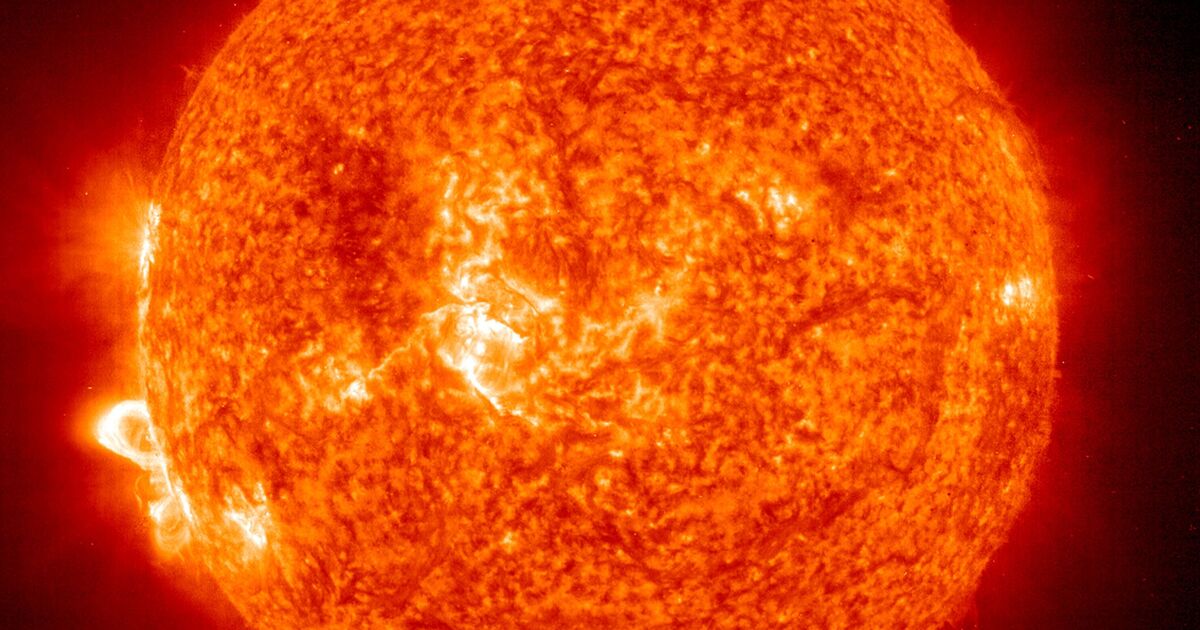
A colossal cluster of sunspots, collectively around the same size as the one that spawned the largest solar storm in recorded history , has just emerged on the sun’s Earth-facing side and is now aimed squarely at our planet. However, experts urge the public not to panic, as while auroras and some technological disturbances are possible in the coming week, the new sunspot complex is unlikely to unleash a second Carrington Event, reports Live Science.
The complex, named AR 4294-4296, consists of two magnetically intertwined sunspot groups, AR 4294 and AR 4296. It first became visible on Nov. 28 when it rotated onto the sun’s Earth-facing side on its western limb. However, NASA’s Perseverance Mars rover had already spotted the dark patches around a week earlier while observing the sun’s far side relative to Earth.
Sunspot complex rivals size of Carrington Event culprit, covering 90% of its area
According to the report, AR 4294-4296 is roughly the same size as a giant sunspot observed by British astronomer Richard Carrington in September 1859, which subsequently triggered the “Carrington Event” – the most powerful solar storm ever witnessed by humans. Although the new sunspot complex appears larger at first glance, its dark spots actually cover an area approximately 90% the size of the Carrington sunspot.
Sunspots capable of unleashing powerful solar flares and coronal mass ejections
Sunspots have the potential to release powerful blasts of radiation, known as solar flares, when their invisible magnetic field lines contort and snap, releasing energy into space. These explosive outbursts can trigger temporary radio blackouts on Earth and launch massive, fast-moving clouds of plasma, or coronal mass ejections (CMEs), towards our planet, causing disturbances in Earth’s magnetic field and interfering with electronics while painting vibrant auroras in the night sky.
According to Spaceweather.com, the new dark patches are “one of the biggest sunspot groups of the past 10 years” and have the capacity to unleash supercharged X-class flares – the most powerful type on the National Oceanic and Atmospheric Administration’s solar flare categorization system. If it does erupt and unleashes a CME, the resulting solar storm “will be geoeffective,” they added.
Carrington Event’s record-breaking X45 solar flare and potential impact on modern infrastructure
The Carrington Event unleashed an estimated X45 magnitude solar flare in 1859, which remains a record, although geological evidence suggests even more powerful blasts occurred long before humans emerged. For context, an X45 flare is more than five times stronger than the most powerful solar flare of the last decade – an X7 blast in October 2024. If an equally powerful blast impacted Earth today, recent simulations reveal that it would knock out every satellite in orbit and wreak havoc on the ground, potentially damaging parts of the electrical grid, with total damages easily exceeding $1 trillion.
Size isn’t everything: Magnetic field configuration and explosion frequency also play a role
While larger sunspots have the potential to launch more powerful solar flares, size alone does not guarantee a huge solar storm. The configuration of a sunspot’s magnetic field and the frequency with which it explodes also play a crucial role in determining its maximum explosive potential, meaning that some giant sunspots can be completely harmless.
The magnetic fields of AR 4294-4296 are quite entangled, suggesting that flares are possible, and the complex has already unleashed a potential X-class flare while still on the sun’s farside, according to Spaceweather.com. However, despite this, experts say there is no clear sign of a superstorm on par with the Carrington Event in the immediate future.
Scientists closely monitoring AR 4294-4296’s magnetic field for signs of incoming activity
Scientists will be keeping a particularly close eye on the magnetic field of the latest behemoth for signs of incoming activity. But if it happens to rotate past Earth without any outbursts, the hefty dark spots are likely large enough to survive more than one trip around the sun, meaning they could be back for “round two” sometime closer to Christmas.
As the gigantic sunspot cluster AR 4294-4296 points directly at Earth, experts urge the public to remain calm and not to panic. While auroras and some technological disturbances are possible over the coming week, the likelihood of a second Carrington Event remains low. Scientists will continue to closely monitor the complex’s magnetic field for signs of incoming activity and assess its potential impact on our planet.