
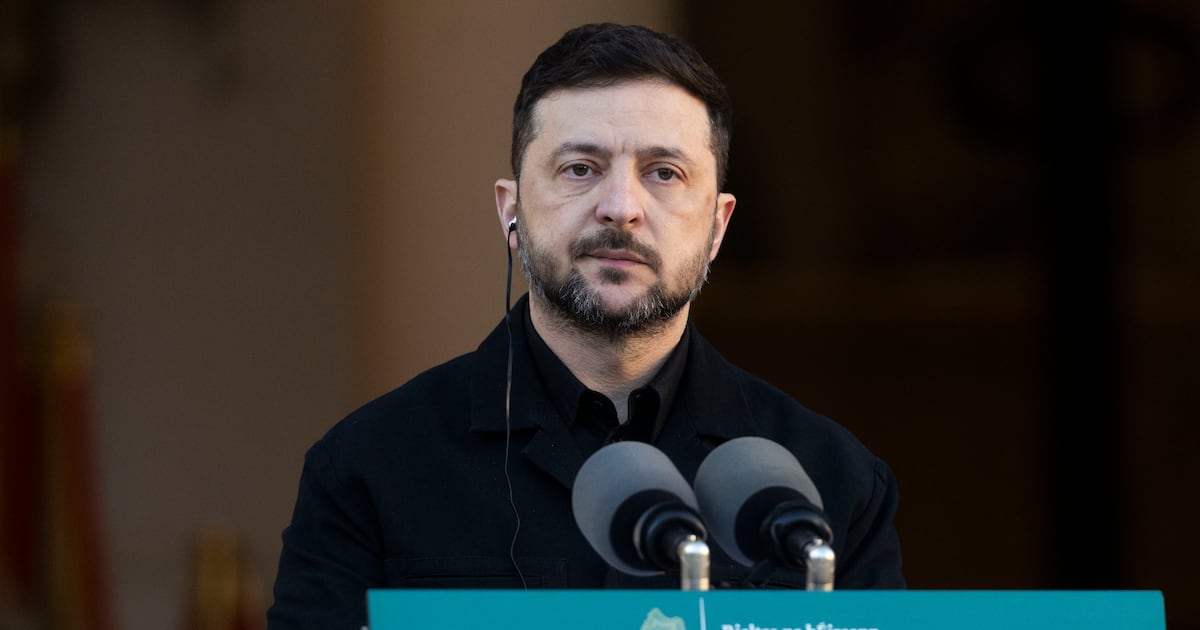
Rogue drones launched as Ukrainian president Volodymyr Zelenskiy was arriving in Ireland were not controlled by some “back garden enthusiast” but likely tied to a “co-ordinated threat” to European interests, Minister for Justice Jim O’Callaghan has said.
The appearance of several drones off the coast of Ireland shortly after the Ukrainian leader’s flight was arriving last week has brought questions about the State’s ability to counter instances of possible foreign interference into focus.
It is understood the drones flew into the path Mr Zelenskiy’s aircraft had taken approaching Ireland some time beforehand, about 13 nautical miles off the coast.
Speaking on Monday, Mr O’Callaghan said it was clear the drones were not controlled by some “back garden drone enthusiast” and investigations were continuing into the incident.
“I think it’s fair to say that we think this is part of a co-ordinated threat to EU and Ukrainian interests,” the Minister said in Brussels.
“It certainly wasn’t a back garden drone enthusiast, I suppose our suspicion is that this was drones that were generated for the purpose of putting pressure on EU and indeed Ukrainian interests,” he said.
It is understood footage of the drones was captured by the crew of the Naval Service’s LE William Butler Yeats. The incident is believed to have been intended to cause embarrassment to the Republic.
The incident highlights potential weaknesses in the State’s defence capabilities, a little more than six months out from Ireland taking over the EU council presidency, a role that will entail hosting European heads of state and other foreign delegations for high-level meetings.
Mysterious drones have caused disruption in several European capital cities, including Copenhagen and Brussels, necessitating the temporary shutdown of big airports. Drones have also been spotted flying over military sites.
The strong belief is that Russia is behind the interference, using drones to cause disruption in Europe and to embarrass pro-Ukrainian governments.
Mr O’Callaghan said the gardaí did a “very good job” in ensuring the security of Mr Zelenskiy’s official visit to Ireland.
“There’s an investigation ongoing in respect of the presence of drones out in Dublin Bay,” he said.
“It’s not just an issue in respect of Ireland but throughout the European Union; there are issues in respect of greater threats being exposed as a result of drone technology,” he said.
The Fianna Fáil Minister said he had not yet reached any determination about whether a state actor was likely behind the drones launched off of Dublin.
[ Zelenskiy visit brings politics of a world at war to IrelandOpens in new window ]
“Obviously I get a lot of information from An Garda Síochána in respect of issues concerning our security, but I think it’s fair to say that we think this is part of a co-ordinated threat to EU and Ukrainian interests,” he said.
Speaking to reporters in Dublin on Monday, Taoiseach Micheál Martin said there had been a “significant escalation” of “hybrid attacks” against EU member states which are believed to originate in Russia.
Referencing a “pattern” of drone incidents in Denmark and Belgium, Mr Martin said the development was “in many ways not a surprise”.
“In respect of the specifics of the drones emerging in Ireland, the National Security Council will be meeting shortly in respect of that and I’ll get a comprehensive report on it.”
Mr Martin said the Government was increasing spending and increasing capabilities on defence ahead of Ireland holding the Council of the EU presidency in the second half of next year.
The Cabinet is expected to hear plans this week for €1.7 billion spending on defence equipment and infrastructure up to 2030 under the revised National Development Plan – with about €300 million to be available next year.
The Government is expected to allocate between €15 million and €17 million next year as part of an accelerated programme to acquire technology to track and intercept drones.
The drone initiative will represent the first component of an overall military radar programme, likely to be the most expensive defence project in the history of the State and which the Government wants fully in place by 2028.
Mr O’Callaghan said boosting the Defence Forces’ ability to counter malicious drones was “something that’s very important in light of what we’ve seen recently”.
The Minister was speaking in Brussels, where he was attending a meeting of justice ministers to discuss migration policy.