
Bangladesh also managed recent natural disasters better than expected, he said, adding, “These are the indicators in my positive basket.”
TBS Report
08 December, 2025, 01:40 pm
Last modified: 08 December, 2025, 01:48 pm
World Bank lead economist Dr Zahid Hussain. Photo: TBS
“>
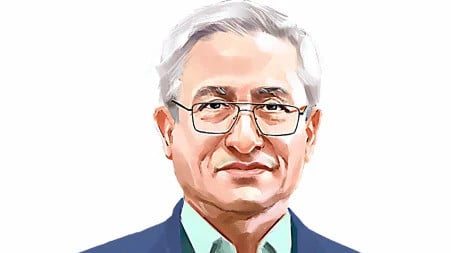
World Bank lead economist Dr Zahid Hussain. Photo: TBS
Bangladesh’s economy is under strain but has avoided a far worse outcome, former World Bank lead economist Dr Zahid Hussain said today (8 December), stressing that sustained reform and an uninterrupted electoral process are now essential for stability.
Speaking at a seminar on the publications Bangladesh State of the Economy 2025 and Sustainable Development Goals: Bangladesh Progress Report 2025, held at the Planning Commission in the capital, Zahid Hussain said the economy shows both strengths and weaknesses, with the negative indicators still outweighing the positive.
He said remittance inflows have reached new highs, illicit financial outflows have slowed, revenue mobilisation has improved slightly, and electricity supply has remained stable.

Keep updated, follow The Business Standard’s Google news channel
Bangladesh also managed recent natural disasters better than expected, he said, adding, “These are the indicators in my positive basket.”
However, inflation remains very high, growth is subdued, real wages have fallen, employment has stagnated, exports have weakened in recent months, investment remains depressed, and poverty has increased, according to recent World Bank assessments.
“Overall, the negative basket outweighs the positive one. The economy is struggling, and so are livelihoods. But it could have been much worse,” he said.
Zahid Hussain outlined three factors that helped prevent a deeper crisis.
The first, he said, is Bangladesh’s “deep social resilience”, which became evident during the three days of the August 2024 upheaval when state institutions temporarily collapsed.
There was no government, no police on the streets, no secretaries, no vice-chancellor, no central bank governor — and yet society did not collapse,” he said.
The second factor, he added, is the interim government’s approach to political management, which has helped reduce the intensity of partisan hostility. He described this as a cultural shift where political actors express criticism without naming individuals directly.
He said sustained dialogue and inclusive political engagement over the past nine months have contributed to this change.
He noted that all political parties criticising the interim government for bias is, paradoxically, “a sign of neutrality”. Zahid Hussain warned that only a major political shock could now halt the electoral process. “Elections will take place — unless there is a six-magnitude political quake,” he said.
The third factor he identified is macroeconomic management and the ongoing reform agenda. He argued that Bangladesh had long engaged in “self-destructive” economic practices that became institutionalised.
Although efforts over the past 18 months have attempted to correct this, significant progress remains limited. He said the belief that “where there is political will, there is a way” needs revisiting.
“Willingness alone is not enough. There is no guarantee of success simply because the intention exists,” he said.
Despite numerous commissions, consultations and reports signalling reform intent, the number of ordinances and Cabinet decisions implementing them remains “very small”.
“We still do not see major visible results on the ground,” he added. The economist stressed that reforms require not only political will but political stamina.
Without stamina, reforms stall “like a computer that suddenly hangs”.
He cautioned that without sustained reforms, achieving stronger economic performance will be “extremely difficult”.
The seminar was attended by senior economists, policymakers and development practitioners who discussed the economic outlook and progress toward the Sustainable Development Goals.