
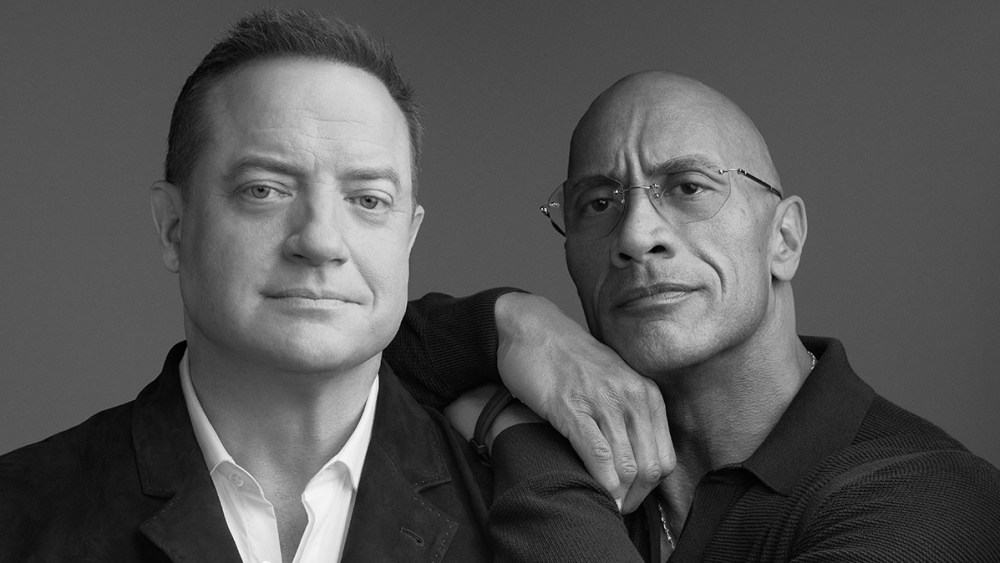
Dwayne Johnson and Brendan Fraser first met making “The Mummy Returns.” The 2001 sequel continued Fraser’s burgeoning leading-man career, but it was the first ever film role for Johnson, then better known as WWE’s The Rock. In recent years, both actors have enjoyed festival acclaim (and lengthy standing ovations). “Rental Family,” Fraser’s first leading role after winning an Oscar for “The Whale” in 2023, tasks the star with playing an actor in Tokyo helping people to feel human connection, and drew tears at its Toronto premiere. And “The Smashing Machine,” starring Johnson as real-life MMA athlete Mark Kerr, earned tearful rounds of applause at Venice and Toronto.

Alexi Lubomirski for Variety
Brendan Fraser: Hi, Dwayne.
Dwayne Johnson: Good to see you, brother. I’d love to start off our conversation by giving you flowers. OK? I’m going to deliver a lot of flowers to your doorstep right now. You and I first connected on “The Mummy Returns.” That was one of the biggest franchises in the world at that time. I was ready to make my transition into Hollywood. And there was a moment where you could have said, “This guy, Dwayne Johnson, he’s never acted before; he’s in pro wrestling.” The word I got back was, “Brendan loves the idea. He welcomed you with open arms.” It meant something to me, because you took a risk on me, and years later, you and I are sitting here. I want to thank you for really changing my life.
Fraser: You’re too kind, Dwayne. You were always the right guy for the job. When I was told that you were a possibility for it, forgive me, but I didn’t know you from the wrestling world. And when I was shown, I said, “That is inspired casting. We’d be lucky to get the guy.” You need a stadium persona to play a villain you love to hate. It’s going to take a lot of confidence and belief. In the wrestling world, you were painting with a 10-inch brush — you need to have big energy.
And your paintings are getting better all the time. I’ve seen “The Smashing Machine.”
Johnson: I know. Thank you for all the support. This was my first foray into this level of drama, and I was running toward this opportunity. I get to the Toronto Film Festival and the film ends and the audience is clapping, and we’re getting whisked onstage. Who was right there, and actually stepped in the line of traffic to stop me? It was you, with the biggest smile and the biggest hug.
Fraser: You nailed it, dude. You got me in the feels. Not only the physical pain, which was formidable — and I know Dwayne’s a big, strong guy, but hard knocks hurt — but that’s not the real pain that you had in that role.
Johnson: That’s right.
Fraser: That guy was accustomed to getting hurt. It’s what he did for a living, right? But the real pain was the emotional stuff.
Johnson: The insides.
Fraser: Do you ever feel like, “It’s OK, you can throw me off the back of a moving vehicle or light me on fire or knock the crap out of me all afternoon; just don’t say anything mean to me, because that’ll really hurt.” That’s the vulnerability. I understand what it’s like to be the guy who’s not allowed to show that pain.
Johnson: You do know that.
Fraser: To a lesser degree, I’m sure, than yourself. But look, we’re human. And at the end of the day, you’re going to need an ice bag, maybe a cup of chamomile tea and someone to kiss you on the forehead and say it’s going to be OK.
Johnson: Brendan, you’re a big guy. You’re a very big man. And there’s a big presence to you, where for years, you weren’t allowed to reveal it. When was the turning point where you went, “You know what? I want to perform now for an audience of one — for me.”
Fraser: There comes a point where you fall apart. And I guess around 2007 or ’08 or ’09, around there, I was doing a movie in Sault Ste. Marie, Ontario — it was a low-budget thing, and we were rolling around in streams and off of mountains, making stuff up as we go along. And I was playing hurt but pretending that I wasn’t. The movie ended and I thought, “I’m getting too old for this shit. It’s starting to catch up with me. If I’m going to continue, I have to have a real reckoning with myself about why I am getting banged around and bruised.” I had to actually ask myself a serious question that I’d been avoiding: Why am I doing this? I had to take ownership of the reason, and that was [that] I was trying too hard.
Johnson: Yes.
Fraser: I was feeling like, unless it hurts, then I’m not earning my keep. That idea is what I saw in your work in “The Smashing Machine,” because we feel for the supposedly invulnerable titan. But how do you bring them down with just a minor injury that takes them apart? Not allowing oneself to be vulnerable publicly — the stoicism seems harder than the loss. That was when I went, “Oh, man, Dwayne, you’ve done it.”
Johnson: There’s this great quote from Floyd Patterson, who was this heavyweight. I’m paraphrasing here, but he says, “When you win, what a walk going back to the locker room! You take it all in. But if you lose,” he goes, “Man, I wish there was a trap door in the ring, where I could just fall into the earth and disappear and never have to do that again.” There was a connection to my life — things could be so loud and noisy in our world, but at the same time, we can feel lonely. We can feel alone.
Fraser: Loneliness is a public health concern, I believe. In “Rental Family” …
Johnson: You deal with that, right? With loneliness?
Fraser: The character, Philip, does deal with that. He’s got such solitude in such a busy, populous place. You’ve been to Tokyo, and you know it’s a beehive of activity. But the instances of suicides and people bereft of connection are too high. And that’s why a “rental family” agency exists and did since the 1980s. Seriously — there’s like 300 agencies. People feel a need for connection in a meaningful way, even if it’s make-believe. Even if it’s only for a little while and you’re paying for it. Loneliness seems like a simple enough thing to ameliorate, but until you really feel it, you’re not going to know exactly what it can do to you.
Alexi Lubomirski for Variety
Johnson: You just have to feel it and experience it. Right. You provided peace — that peace is something we all look for. One of the moments that rocked me was Kikuo, the character in the film, an older gentleman—
Fraser: Akira Emoto-san is [the actor’s] name.
Johnson: He’s a legend.
Fraser: He’s like the Japanese Ian McKellen.
Johnson: How is he to work with?
Fraser: Incredible. He has his own theater, a black-box theater in Tokyo, and he lives on the floor above. Every morning at eight a.m., he has a free performance that he gives — of anything. He’ll read something from a play, or some piece of obscure text. One morning I went, he was reading this 15th-century shogun’s shopping list.
Johnson: Wow.
Fraser: A certain amount of bushels of wheat, and the peasants are acting up again — and he’s performing it in this classical form of Japanese that even Japanese people are going, “What did he say?”
Johnson: Was there a different tone and intonation?
Fraser: I don’t know enough about the language, but it’s the difference between you and I speaking right now and “Henry V.”
Johnson: You feel his power onscreen. I loved the relationship between you two. And I’m dealing with dementia in our family, so I loved this idea that you want to create this moment for him, even if he’s going to forget it, to give him this peace, take him home. What you say to him rocked me, because it’s what I said to my dad. It’s your version of “I’ll see you again, my friend.” It just moved me. I was getting emotional — I was crying! And I loved the relationship you had with the little girl.
Fraser: Shannon [Mahina] Gorman is her name. Her mother is Japanese, her father is Irish. And that’s the dynamic of who she is written to be — because she’s the daughter of a single mother. Whoever her father is, he’s just not in the picture. But he was Caucasian. So she feels trapped between worlds.
Shannon showed up to the rehearsal with an explanation of what it felt like to be made to feel other. She said, “I’ve been bullied.” And that can be biting, because you’re not “Japanese enough.” Or you’re not “white enough.” She showed up at this movie with all of this emotional bandwidth. It was so available, that we had to stop rehearsing, because we didn’t want to play our game in the locker room.
Johnson: Yes. Go out on the field.
Fraser: “Just point the camera at the kid and we’re good! Just give Brendan a Red Bull.”
Johnson: The movie’s amazing, but the conceit of it is so unique and different. How did the script come to you?
Alexi Lubomirski for Variety
Fraser: I was just looking for a job, man. It’s all in the title: “Rental Family”? Insert pejorative, cheeky joke here. But it piques your interest. And that’s what this director, Hikari, embraces. She goes toward the prickly side of what that could mean, along with the softer side. The movie lives in between — it’s not cynical. I needed to find something like that.
Johnson: Why did you need something like that? I’m curious.
Fraser: It was before the Oscars. I saw the script first before the Oscars. Not that that changed — believe me, it doesn’t change much of anything.
Johnson: You still would’ve done it, right?
Fraser: Yes, absolutely. But I’m still the same guy. I was looking for a job, and I wanted something that was out of the ordinary. I wanted to not jump into something splashy and huge. I wanted to be challenged by working with what I’ve got.
Johnson: After your Oscar win, did you feel anything shift? Did it allow you to look at things maybe a little deeper, or look at material differently? Did it give you a different kind of desire to challenge yourself?
Fraser: I think of it two ways. On the one hand, “You better earn this. You got the brass ring but be worthy of it going forward. Uphold the standard if you can.” But also, I felt like I don’t have anything to prove. But that doesn’t mean I’m going to just coast.
Johnson: It’s not like you’re not hungry.
Fraser: If anything, I feel like I have to work.
Johnson: Hungrier. When I saw you win — and I’ve known you a long time — I thought, “Oh, if you think he’s not going to be hungry anymore, that is not him. You’ve made him hungrier.” And then, the idea of, “Hey, you’ve got to be worthy of this.”
Fraser: Like you, I’m in it for the long haul. Most actors, the secret is, we would be doing this whether they paid us or not. I love it. And you have to take ownership of who you are, what you’re capable of, and have the courage to continue.
Johnson: You brought up the idea of “I felt like I didn’t need to prove anything anymore”? Had you felt that before —
Fraser: I had everything to prove. I knew I was a capable actor, and I had plenty of bumps in the road along the way, but that’s just the way it goes. And maybe it was a perfect storm of when “The Whale” was shot: It was during COVID. It was one room. It was a man encumbered by a health condition that caused his body to be so overweight that he was confined to a single place. What Darren Aronofsky directed was a movie that made us all feel — because it was when we were all locked down — that we were all under existential threat. This might be the last time we ever get to do this.
Johnson: So it had that energy.
Fraser: “If I’m going to do this, I’m going to go down swinging. I’m going to give it everything I’ve got.” When I finished, I felt like, “Well, I am all out of moves. If it doesn’t land, I guess I’ll crack open the Yellow Pages and go look for a marketing job or something. I really don’t know what the hell I’m doing.” And that was the first time in my career that I felt like I left it all out there.
I owe you a debt of gratitude because when I took “The Whale” with Darren and the crew to Venice, and they applauded for a very long time and stayed on their feet — I’d never been there before. I didn’t know the whole ritual of it.
Johnson: I was in tears when I watched you.
Fraser: I know! And you put your shoulder into that by showing your support through Twitter. Dwayne, you’re a godfather of sorts of the success of that project. Thank you for that.
Johnson: Look, I’m happy to support you. But also, that moment rocked me and it moved me. I had not experienced Venice until “Smashing Machine.” I’ve watched it from afar. And then I see this long applause for you. You’re emotional; I’m emotional watching you get emotional. But I felt such joy for you because I felt like that’s what you work for. The other stuff that comes our way — if it does well, great. If it flops, OK, we move on. But that ceremonial applause for something that you ripped yourself open and you went elsewhere — I was so happy for my friend and even more inspired. I want to do that. I want to find that role.
Fraser: I felt like I was in an out-of-body experience. It felt like the fulfillment of a dream I would never have admitted to having. What happened when the shoe was on the other foot with the reception for “The Smashing Machine”? Where did it take you?
Johnson: I was living my dream; not others’ dreams. These other projects, which I love doing, there’s a lot of other entities connected to them. “Smashing Machine” was just me, Benny Safdie and Emily Blunt. That was my exhale. I felt like I’d never exhaled like that in my career. Like, Wow. We did it.
Fraser: Did you compare it to everything you’ve done prior? I found myself thinking, “All right, for all these movies I made, some might’ve been crap, some were good, [but] all of them brought you to this point.”
Johnson: That’s right. Every single thing I’ve done has led to this moment.
This is a conversation from Variety and CNN’s Actors on Actors. To watch the full video, go to CNN’s streaming platform now. Or check out Variety’s YouTube page at 3 p.m. ET today.
Production: Emily Ullrich; Agency: Nevermind Agency