
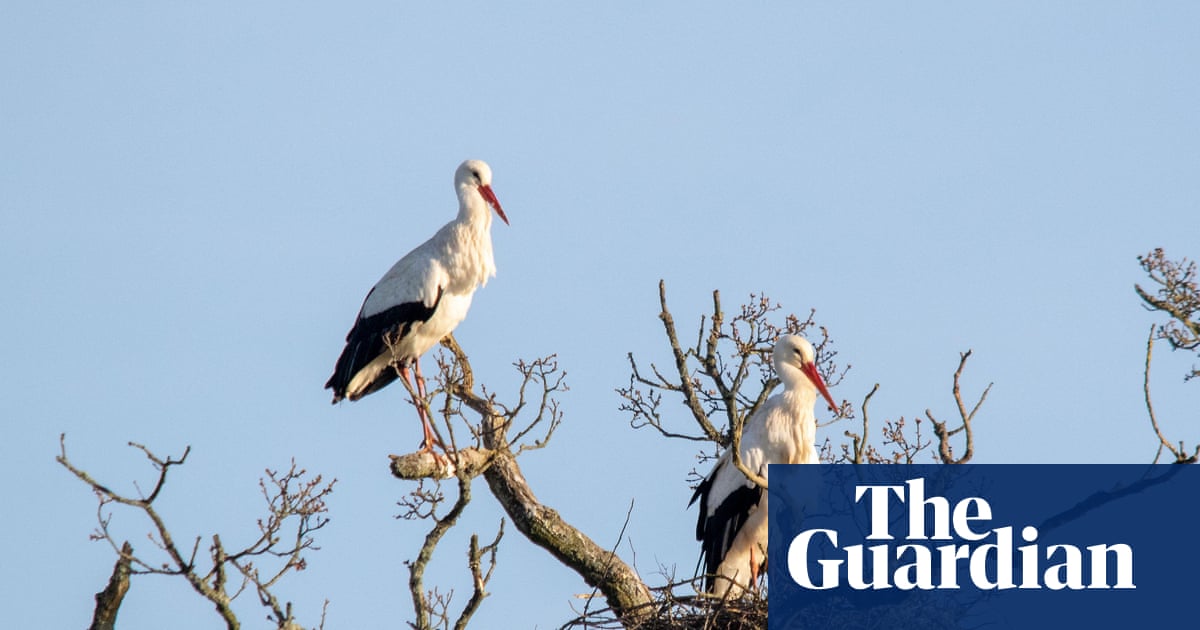
Above the roar of traffic, the rumble of the tube and the juddering construction noise of a towering new datacentre in Dagenham, east London, will soon rise a beautiful and unlikely melody: the bill-clattering of white storks.
The birds will next year make a historic return to the UK capital as part of an ambitious rewilding effort to bring charismatic nature into busy city communities.
Following the successful reintroduction of the birds to the Knepp estate in West Sussex, 45 miles south of central London, the species will be helped back to the city in a project that will also return beavers to flooded former gravel pits in Eastbrookend Country Park, Dagenham.
“It’s thrilling,” said Sam Davenport, the director of nature recovery at London Wildlife Trust, which is working with Barking and Dagenham council, assisted by funding from the London mayor. “Species reintroductions like this close to where people live spark conversations about the art of the possible in urban areas. It might surprise people that east London has lots of suitable habitat for these species.”
Wild storks have been spotted on Thameside wetlands fairly regularly since they were reintroduced by the Knepp rewilding project, where chicks hatched successfully for the first time in 2020. The popular birds, which nest on chimneys, treetops and special platforms in villages and urban areas across Europe, had been extinct as breeding birds in Britain since 1416.
This year, 45 wild storks fledged successfully from nests at Knepp, many then migrating to southern Europe and north Africa. They return in the spring to nest.
The first captive-bred birds brought to Eastbrookend next year will be placed in a large aviary tucked in rough grass and scrubland behind the datacentre, where they can get comfortable in their surroundings.
Their offspring will grow up knowing that east London is home and gradually the aviary roof will be rolled back so the birds can freely come and go, and find their own food. Storks feed on a wide variety of insects, invertebrates, amphibians and small mammals they find stalking through wetland areas.
At Knepp, some of the locally born birds have paired up with wild storks. In this way, a “natural” population can be built up gradually, although experts caution that it can take decades to fully restore wild populations.
According to Davenport, the Rewilding East London project is possible only because of vital habitat restoration work in the area, with marshlands being revived along the green corridor formed by the Rom/Beam, a tributary of the Thames.
That restoration will be accelerated when beavers are released into a vast fenced area at Eastbrookend in 2027, with these ecosystem engineers creating new invertebrate and amphibian-rich edges to the former quarry pools, and nurseries for fish as well.
The project is aimed at fostering local pride and engagement with nature. A stork officer will work with schools and the community so young people can visit, monitor and help the wild animals.
skip past newsletter promotion
The planet’s most important stories. Get all the week’s environment news – the good, the bad and the essential
Privacy Notice: Newsletters may contain information about charities, online ads, and content funded by outside parties. If you do not have an account, we will create a guest account for you on theguardian.com to send you this newsletter. You can complete full registration at any time. For more information about how we use your data see our Privacy Policy. We use Google reCaptcha to protect our website and the Google Privacy Policy and Terms of Service apply.
after newsletter promotion
“Barking and Dagenham has a really young demographic for London,” said Davenport. “There are the immediate benefits for children of being in nature and the more connected people are to nature the more they are likely to take action for nature in the future.”
The mayor of London’s Green Roots Fund is supporting the project with £500,000 towards the aviaries, beaver fencing and staffing.
Mete Coban, the deputy mayor for environment and energy, said: “Reintroducing white storks and beavers to the capital complements our work to transform neighbourhoods and improve London’s green and blue spaces. Access to nature is a social justice issue and we want to ensure all Londoners can experience the brilliant green spaces and wildlife in this city.”
Dominic Twomey, the leader of Barking and Dagenham council, said: “This is a brilliant achievement for our borough and a real win for our residents … It’s about more than wildlife – it’s about giving families, schools, and community groups the chance to be part of something inspiring and hopeful.”