
“We were all still working on Independence Day and writing proposals and trying to point all the telescopes we could at this part of the sky to really understand what was going on,” says Brendan O’Connor, astronomer at Carnegie Mellon University, who led another study on the event also in the Astrophysical Journal Letters.
Initially, scientists thought the gamma ray signals could have come from inside the Milky Way, which would be simpler to explain. “If it’s within our own galaxy, it doesn’t have to be anywhere near as powerful as if it’s in a very distant galaxy” because the brightness could be explained by a more run-of-the-mill cosmic event that’s relatively close by, says Andrew Levan, an astrophysicist at Radboud University in the Netherlands.
Follow-up observations quickly debunked that theory. Once NASA’s Neil Gehrels Swift Observatory pinpointed where on the sky the event had taken place, the European Southern Observatory’s Very Large Telescope in Chile found the fading afterglow next to a smudge the sky, and NASA’s Hubble Space Telescope showed that smudge to be a previously unknown galaxy. Then the James Webb Space Telescope, which penetrates through thick cosmic dust using its infrared vision, helped the scientist-detective team figure out that light from the crime scene has been traveling toward us for 8 billion years.
“This was even brighter and more brilliant than you’d have thought, because it was hidden behind so much dust in the galaxy,” Levan says.

NASA’s James Webb Space Telescope gave astronomers their clearest view of GRB 250702B’s home, a large, extremely dusty galaxy around eight billion light-years away from Earth. In the zoomed inset, the burst’s position (indicated with tick marks) near the top edge of the galaxy’s dark dust lane eliminates the possibility that the burst was associated with the supermassive black hole at the galaxy’s core.
NASA/ESA/CSA/H. Sears, Rutgers. Image Processing: A. Pagan, STScI
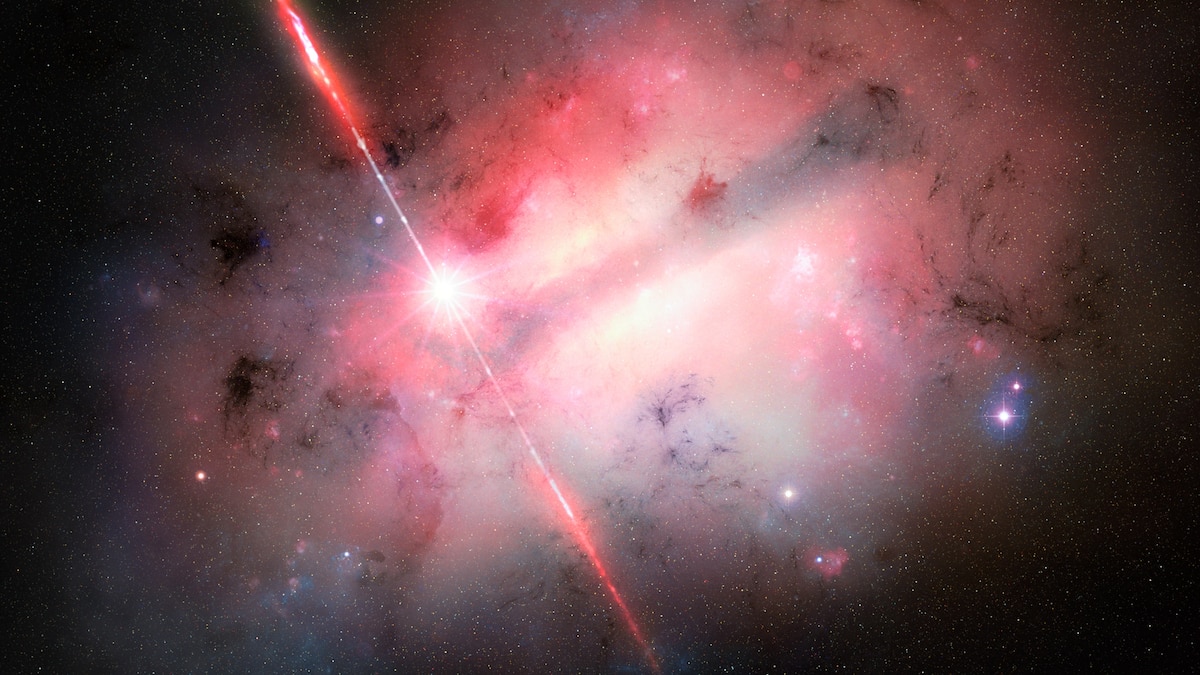
Scientists tracking this saga agree that the destruction of the star must have created a jet of particles shooting out of the crime scene at nearly the speed of light, which generated the gamma rays. The big mystery, says Levan, becomes: “What is it that makes that jet happen in the first place? What’s sitting in the middle there and actually powering that jet?”