
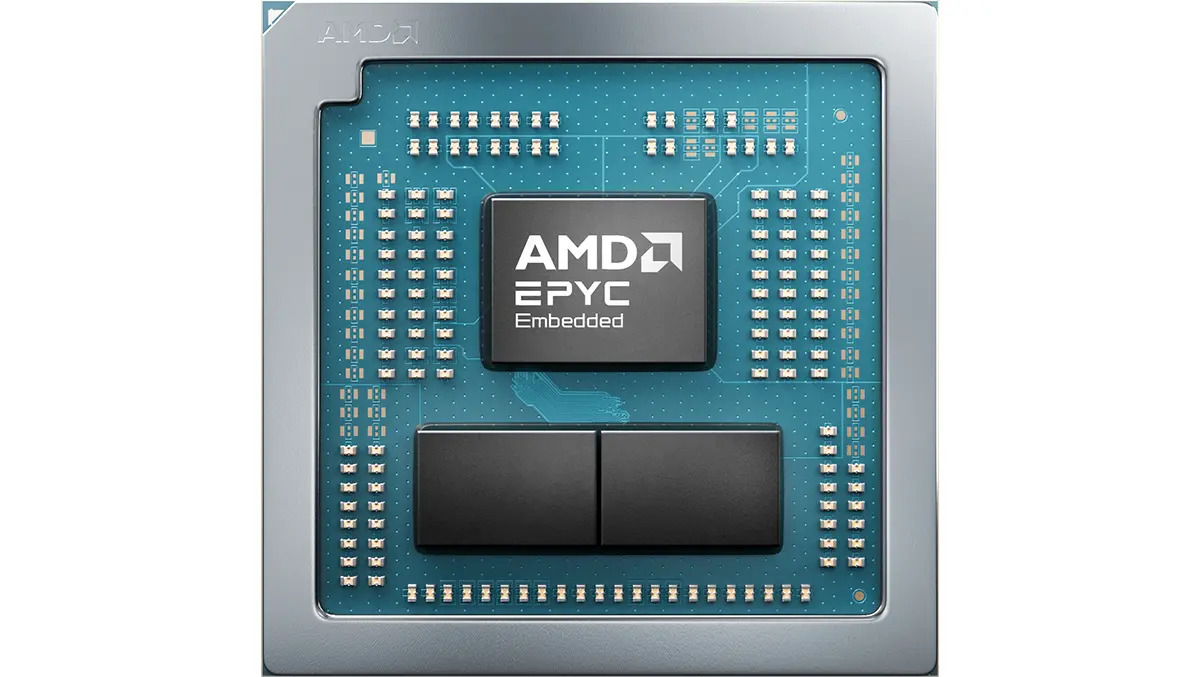
AMD has launched a new family of embedded processors that targets compact, power-constrained networking, storage and industrial systems.
The EPYC Embedded 2005 Series is based on the company’s Zen 5 core architecture. It is built in a 40mm by 40mm ball grid array package that AMD positions for AI-driven and always-on infrastructure.
The chips offer up to 16 x86 cores and 64MB of shared L3 cache. They support configurable thermal design power settings between 45W and 75W.
AMD is positioning the series for use in switches, routers and data processing unit control planes. It is also targeting cold cloud storage, aerospace and robotics equipment.
The company said system designers can deploy the processors in space, thermal and power constrained environments. It is focusing on applications where density and efficiency matter more than raw peak performance.
Smaller package
The new processors use a compact BGA package that AMD says can reduce system footprint. The company said the 40mm square package is 2.4 times smaller in area than comparable Intel Xeon 6500P-B parts.
AMD said the package supports a high density of input-output connections. The shorter electrical paths are designed to improve signal integrity. The form factor also supports tighter thermal management solutions.
The EPYC Embedded 2005 Series supports PCIe Gen5 connectivity. It provides 28 PCIe lanes. Engineers can group up to 16 of those lanes for high-speed network interface cards, FPGAs or networking ASICs.
The processors also support DDR5 memory. AMD said this offers higher bandwidth than DDR4 and a migration route as earlier memory standards phase out.
Performance-per-watt focus
AMD is highlighting performance-per-watt and performance density as core attributes. It said the EPYC Embedded 2005 Series provides up to a 28 percent higher boost CPU frequency and 35 percent higher base CPU frequency than the Intel Xeon 6503P-B, at half the thermal design power.
The range of 45W to 75W TDP is intended for fan-constrained or passively cooled designs. It also targets edge deployments where power budgets are limited.
The Zen 5 architecture underpins the series. AMD said it has optimised the cores for energy efficiency as well as throughput. It expects customers to place multiple processors in dense edge and industrial systems.
24/7 operation
AMD designed the EPYC Embedded 2005 Series for continuous operation. The company said the chips support 24/7 workloads and up to 10 years of field use.
It plans up to 10 years of component ordering and technical support. It also expects to provide up to 15 years of software maintenance.
These timelines target sectors such as telecoms, transport, aerospace and industrial automation. Those sectors often run equipment over long lifecycles and rely on extended availability of replacement parts.
The processors support advanced Reliability, Availability and Serviceability features. These features detect, prevent and correct errors during operation. AMD said this approach reduces unplanned downtime and extends system life.
Application-specific elements include Baseboard Management Controller support, PCIe Hot Plug and multi-SPI ROM. These are aimed at remote management and flexible I/O in networking and storage designs.
Security and software
The EPYC Embedded 2005 Series adds hardware-based security features under the AMD Infinity Guard umbrella. These include AMD Secure Processor, AMD Platform Secure Boot and AMD Memory Guard.
These functions support secure boot and memory encryption in embedded deployments. The goal is protection of data integrity and system state in networked and industrial environments.
AMD is pairing the hardware with an open-source software stack. It cited upstream support for the Yocto Project, kernel drivers and the EDK II firmware development environment.
These tools target developers building custom boards and embedded operating systems. The company said they assist integration and shorten design cycles for original equipment manufacturers.
Embedded market push
Embedded and edge systems are under pressure from AI-related workloads and increasing data volumes. These trends are changing expectations for compute density and responsiveness at the network edge.
AMD said the EPYC Embedded 2005 Series addresses these requirements in networking, storage and industrial markets. It is aiming at designs where system builders weigh each watt of power and each millimetre of board space.
The company expects demand from AI-enabled switches, routers and industrial controllers. It also sees an opportunity in cold data storage and robotics platforms.
“As constrained networking, storage and industrial workloads continue to evolve, the AMD EPYC Embedded 2005 processor with powerful Zen 5 cores, scalable I/O, and robust security and longevity, delivers the performance, power efficiency, and long-term reliability required for next generation, AI-driven, connected systems,” said AMD.