
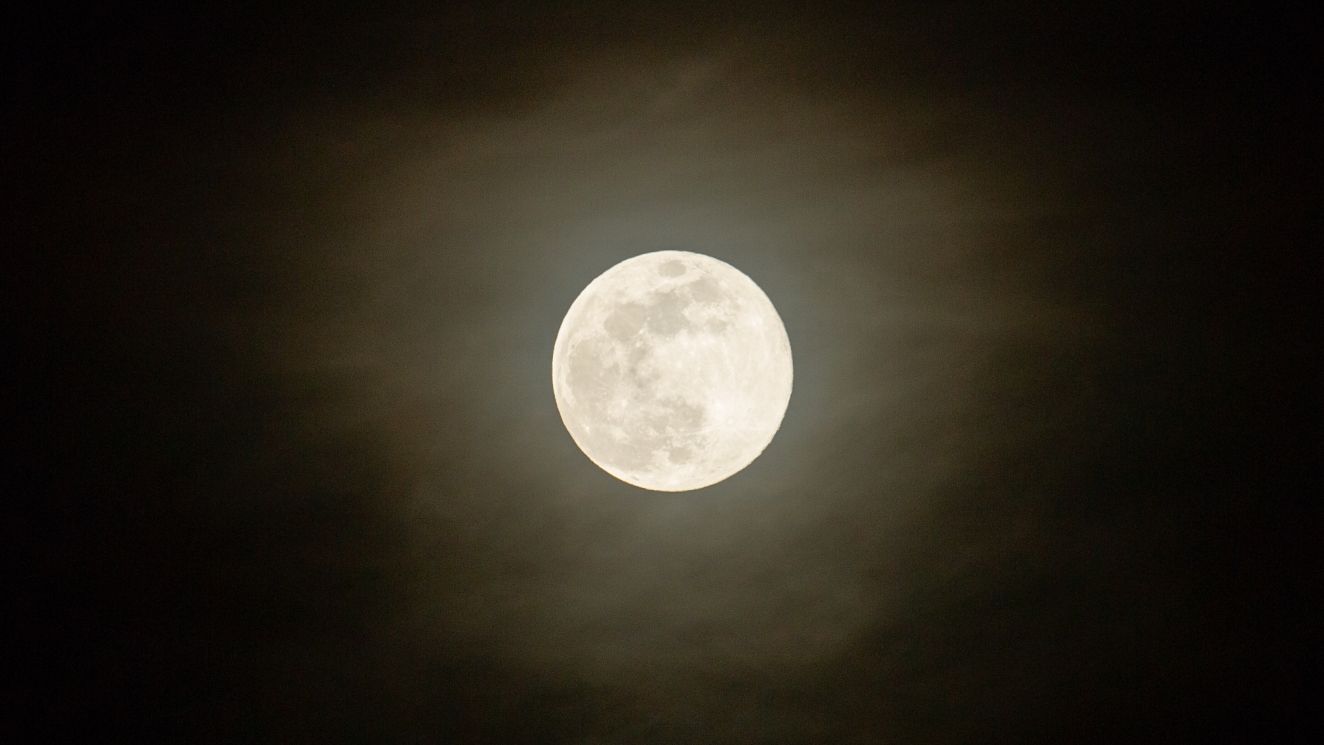
The January full moon will occur at 5:03 a.m. EST (1003 GMT) on Jan. 3, when the moon sits opposite the sun and appears completely illuminated from our perspective.
This month’s full moon will reach its full phase while close to perigee — the nearest point to Earth in its 27-day orbit —giving rise to a visually spectacular “supermoon“, which can be 30% brighter and 14% larger than the smallest full moon of the year, according to NASA.
You may like
When to see the January full moon
Look east at sunset on Jan. 3 to see the fully-lit lunar disk climb over the eastern horizon. It will likely take on a yellowish hue in the period following moonrise, as a phenomenon called Rayleigh scattering deflects bluer wavelengths of light while allowing redder wavelengths to pass through unhindered.
Full moon timings for when the moon is 100% illuminated (note local moonrise and moonset times will vary depending on your location):
Swipe to scroll horizontally
New York
5:03 a.m. EST
London
10:03 a.m. GMT
Tokyo
7:03 p.m. JST
Beijing
6:03 p.m. CST
Sydney
9:03 p.m. AEDT
Why it’s called the Wolf Moon
January’s full moon is called the “Wolf Moon” a name that invokes the hungry predators who vie for food in the scarce winter months and as the “Quiet Moon”, according to TimeandDate.com. It was also named it the “Center Moon” by Canada’s indigenous Assiniboine people owing to how the date of its rising comes close to the middle of the winter season and as the “Severe Moon”, to reflect the austere nature of the bitter month, according to the Old Farmer’s Almanac.
Cultural traditions and festivals
The January full moon coincides with the Sri Lankan festival of Duruthu Poya Day — a Buddhist celebration that marks Buddha’s first visit to the country and the establishment of the first Buddhist temple therein.

Buddhist devotees photographed praying during Duruthu Poya Festival in Sri Lanka. (Image credit: Photo by Thilina Kaluthotage/NurPhoto via Getty Images)What else to see in the sky around the full moon
On the night of Jan. 3, the moon will rise in the eastern sky among the stars of the constellation Gemini, with the gas giant Jupiter shining less than four degrees to its lower right, according to in-the-sky.org. For context, the width of the tip of your little finger accounts for one degree when held at arm’s length against the night sky.
Look above the southeastern horizon to find the stars of the constellation Orion twinkling with the sideways ‘V’ formation of the Hyades open star cluster forming the face of the great bull in the constellation Taurus above, as the Pleiades glows nearby.
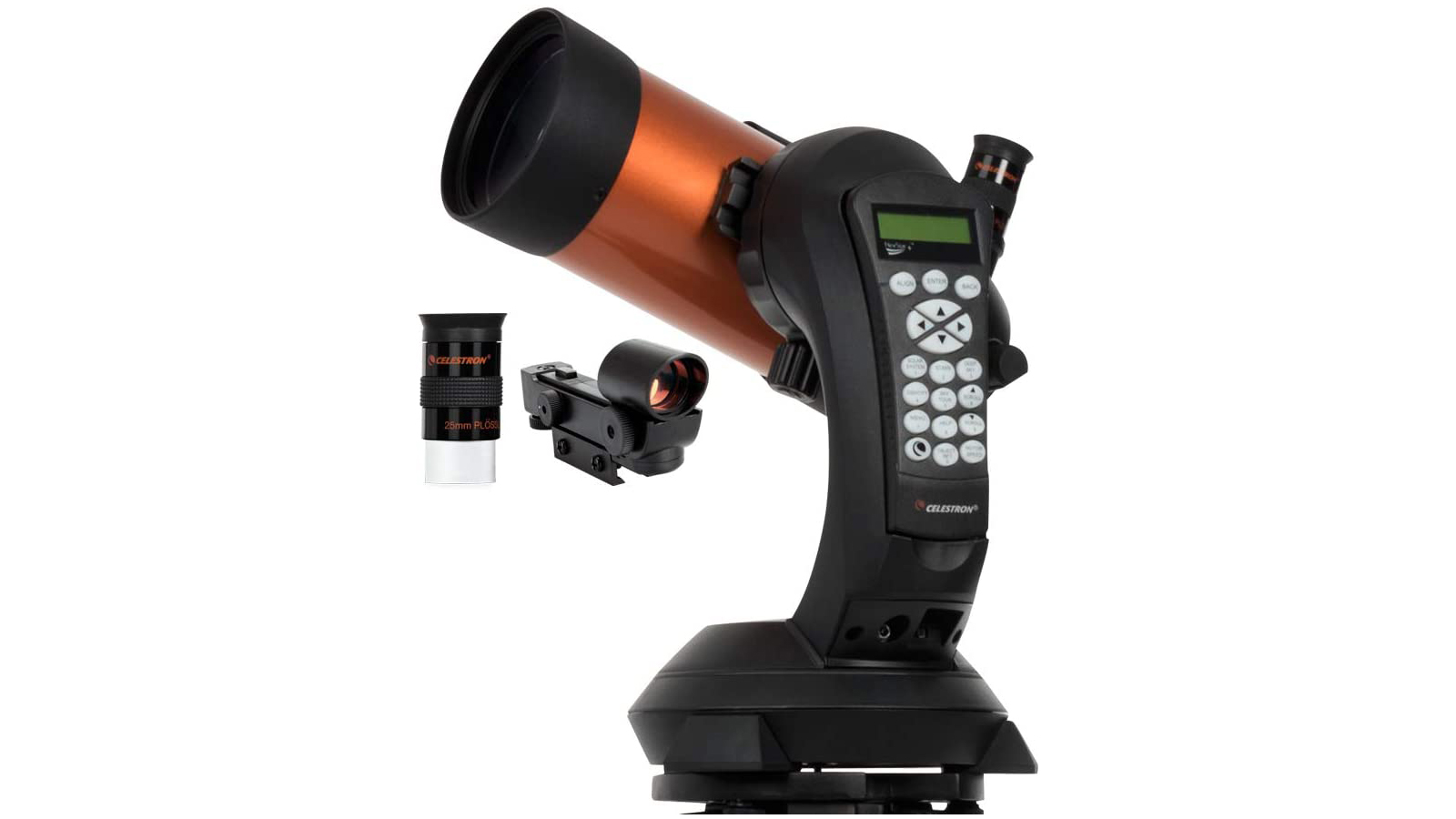
Celestron NexStar 4SE
(Image credit: Amazon)
Want to see the full moon up close? The Celestron NexStar 4SE is ideal for beginners wanting quality views of Earth’s natural satellite. It’s quick to set up and automatically locates night sky targets and provides crisp, clear views. Check out our Celestron NexStar 4SE review for more!
Saturn, meanwhile, will shine close to the circlet of stars that represents the “Great Western Fish” in the constellation Pisces in the southwestern sky in the hours following sunset. The diamond formation of stars that makes up the famous “Square of Pegasus” asterism can also be found glowing to its upper right on the night of Jan. 3, which will slip below the horizon around midnight local time.
You may like
Look out for shooting stars belonging to the Quadrantid meteor shower on the night preceding the full moon on Jan. 2-3, when the annual shower hits its peak. Up to 25 shooting stars could be visible streaking through the night sky from the constellation Bootes under ideal dark sky conditions, according to the American Meteor Society. However, you shouldn’t expect to see that many in 2026, when the light of the near full moon will conspire to hide dimmer members of the shower.
Observing tips
The entirety of the Earth-facing lunar surface is laid bare during the monthly full moon phase, making it an excellent time to photograph the dark expanses of lunar seas and to reveal the locations of bright impact sites and ejecta rays marking the ancient natural satellite.
You can use a DSLR camera with a telephoto lens, or even a modern smartphone camera — particularly one with a bespoke astronomy function — to capture gorgeous images of the full moon. The following tips will help, but for best results, you should read our expert guide to imaging the moon, along with our roundups of the best cameras and lenses for astrophotography if you want to upgrade your equipment.
Top tips to photograph the moonUse a tripod to keep your camera as steady as possible.Use a remote shutter/timer to prevent camera wobble.A smartphone stargazing app can help you find the exact point of moonrise on your local horizon.A lens with a focal length of 12-50 mm is useful for landscape photography, while a focal length of at least 400 mm is advised for capturing more detailed views of the lunar surface.The moon can be made to appear particularly large while close to the horizon next to foreground objects, where it may take on an orange-yellow appearance thanks to Rayleigh scattering. A cleaner, more “classic” view can be captured as it soars high overhead.
Full moons are spectacular events that bring out the very best in the astrophotography community. However, the weeks surrounding them can provide spectacular views of their own, as the line separating night from day, known as the terminator, sweeps across its surface, throwing ancient craters, ravines and mountain ranges into relief.
Why not try and capture an image of the moon during each major phase (excluding the new moon phase) to see how its appearance shifts over its 27-day orbit.
Swipe to scroll horizontallyUpcoming full moons
Month
Full moon name
Date and time
February
Snow Moon
Feb. 1, 5:09 p.m. EST (2209 GMT)
March
Worm Moon
March 3, 6:38 a.m. EST (1138 GMT)
April
Pink Moon
April 1, 11:12 p.m. EDT (0312 GMT April 2)
These times mark the exact instant of full illumination. Your own moonrise or moonset may be hours earlier or later, depending on your location. For the best viewing plan, use an app such as Stellarium or SkySafari 7 Pro to find your local moonrise time.
Editor’s Note: Did you capture a beautiful picture of the moon and want to share it with Space.com’s readers? Then please send your photo(s), comments, and your name and location to spacephotos@space.com.