
 Credit: CNES
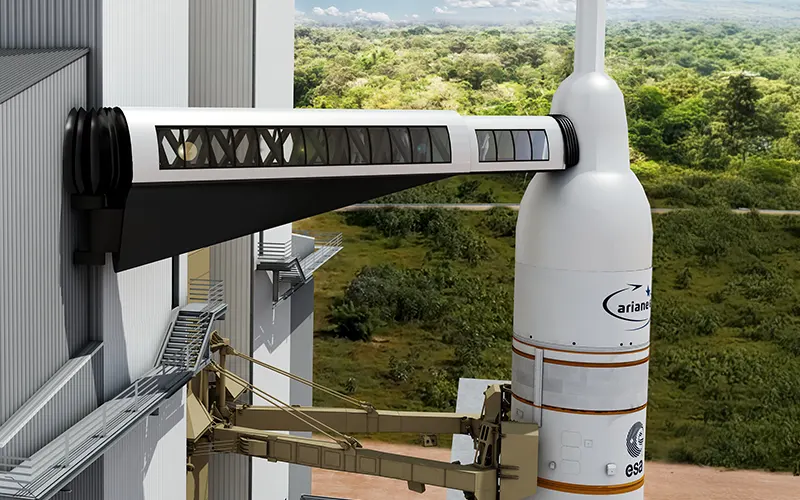
The European Space Agency has published a call for tenders to develop a launch abort system for a future crewed launch capability. The system would be used in the event of an emergency, either on the launch pad or during the initial stages of flight.
Published on 28 November, the day after the conclusion of the ESA Ministerial Council meeting (CM25), the Launch Abort Demonstrator call is described as a “first step towards derisking a Launch Abort System for a crew vehicle.” The call briefly describes the activities to be performed, including system modelling of the entire launch abort sequence, with a focus on pad abort cases, and the definition of a path to a flight demonstration.
While the call does not provide much detail, material shared by Stefaan De May, the Strategy Team Leader for the agency’s Human and Robotic Exploration programme, before the start of CM25 provided additional information, explaining that the programme is part of the agency’s post-ISS low Earth orbit strategy. This strategy, he explained, includes the development of an end-to-end European crewed flight solution.
The Launch Abort Demonstrator call will be run through the agency’s EXPRO+ system, a simplified tendering process for low- to medium-value procurements that allows ESA to limit participation to pre-selected suppliers.
In addition to developing a crewed launch capability, the agency’s post-ISS strategy includes options for low Earth orbit infrastructure. In material shared with delegations of member states in preparation for CM25, three potential options for post-ISS infrastructure projects were presented.
The first is to make no investment at all. The second is to leverage one of the many commercial low Earth destinations currently under development, preferably one with a European component, such as Starlab, a joint venture between Airbus and Voyager Space. This second option is considered the agency’s baseline. The final option, likely a backup should the commercial options fail to materialise, is a European-led project to develop a low Earth orbit outpost with contributions from international partners.
A month prior to CM25, the director of ESA’s Human and Robotic Exploration programme, Daniel Neuenschwander, explained that ESA could not be “bystanders to this emerging new space ecosystem” and that the agency was preparing to present “an ambitious and renewed programme.” He explained that this renewed programme would offer “new solutions in Low Earth Orbit to both safeguard the continuity of our activities while securing our role on the longer-term.” However, given the results of CM25, the directorate’s ambition will likely need to be curtailed somewhat.
The initial proposal to Member States for the Human and Robotic Exploration programme included spending totalling over €3.7 billion. However, once all contributions were totalled following the conclusion of the Ministerial, €2.975 billion had been committed, a shortfall of roughly €797 million. While this will certainly mean that some initiatives will need to be revised at best, Neuenschwander confirmed that ExoMars did receive all necessary funding, as did the agency’s LEO Cargo Return Service and Argonaut lunar lander projects.
Keep European Spaceflight Independent
Your donation will help European Spaceflight to continue digging into the stories others miss. Every euro keeps our reporting alive.