
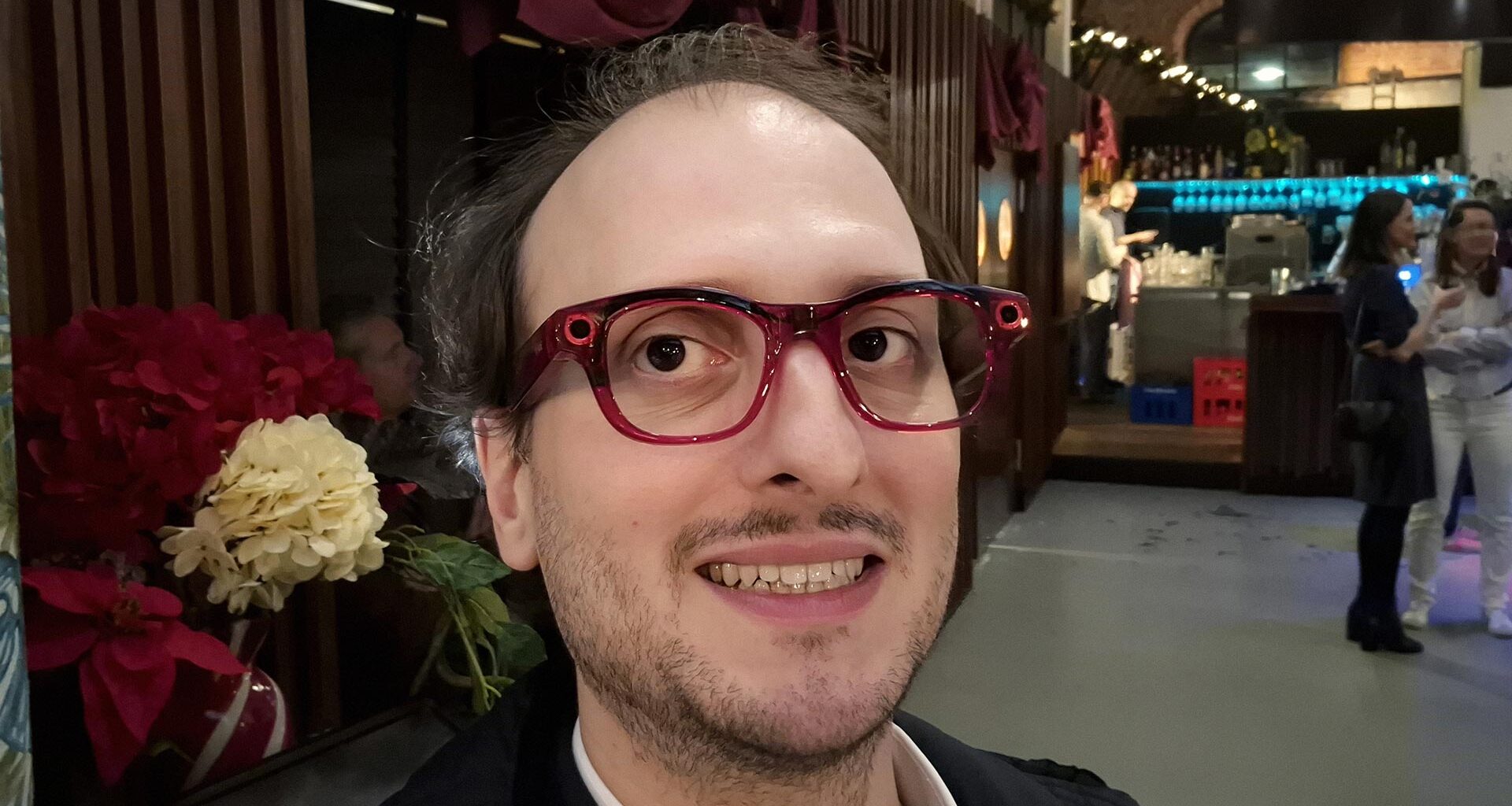
Yesterday was the first day of United XR Europe. The Expo was not open (it opens on the second day), but being the pirate I am, I was still able to try a couple of experiences…
VIVE Eagle Smartglasses
Trailer of the Vive Eagle glasses
HTC VIVE does not have a booth at United XR Europe, but a Vive employee is going around with the glasses on, letting people try them. A guy strongly suggested to me to try this device, so I went to the VIVE afterparty, ate a lot of free food (which is the most important thing), and then, as soon as I saw a guy from HTC, I jumped on him, asking him if he was “the glasses guy”. He was not, but he took me to the right glasses guy, who was kind enough to let me try the glasses. The test was very brief and happened during a party, so what I’m going to write doesn’t count as a review and not even as a first impression… it is like “very early impressions”.
Anyway, the glasses I’ve tried came in two colors: a pair was red with transparent lenses, and the other was black with lenses that could get obscured. These are some pictures I’ve taken of the latter.
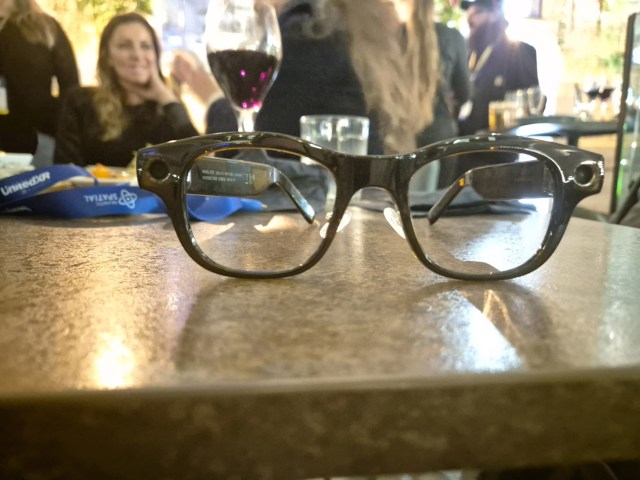
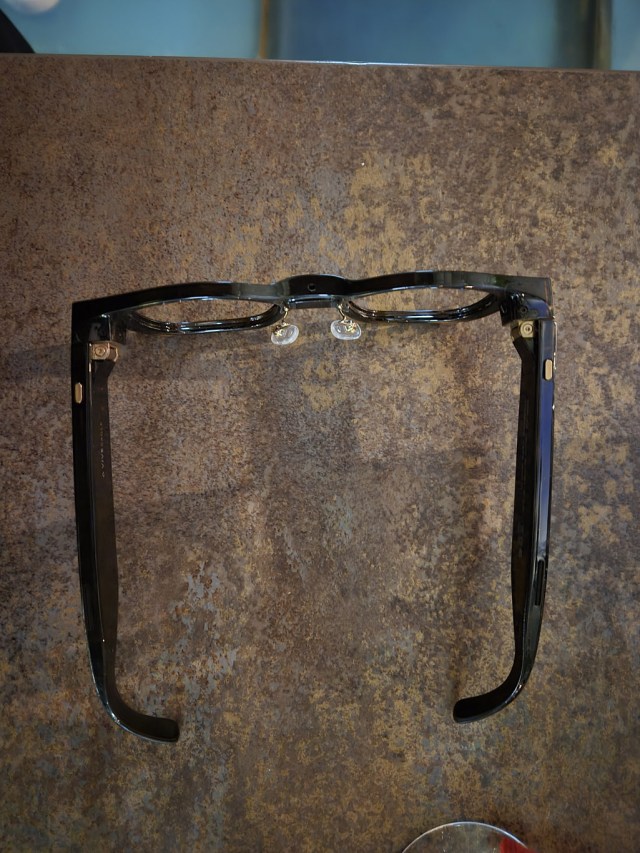
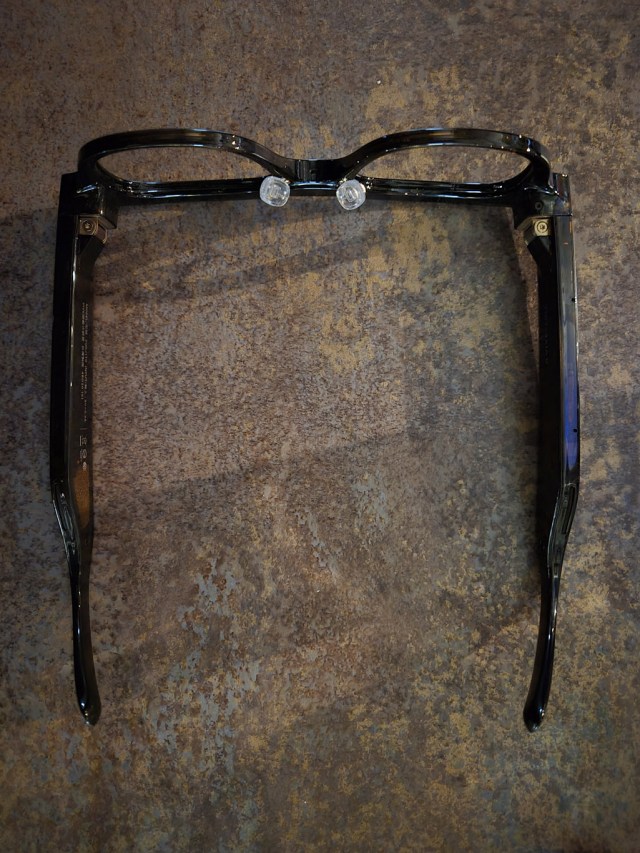
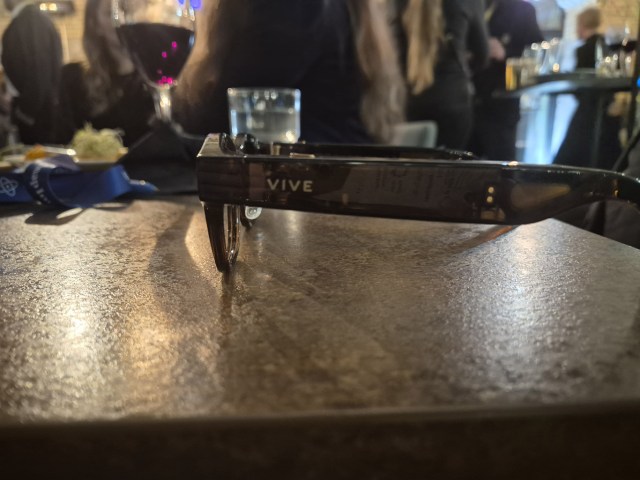
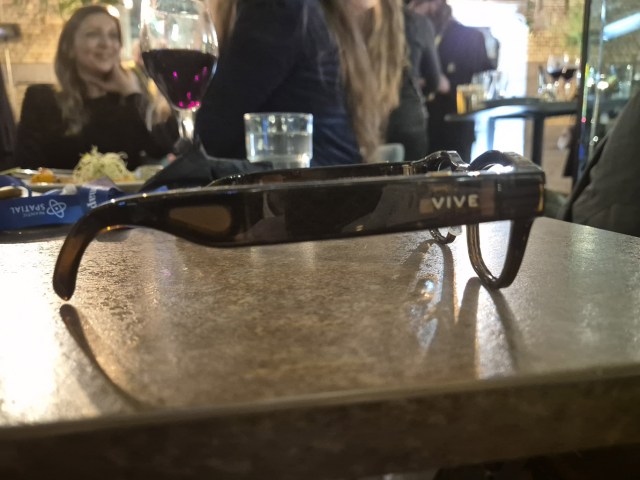
And this is a picture of me, my buddy Christian Steiner, and HTC’s Thomas Dexmier, from which you can see how they fit the faces of people.
 Looking cool with the Vive Eagle smartglasses
The glasses have a nice design, but it is not an elaborate one: so I look pretty good in the pictures, but I don’t seem like someone fashionable. I still prefer Ray-Ban’s design. What Vive did well was try to propose glasses with bold colors: Vive Eagles could be red or blue. I guess it is the only smartglasses brand doing that now, so we need to owe them they are trying something different. Bold colors only suit bold people, though: I don’t think everyone wants to go on the street with straight red glasses on their face, so it’s good they also have more traditional options like the black ones.
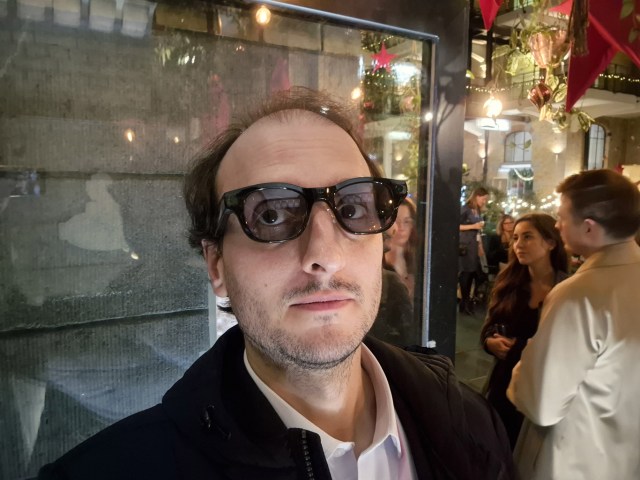 Still looking good with the black glasses
The glasses really look like regular glasses, and the only thing that makes them a bit different is that the temples of the frames are bulkier than usual. Wearing them, they felt lightweight and comfortable, even if they were a bit too heavy on my nose because this was the model currently sold in Taiwan and the surrounding areas. Chinese units are never comfortable for us Westerners, so for sure, HTC will slightly modify the fit of the device when selling it here in Europe. I would need more time to evaluate the exact comfort, but let’s say that for now it seemed pretty good… even if, as a non-glasses wearer, my face was constantly perceiving there was something new on my face.
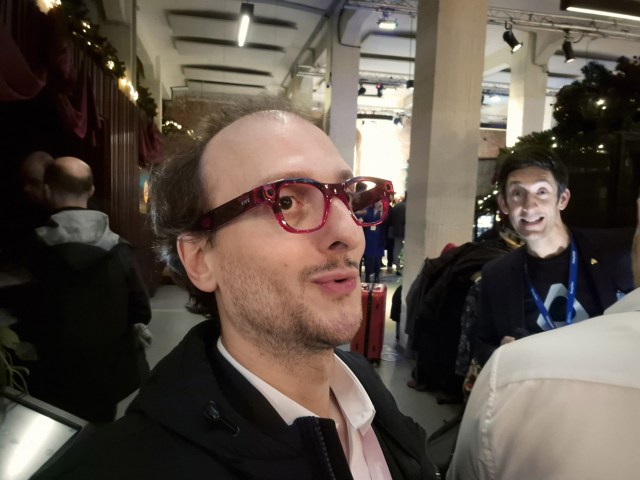 Looking like a creative guy with the red model
Regarding the functionalities, these glasses have a camera and some integrated speakers. The HTC representative used his phone (with a companion app) to play some music on the device. Notwithstanding the messy and noisy space of the party, I could still clearly hear the song. This means the speakers are good.
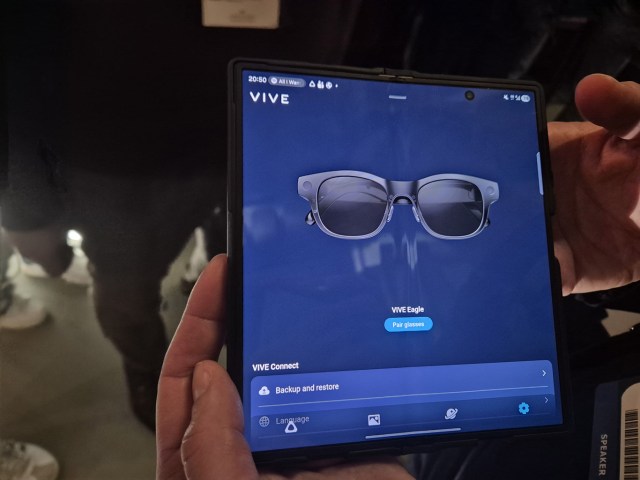 The glasses companion app running on the (big) phone
HTC stressed the fact that these glasses can be configured to use whatever AI model the user wants (e.g., Gemini vs ChatGPT), and enterprise customers may even choose to use an LLM that is installed on the private servers of the company. This is a very interesting feature for companies, and confirms HTC’s expertise in handling B2B customers.
I came out with a good impression from this quick test on the glasses. But the problem is that their price is NT$15,600, which is more than $500. These glasses have more or less the same features as Ray-Ban Meta and cost almost twice as much. Unless HTC offers a more competitive price in the West, it’s hard for it to compete…
Zoo Of The Future
The Zoo Of The Future is a location-based VR experience that is available within 5 minutes on foot from the UnitedXR Europe venue. The concept is pretty interesting: instead of taking the animals from their natural habitat and keeping them “prisoners” in a zoo to let people see them, people could visit them in their natural environment in virtual reality.
When you arrive at the Zoo Of The Future, after a brief registration, you are given headphones speaking the language you choose. Then you enter a closed room where there is projection mapping on the four walls. A video starts and basically introduces you to the experience, telling you why it has been created, while showing you different animals in their habitat. This video experience is already nice because it feels a tiny bit like a CAVE experience, where you are immersed in a place not via a VR headset, but via projections on the walls. This part ends with the narrating voice telling you that you can experience the animals via virtual reality. Remember that this is an experience for ordinary people, so it is important to explain things and let them slowly get used to virtuality (first with projections and then with a headset).
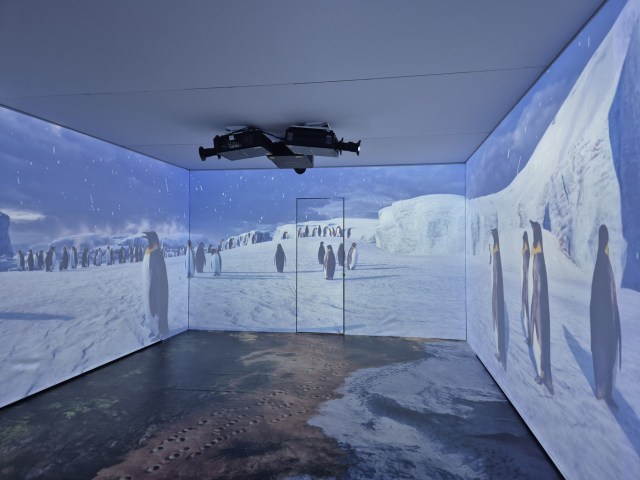 As you can see, the video projections are pretty well made
After this introductory room, people can enter the real “zoo”. The zoo is a physical space that is divided into zones, where every zone represents a different habitat, like Antarctica, the forest, or the savannah. Zones show different physical settings: for instance, Antarctica shows images of snow, and there is, for instance, a fake snow block there in the room. I’ve been told that every zone also has a slightly different smell, so that when you walk across the zone, your brain truly perceives you’re going into different environments.
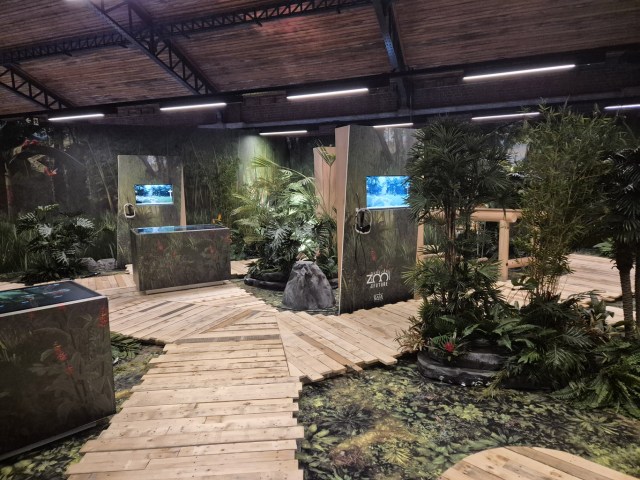 Welcome to the jungle
You can interact with these different areas both in AR and VR. The AR interaction is pretty simple and mostly studied for kids: you’re given a tablet, and you can frame the picture of an animal on the walls to make it appear in AR. For instance, you look at a panda, and the animated 3D model of a panda eating bamboo appears in front of you. You can then take a picture of it. It is pretty cute and I’ve been told many people are also taking selfies with the AR animals.
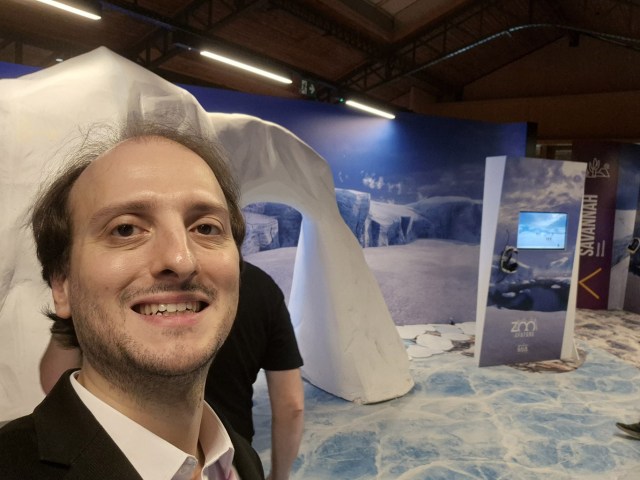 This is the section of the location dedicated to Antarctica
Regarding VR, there are different stations with a display and a headset (currently a Meta Quest). When you put on the headset, you see yourself in the virtual environment where the animals are. For instance, if you were in the physical savannah, you could see a family of giraffes walking towards the water. You can not interact with animals: you are just an observer of them in their natural habitat. The only thing you can do is teleport around to discover the various animals inhabiting that place. To move around and teleport, you just point at locations with your index finger (the experience uses hand tracking to avoid messing with controllers handled by the visitors). The teleporting with the straight out index finger is a bit uncomfortable in the long run, but it has been chosen because it is easy to understand and so ideal for the average user. Also, the fact that as soon as you put the headset on, you are immediately in the experience (no menus, no intros, etcc…) has been done for the sake of simplicity.
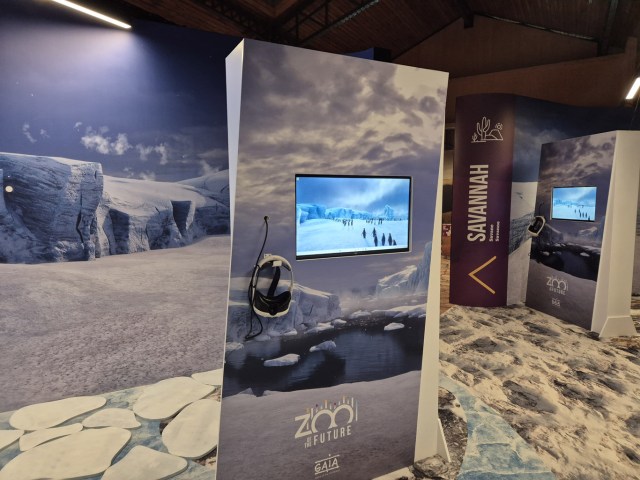 One of the stations with the VR headset and the screen doing the mirroring
The graphical quality of the experience is definitely good. It has been made with Unreal Engine, and the animals are modeled pretty well. When I saw the giraffes in front of me, they looked pretty realistic. The used headsets are Quest 3 connected via USB to a computer: using PCVR, you can have pretty good graphics, so the experience feels immersive.
Is this like going to the zoo? Well, not for now, but I see the potential. The graphics are immersive but are not perfectly photorealistic; these are not some Gaussian splats recordings. The experience could compensate with something else, like letting you interact with the animals, or creating some missions you have to accomplish in the places you go, or fostering multiplayer interactions. The good thing about virtual reality is that you can do more than you can do in reality, and the Zoo Of The Future should exploit this more.
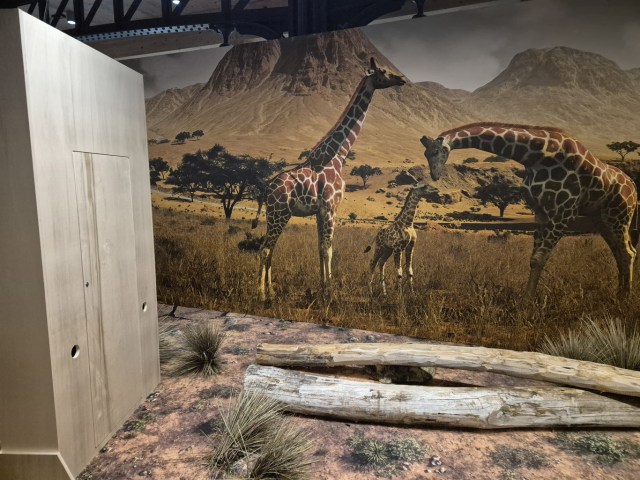 Giraffes were pretty nice to experience
The concept is for sure interesting, and with the continuous advancements of virtual reality, it could in the future really feel like being with the animals in their habitats, making the zoos mostly obsolete. And the Zoo Of The Future is a good present representation of that: I think the team working on it did a great job both with the physical space, and the easy-to-use AR and VR experiences. If you are around UnitedXR Europe, I suggest you visit it: during the event, there is a heavy discount, and it is just 5€ per person. You can find more information here: https://zooofthefuture.be/
A Panel on the main stage
Today I also had my panel together with Gabriele Romagnoli, Casandra Vuong, and David Heaney, moderated by Peter Siekerman.
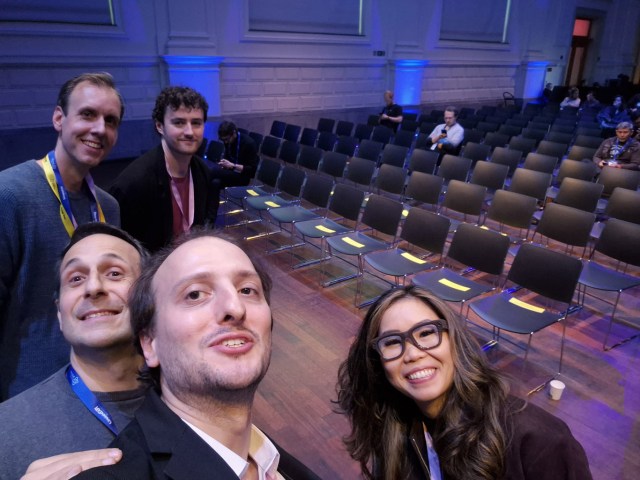 A random selfie I shot before we got on stage
It was nice having a chat with these smart people on stage. And for me, it also also an important achievement because it was the first time on the main stage of an event of the AWE family. I’ve always spoken in secondary rooms, so it felt a bit special to me, and that’s why I took a selfie from the stage after we finished our talk! Probably it is not going to happen again… but who cares, I managed to have at least my moment of glory!
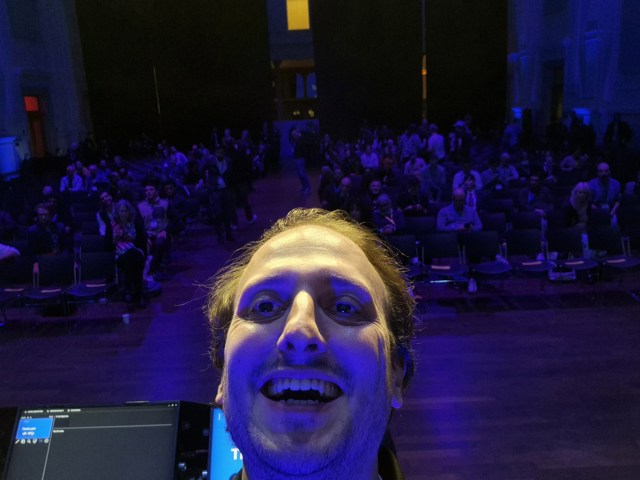 MAAAAAAIN STAAAAAGE!
Ah, and Ori Inbar made me scream during his keynote, but that’s another story for another day…
Disclaimer: this blog contains advertisement and affiliate links to sustain itself. If you click on an affiliate link, I’ll be very happy because I’ll earn a small commission on your purchase. You can find my boring full disclosure here.
Share this with other innovators
Related