
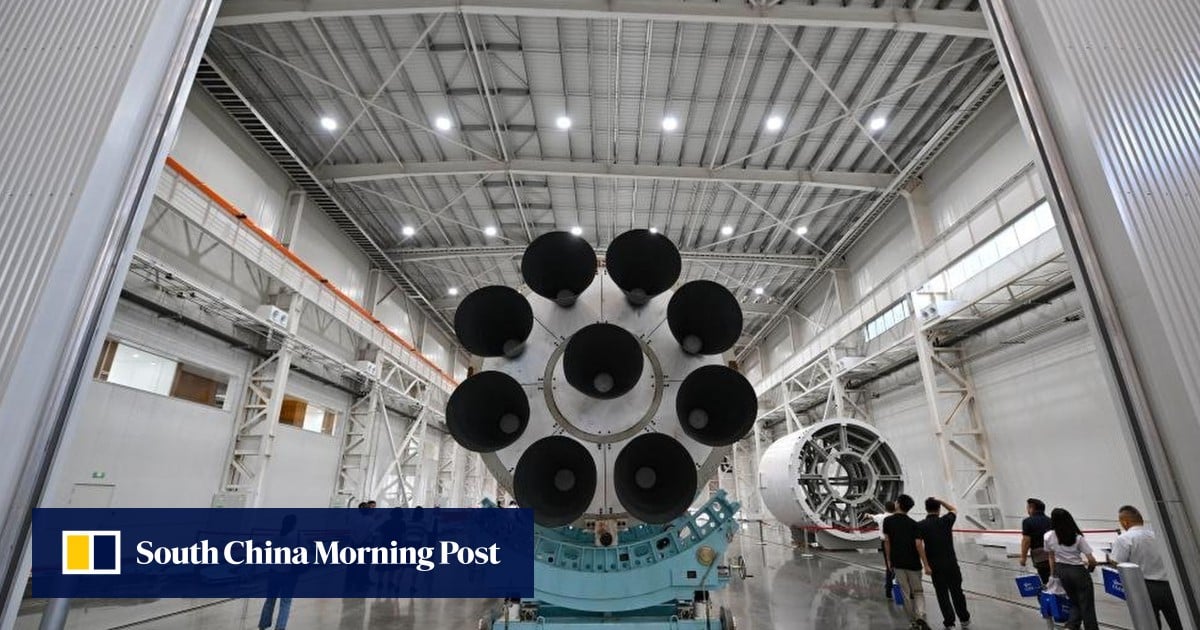
China is about to switch on a satellite “super factory” able to produce 1,000 units annually – a major step in Beijing’s race to build low Earth orbit constellations as part of its ambition to one day rival Elon Musk’s Starlink.
The facility, located inside the Wenchang spaceport in China’s southernmost Hainan province, integrates a “factory-to-launch” pipeline that assembles, tests and pairs satellites with rockets. This makes it the only base of its kind in the country and Asia’s largest satellite manufacturing hub, according to state-run news agency Xinhua.
The new factory comes amid a boom in China’s commercial space sector. Backed by supportive policies, a surge in private rocket launches and even early visions of space tourism, Beijing is accelerating its efforts to compete with the US.
The facility’s main advantage lies in the speed of its pipeline, which could significantly reduce costs, Xinhua reported. Satellites could move from final assembly to launch pads in a matter of hours instead of days, thanks to its proximity to the Wenchang and Hainan commercial launch sites, both just a few kilometres away.
China has already seen a record number of space launches in 2025, with the tally reaching 80 by December 6 according to the Space Stats Online database. By comparison, Musk’s private aerospace firm SpaceX had completed 146 missions by early November, breaking its own annual record.
The country’s previous record was set in 2024, with 68 rocket launches – 12 managed by private companies – sending 201 commercial satellites into orbit, according to the China National Space Administration and the China Centre for Information Industry Development.
SpaceX, meanwhile, launched 134 rockets last year, deploying more than 2,300 Starlink satellites – underscoring the stark contrast in scale and pace between the two space powers.