

Broadcaster Park Na-rae. Sports Kyunghyang DB
As allegations have surfaced that TV personality Park Na-rae (40) received IV drips and medication prescriptions from so-called ‘injection aunties’, attention is also turning to the realities of ‘illegal medical practices’. In fact, on online communities and secondhand trading platforms, it has been confirmed that various prescription-only injectables and vaccines, and even narcotic analgesics and psychotropic medicines, are being traded. There are calls for the authorities to urgently strengthen crackdowns and management systems.
“We are sensitive because of Park Na-rae, but it is fine as long as no one exposes it”
On the 11th, seller A, whom this reporter contacted through an online community for nurses and nursing assistants, introduced himself as “a former pharmaceutical company employee and currently a clinic sales/wholesale dealer.” He said, “We are on edge because of the Park Na-rae (case) right now, but unless someone exposes it, you personally will have no problem.” This indicates he is aware that such transactions are crimes.
When asked about the price of the ‘nutrition IV’ that Park was said to have received, A immediately quoted prices: “○○ injection 600㎎ 10 vials 44,000 won, ○○ injection 370,000 won, domestic XXX 330,000 won.” Another seller, B, who did not reveal identity, said, “If you buy a lot, I will include ○○○○○ powder and ○○ injections as a free service.” All are prescription-only medicines that cannot be administered without a physician consultation and prescription.
Vaccines were also easy to obtain. When asked about the sale of a specific vaccine, A said, “One prefilled (a single-use syringe containing the drug) 220,000 won,” adding, “Because vaccines must be kept at 2~8 degrees, I put them in an ice pack and deliver them myself.”
Narcotic-class medicines were also not hard to get. When asked B about purchasing opioid analgesics, anti-inflammatory painkillers, and the like, he immediately provided prices. The ‘list of trade items’ that A sent included numerous psychotropic drugs as well as local anesthetics.
In nurse and nursing assistant communities, dozens of posts appear such as “Where can I get ○○·XX injections?” and “Does anyone know a place to buy ○○○○·XXX?” In the comments, ‘salesy’ replies like “Please send a private message” follow. There were also posts mentioning the internal distribution structure, such as “If you work at a hospital, you can obtain them cheaply through pharmaceutical company reps.”
“Processed under the hospital name, goods go to individuals”… ‘Paper-only fake transactions’ entangling hospitals, pharmaceutical companies, and wholesalers
Black-market trades in medicines appear to be widespread through a ‘book-only delivery’ structure entangling hospitals, pharmaceutical companies, and wholesalers. A said, “We trade with 60~70 hospitals, but if they use many non-reimbursable items, their remaining tax base does not match,” adding, “When a hospital asks us to ‘reduce the tax base a bit,’ we adjust it by processing it as delivered only on the books.”
He explained, “We issue the goods under the hospital name, send the physical items to individuals, and record only receipt (stock-in) for the hospital.” On the books it is processed as delivery to the hospital, but in reality nothing is delivered there and the goods go to individualsan ‘invoice-only fake delivery for tax cleanup’ that has become routine.
Within this structure, some hospital staff such as nurses and nursing assistants act as ‘injection aunties’ and ‘IV aunties’, taking margins. Because the gap between drug cost and the price charged at hospitals is large, demand is considerable. B said, “An ampule of ○○ injection costs 4,400 won each, and normal saline is about 2,200 won per 100㎖, so if you mix one ampule into saline and hook it up, the cost is under 10,000 won,” adding, “Hospitals charge 30,000~50,000 won per session, so it is a profitable business.” A also said, “One nurse who bought (injectables) from me went to the countryside for the holidays, administered them widely even to cousins, and earned 2 million won as pocket money.”
A said he personally trades with “more than 100” people in the medical field, adding, “Even nurses at university and general hospitals buy 600,000~700,000 won worth at a time.” Such black-market deals “surge before holidays,” he said. A drug known as a weight-loss injection also “sells at least two a day.”
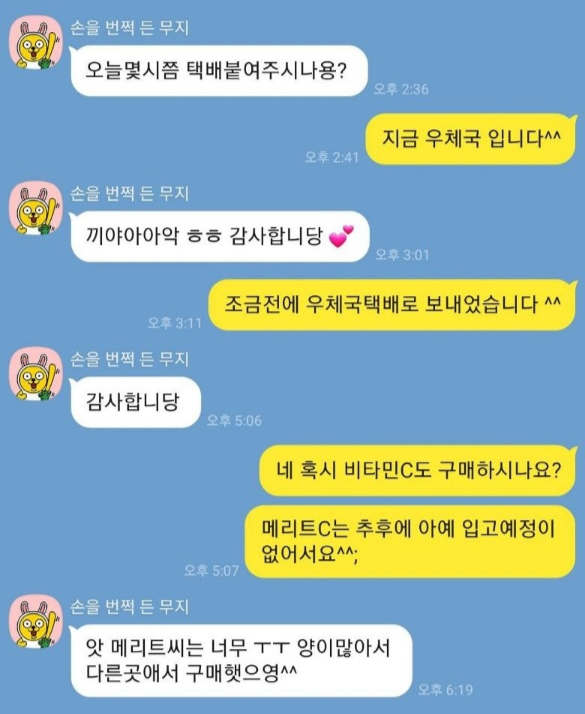
The ‘trade verification’ message history that seller B sent on the 11th.
On online communities, multiple indications of constant leakage of medicines from hospitals were also identified, such as posts stating, “5DW (5% dextrose IV solution) and NS (normal saline) are just given if you say you are practicing IV (intravenous) at home,” and “You can get flu vaccines at cost for each family member every year.”
“IV drips administered at golf gatherings”, ‘flu shots’ also traded on secondhand platforms
Some traders did more than simple distribution. A said he even connects nurses/assistants for ‘gig procedures’ to directly administer injections and IV drips. He said, “There are many seniors in a golf group; once a week we call in a nurse or assistant to put in IV drips,” adding, “We charge 20,000 won per person, about 15 people.” He continued, “You know assistant pay is low,” adding, “All they do is connect the IV, and we handle finding veins and removing needles.”
Illegal injection service deals were also detected on secondhand trading platforms. On the 5th of last month, as demand for flu vaccines jumped, a poster on the secondhand platform ‘Danggeun Market’ wrote, “I have prepared trivalent flu vaccines,” and “If you get it at a hospital it costs 30,000~40,000 won, but since I buy and administer it, just pay 15,000 won.” Th post added, “I put the vaccines in a cooler bag with ice packs and bring them safely, so do not worry.” On the 7th of last month, ahead of the college entrance exam, a post also appeared stating, “We administer IV drips for test-takers.”
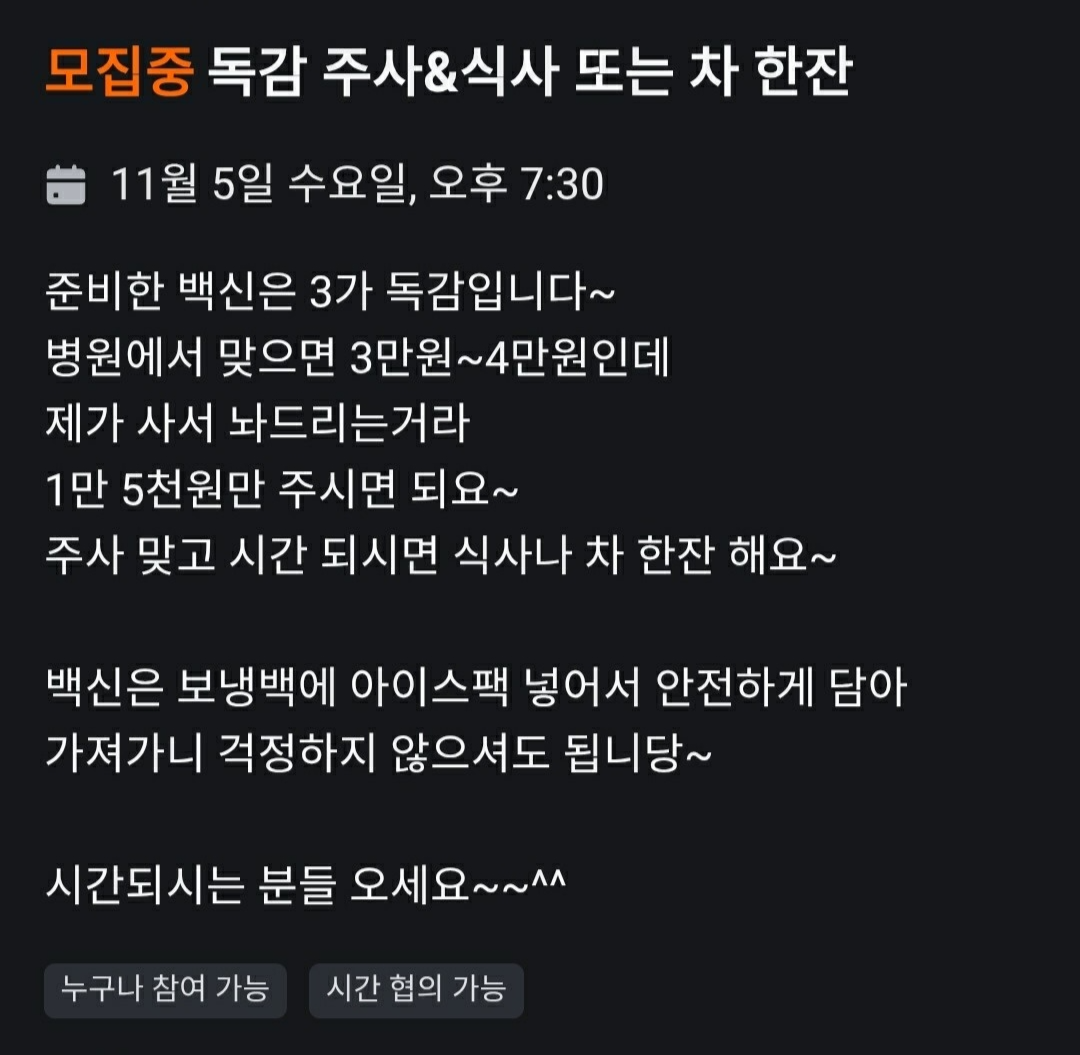
A post uploaded on the secondhand trading platform ‘Danggeun Market’ on the 5th of last month.
Patients can also be accomplices···“Regulations on the medicine management system must be strengthened”
Injection and procedure acts by non-medical personnel are crimes that violate Article 27 of the Medical Service Act (prohibition of unlicensed medical practice). Even for licensed medical personnel, performing procedures outside medical institutions is illegal.
The government is also closely watching the controversy over unlicensed medical practice. Regarding Park Na-rae, the Ministry of Health and Welfare said on the 8th, “Since this case has already been reported to or recognized by investigative authorities, we will monitor the progress of the investigation and consider an administrative investigation if necessary.” It added, “While those who committed the violations are the primary targets of punishment, patients who, despite recognizing the Medical Service Act violation, actively request and participate can also be punished as accomplices.”
Jung Hyeong-seon, a professor in the Department of Health Administration at Yonsei University, said, “The inventory and prescription management system for medicines has effectively collapsed,” adding, “It is necessary to strengthen regulation by mandating management of prescription programs and monitoring of drug inventories.”