
State and territory health ministers have failed to reach an agreement with their federal counterpart after launching another coordinated attack on the government over public hospital funding.
State health ministers unveiled a new report in the lead-up to the Friday meeting that showed more than 3,000 aged care patients were currently languishing in hospital beds across the country — a more than 25 per cent increase in just three months.
Those patients are medically fit for discharge but stuck in hospital while waiting for a federal government residential aged care bed.
“I’m beyond frustrated, I’m furious,” NSW Health Minister Ryan Park told the ABC.
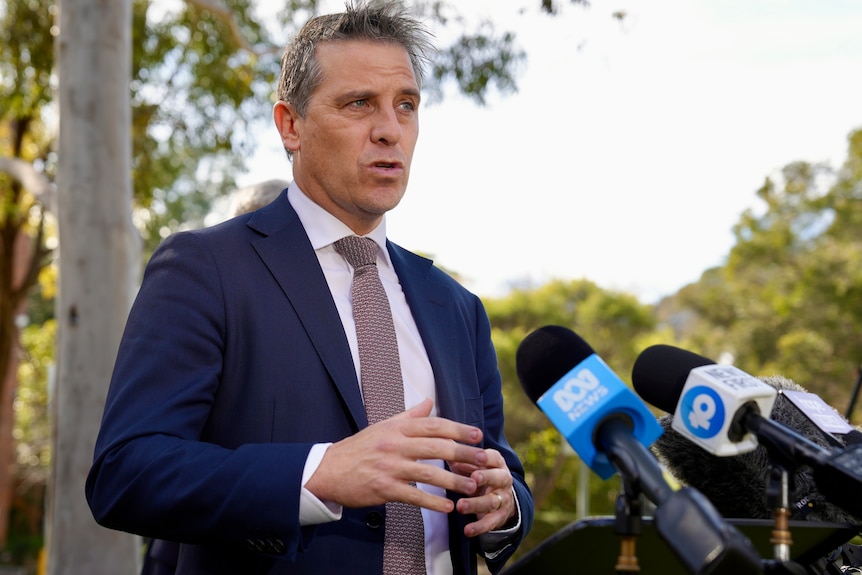
Ryan Park says he is incensed by the figures. (ABC News: Andrew Whitington )
“I’m deeply, deeply furious about what is happening because it is not fair on those patients.
“Hospitals are not places where, particularly older people or people with a disability, should be for weeks and months on end.
“It actually increases their chance of things like hospital-acquired infections. It increases their chance of things like falls and delirium.”
The report noted a significant shortfall in aged care beds, with about 800 delivered by the federal government last financial year, compared to an estimated annual demand of 10,600.
The states and territories suggested the cost to taxpayers was now $1.2 billion a year.
“It’s a national shame,” South Australian Health Minister Chris Picton said.
“These people are effectively homeless, stuck in a hospital bed for months and sometimes years with nowhere to go because they can’t get a federal government aged care bed.”
The states and territories have attacked the federal government again over public hospital funding. (ABC News: Keane Bourke)
Federal Health Minister Mark Butler said the bed shortfall was a “very serious issue”.
“I feel that very acutely as the cabinet minister responsible for aged care,” he said.
“We’re at an incredible inflection point … where the baby boomers are starting to turn 80 this year, which is really the age where they start to need aged care. I very much agree with state ministers, we need more aged care supply into the system.”
The Commonwealth has been embroiled in a funding stoush with the states and territories for months as it tries to secure a new five-year public hospital agreement while protecting a depleted budget bottom line.
The ABC on Thursday revealed Prime Minister Anthony Albanese sought to ease those tensions by adding an extra $1 billion over five years to an existing offer, prompting Queensland Health Minister Tim Nicholls to label the Commonwealth the Christmas “Grinch”.
States lash Commonwealth’s revised public hospital funding offer
Mr Albanese also offered $2 billion over four years to specifically deal with the issue of aged care patients stuck in public hospital beds.
However, the ministers failed to reach an agreement at Friday’s meeting with Mr Picton saying the current proposal put forward by the federal government won’t meet the needs of public hospital patients.
“We need to have an agreement which is going to make their needs in the context of an ageing population and a growing population where we have seen historically the federal government’s share of funding decrease,” he said.
Mr Butler said there was a range of pressures contributing to hospital bed block that did not just fall to the Commonwealth to solve.
“Right across the country — right across the world — given the aging of that post-war baby boom, our hospital systems are facing pressure … so we’re trying to work cooperatively with states to relieve pressure across a range of areas,” he said.
“Frankly, we’re having some challenges with planning approvals. There are a range of pressures, they’re not all the Commonwealth’s responsibility.”

The federal government is still holding out for a deal before the end of the year. (ABC)
Tasmanian Health Minister Bridget Archer said the offer on the table would have “very real consequences for our patients”.
“This is not an abstract issue between states and the Commonwealth,” she said.
“This is about everyday people and about their health, and about their access to health care in our states … and that’s why we are fighting so hard for the Commonwealth to uphold that deal.”
Aged care patients ‘big part’ of hospital pressures
The long-running dispute follows an agreement made by national cabinet in 2023, where the federal government promised it would increase its share of public hospital funding to 42.5 per cent by 2030, and 45 per cent by 2035.
In return, the states and territories vowed to help fund some disability services outside the rapidly growing National Disability Insurance Scheme.
Under the deal, an annual 6.5 per cent growth cap on the Commonwealth’s contribution would be replaced with a “more generous” approach.
The federal government is now offering a 8.5 per cent growth cap in 2026-27, after a one-off
catch-up year of 12.3 per cent, before dropping to 8 per cent for the remaining years of the agreement.
The Commonwealth has been fighting with the states and territories for months over hospital funding. (ABC News: Jayden O’Neill)
The ABC last month revealed Mr Albanese wrote to state and territory leaders in September asking them to rein in spending if they wanted the original deal honoured.
“The tone of the prime minister’s letter the last time round was pretty frustrating in suggesting that states and territories could constrain demand on the hospital system when it is older people who are ready for discharge, who have nowhere to go because of the challenges in aged care,” said ACT Health Minister Rachel Stephen-Smith.
“That is a big part of our increased pressure on the hospital system.”
Shadow Health Minister Anne Ruston said the federal government had “a lot to answer for its failures”.
“The government should stop making promises that it either can’t or won’t keep,” she said.
“They can’t go and make promises in 2023, make promises in the lead-up to the election, and then walk away from those promises after an election.
“That’s not the way a responsible, mature government conducts itself.”
The Australian Medical Association this week called for the federal government to invest an additional almost $35 billion into public hospitals over five years, saying it was the only way to address issues “plaguing” the system.