
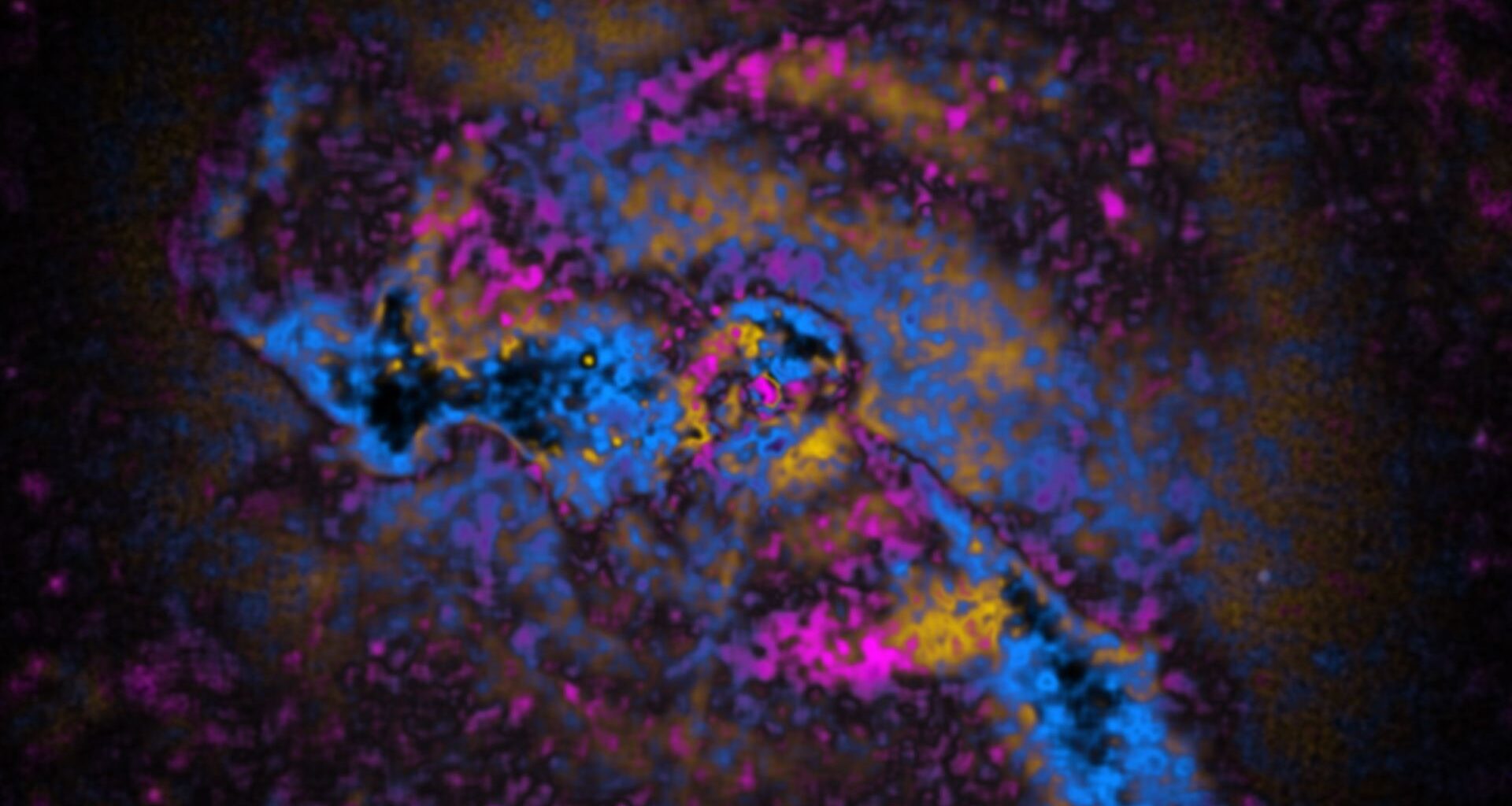
New images from NASA’s Chandra X-ray Observatory give galaxy clusters a bold new splash of color, highlighting the beauty of these cosmic giants.
Using a novel image-processing technique called “X‑arithmetic,” scientists were able to study the nature of different features in the hot gas of galaxy clusters, revealing the dramatic influence of supermassive black holes in vivid detail, according to a statement from NASA.
You may like

The galaxy clusters imaged by Chandra. (Image credit: X-ray: NASA/CXC/Univ. of Chicago/H. McCall; Image processing: NASA/CXC/SAO/N. Wolk)
“By splitting Chandra data into lower-energy and higher-energy X-rays and comparing the strengths of each structure in both, researchers can classify them into three distinct types, which they have colored differently,” NASA officials said in the statement.
The new set of images, released on Tuesday (Dec. 9), shows jet‑blown bubbles in yellow, cooling or slow-moving gas in blue and rippling sound waves or weak shock fronts in neon pink. Five major galaxy clusters are featured: MS 0735+7421, the Perseus Cluster, M87 in the Virgo Cluster, Abell 2052 and Cygnus A. While astronomers have studied these objects for years, the new processing technique uncovers structures and dynamics that show how physical processes shape the clusters, rather than just highlighting where the gas shines brightest.

Chandra X-ray images of five galaxy clusters — MS 0735+7421, the Perseus Cluster, M87 in the Virgo Cluster, Abell 2052 and Cygnus A — show jet-blown bubbles in yellow, cooling gas in blue and rippling sound waves or weak shock fronts in neon pink, highlighting the dynamic processes shaped by the supermassive black holes at the center of each structure. (Image credit: X-ray: NASA/CXC/Univ. of Chicago/H. McCall)
The images highlight remarkable differences between galaxy clusters and smaller galaxy groups, suggesting that black hole feedback — where energy from black hole outbursts heat and reshape surrounding gas — is stronger in galaxy groups, whose weaker gravity makes them more easily disrupted than massive clusters.
“The galaxy clusters in the study often have large regions of cooling or slow-moving gas near their centers, and only some show evidence for shock fronts,” NASA officials said in the statement. “The galaxy groups, on the other hand, are different. They show multiple shock fronts in their central regions and smaller amounts of cooling and slow-moving gas compared to the sample of galaxy clusters.”
The X‑arithmetic technique offers a powerful new way to map the physics of other galactic structures across the universe and track how black holes shape their environments over millions of years.
The findings were published Aug. 12 in the Astrophysical Journal.