
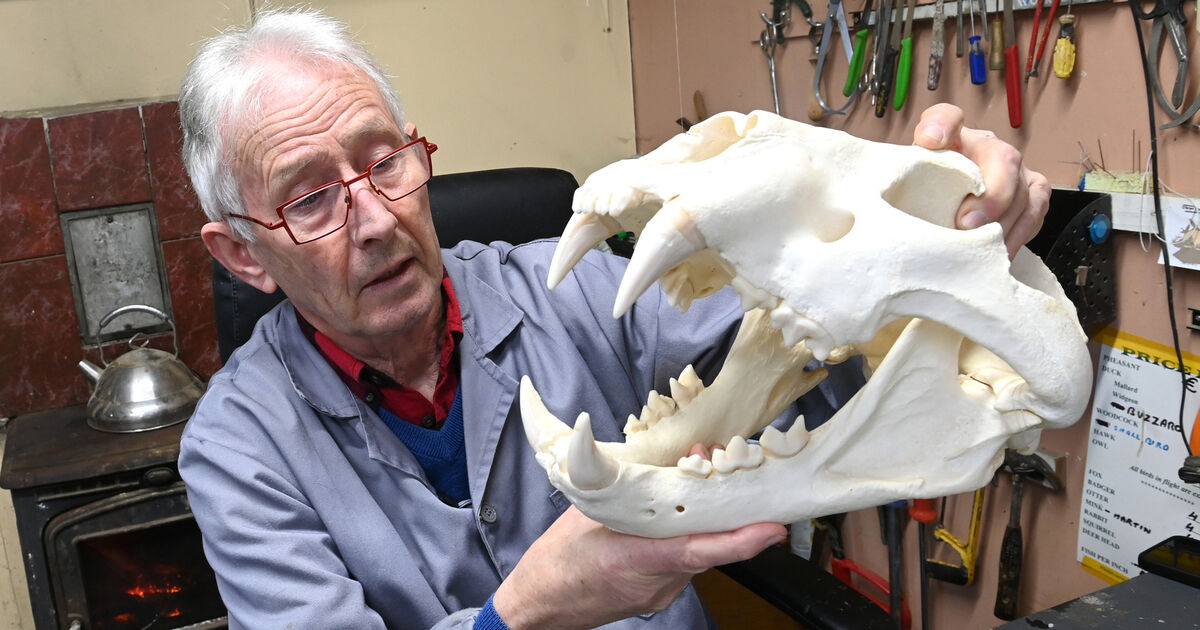
The skeleton of a real-life Siberian tiger isn’t the first thing one might expect to see while exploring the treasures of Ger O’Brien’s workshop in Kilkenny.
While most man caves typically house items such as tools and DIY equipment, this father of three devotes his time to something a little different.
One of the most talented in his field, Ger from Oak Hill Taxidermy has become the go-to taxidermist for zoos and wildlife parks who require his niche services for a myriad of reasons.
The stuffing and mounting of dead animal skins dates back to the 1600s, the pre-television age when limited travel meant it was the closest most could get to exotic creatures.
These days Ger is asked to carry out work on animals such as lions and tigers — all of whom have died of natural causes — for educational purposes.
Some of his work is displayed at educational facilities to shed light on the animal’s anatomy and provide an insight into how such animals look and feel up close.
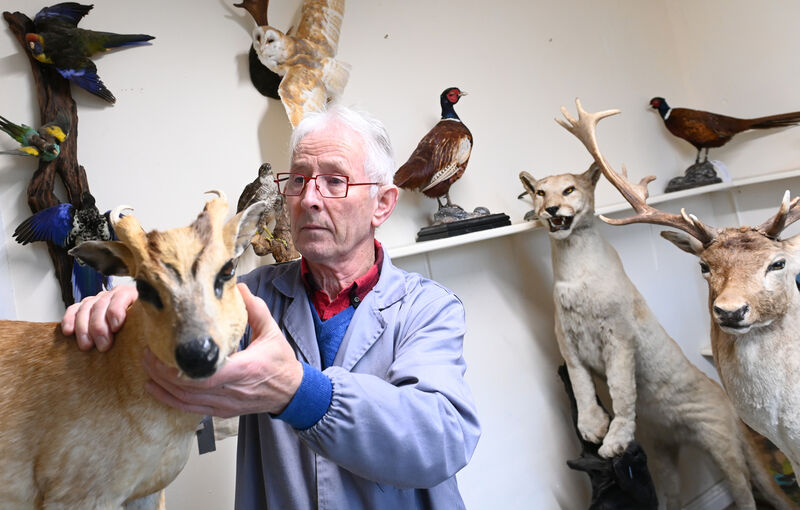 Taxidermist Ger O’Brien has been perfecting his craft for 40 years. Picture: Larry Cummins
Ger said the sensory element is particularly important for people with visual impairments, who may be unable to enjoy zoos and wildlife parks in the same way as others.
“You can get close to a stuffed lion and touch him and see how he feels,” he said.
“This can be really beneficial to people who are blind. They can feel the mane and the width of the legs. By doing this they are able to get an idea of the strength of the animal.”
The grandfather, who started in the taxidermy business 40 years ago, admits he has to turn down work on a regular basis.
There isn’t a week that goes by that I don’t get a call from someone with a request about a cat or dog. The truth is I don’t do pets because it’s too close to home. A pet is like a member of the family and you’re not going to stuff a member of the family.
“It’s not that it isn’t possible, but I’ve heard stories about people who have it done over the years who are sorry six months down the road. They are looking at this animal in the knowledge that it’s never going to move again and that can be painful. A lot of the time they just end up burying the animal anyway.”
Ger’s latest project involves recreating the skeletal architecture of a Siberian tiger.
“The bones are seeping at the moment. It can take nine months to a year just to degrease the bones. You can’t rush something like this. If you don’t degrease the bones properly they tend to yellow. You have to keep putting them into water with the ammonia and change the water every couple of weeks.
“The full skeleton will be put back together to show veterinary students, or anyone else who might have an interest in the full anatomy of the animal. This will also be going into an educational centre.”
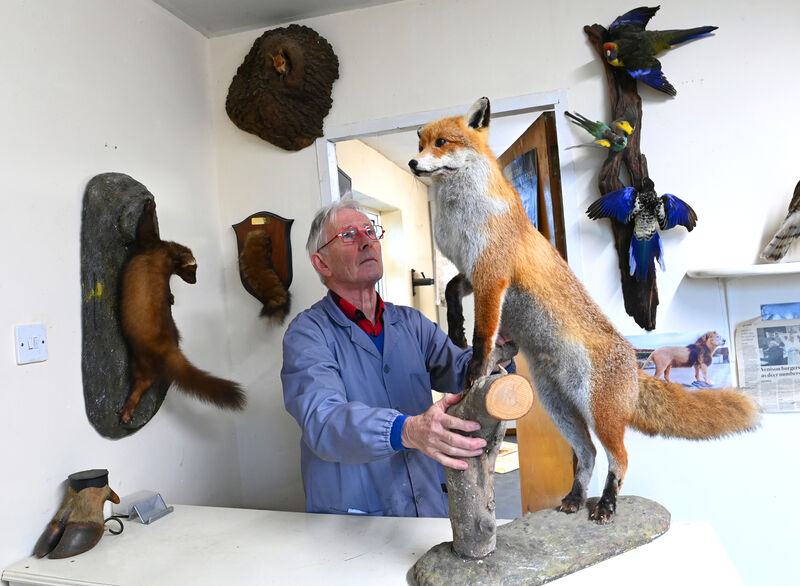 Ger O’Brien with a mounted fox at his workshop. Picture: Larry Cummins
Ger never imagined he would one day be carrying out taxidermy work on exotic animals.
“I started out in taxidermy 40 years ago. At that time, I thought I would just be preserving a few pheasant skins. I learned everything from a taxidermy book from the library.
“I took it out regularly and could tell from the stamps that I was the only one who ever read it. One day I went to sign it out when I discovered it had been stolen. I was very annoyed at the time because I knew the person who had taken it probably wasn’t even interested in taxidermy. Years later the man who did it confessed all to me. It wouldn’t have mattered so much if it happened today because you can find anything you need on the internet.”
Attention to detail is extremely important to Ger.
“The eyes on every animal is different. For example, a lion’s pupil is round and quite small. The pupil of a deer on the other hand is horizontal and rounded at both ends. If you put the wrong eye into an animal you would know by looking at it that there was something wrong. However, you wouldn’t be able to put your finger on it.”
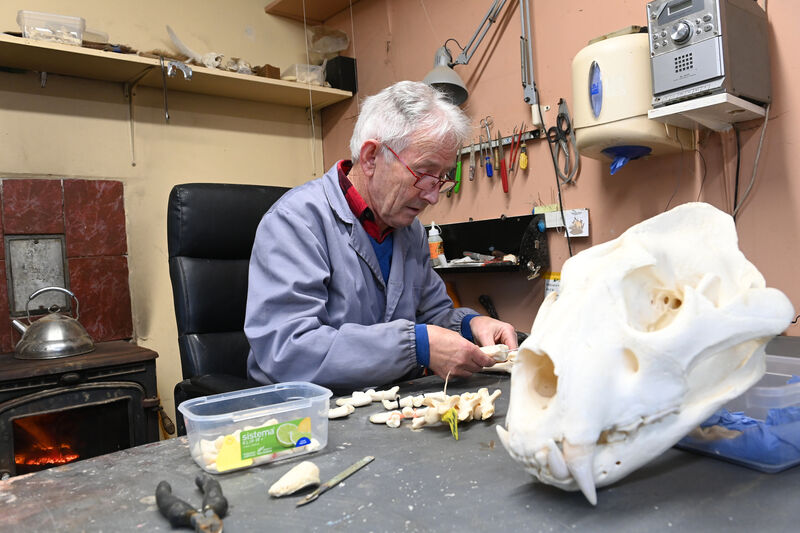 Ger cleaning some pieces of the siberian tiger skeleton. Picture: Larry Cummins
“It’s a very time-consuming job. There is a lot of work involved in it which can be hard to believe. You have to remove the skin. Take for example the leg of a lion or a deer head.
“I tan that skin into leather, the same as a with a leather pair of shoes or jacket. It’s then put back over a form. You have to get a body that suits the animal skin.
“If you have a leg that’s too long or too fat, then you lose the skin somewhere else, so everything has to be in proportion. The legs have to be the right length. The neck has to be the right length and width. All the dimensions need to be correct.”
Ger described the changes in the taxidermy world over the years.
“What goes inside in the animal nowadays is totally different to what went in years ago. Back then packing straw was used. That came with its own issues because it was a haven for wildlife and insects.
“Nowadays everything is Styrofoam. You can buy bodies for the likes of a fox or a squirrel. I order these from America.
“Remodelling with Styrofoam is easy enough. You can sand it down or you can cut it. It’s quite manageable in that regard. One of the biggest issues now is how costly taxidermy is.
“If you are getting $1,000 worth of stuff from America you might end up paying €2,000 because the duty and postage is so dear now.
“It makes it very expensive.”