
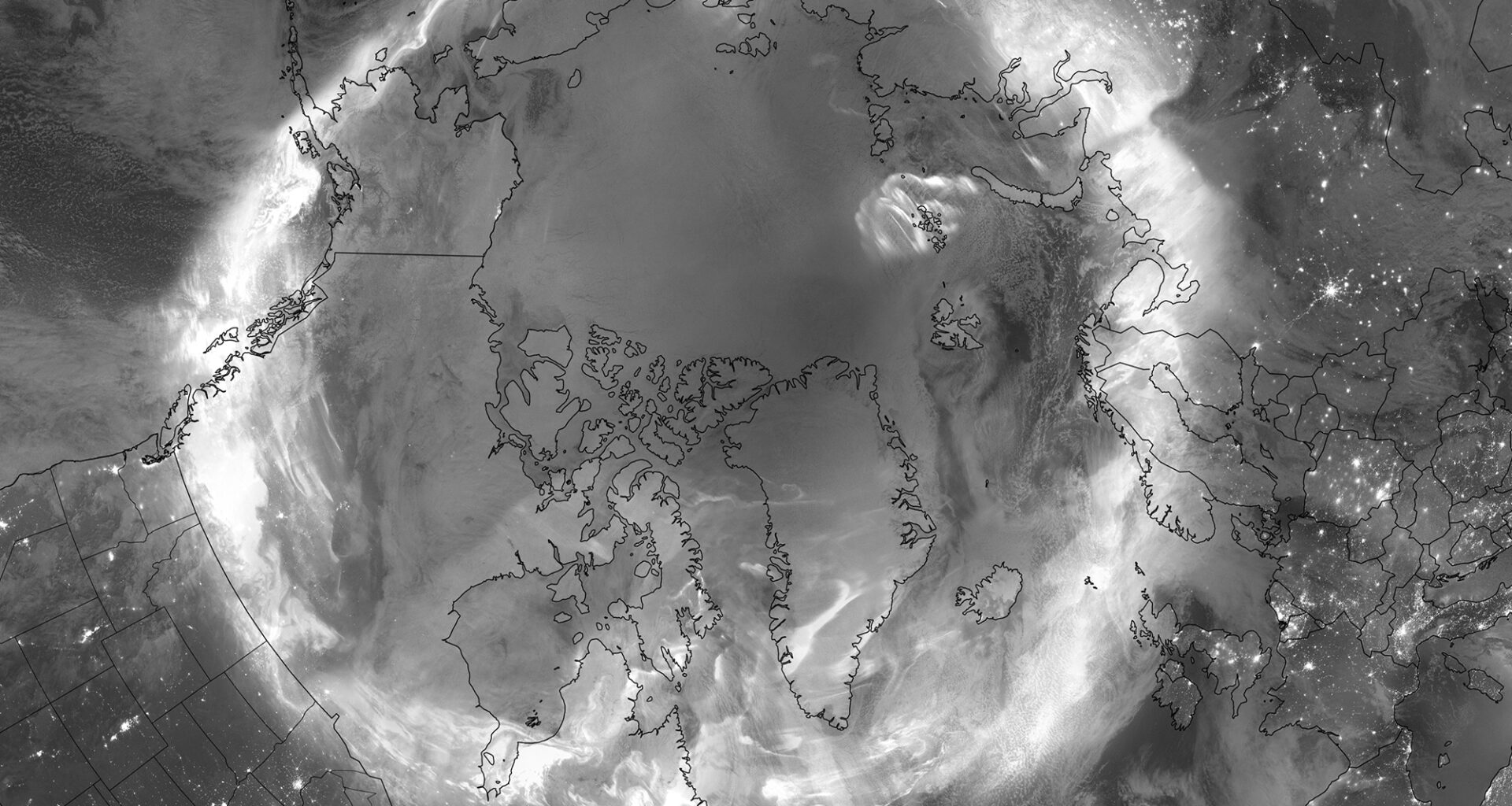
ESA’s Swarm satellites recorded an unusually sharp rise in high-energy protons over Earth’s polar regions during a geomagnetic storm in November 2025. The signal came from an unexpected place: the spacecraft’s star trackers, normally used to keep each satellite correctly oriented.
Swarm’s magnetometers also saw the storm. On 12th November, the mission measured magnetic fluctuations around ten times stronger than typical background levels. Over the 11–13 November period, ESA says proton flux at the poles briefly climbed to roughly 300 times normal levels.
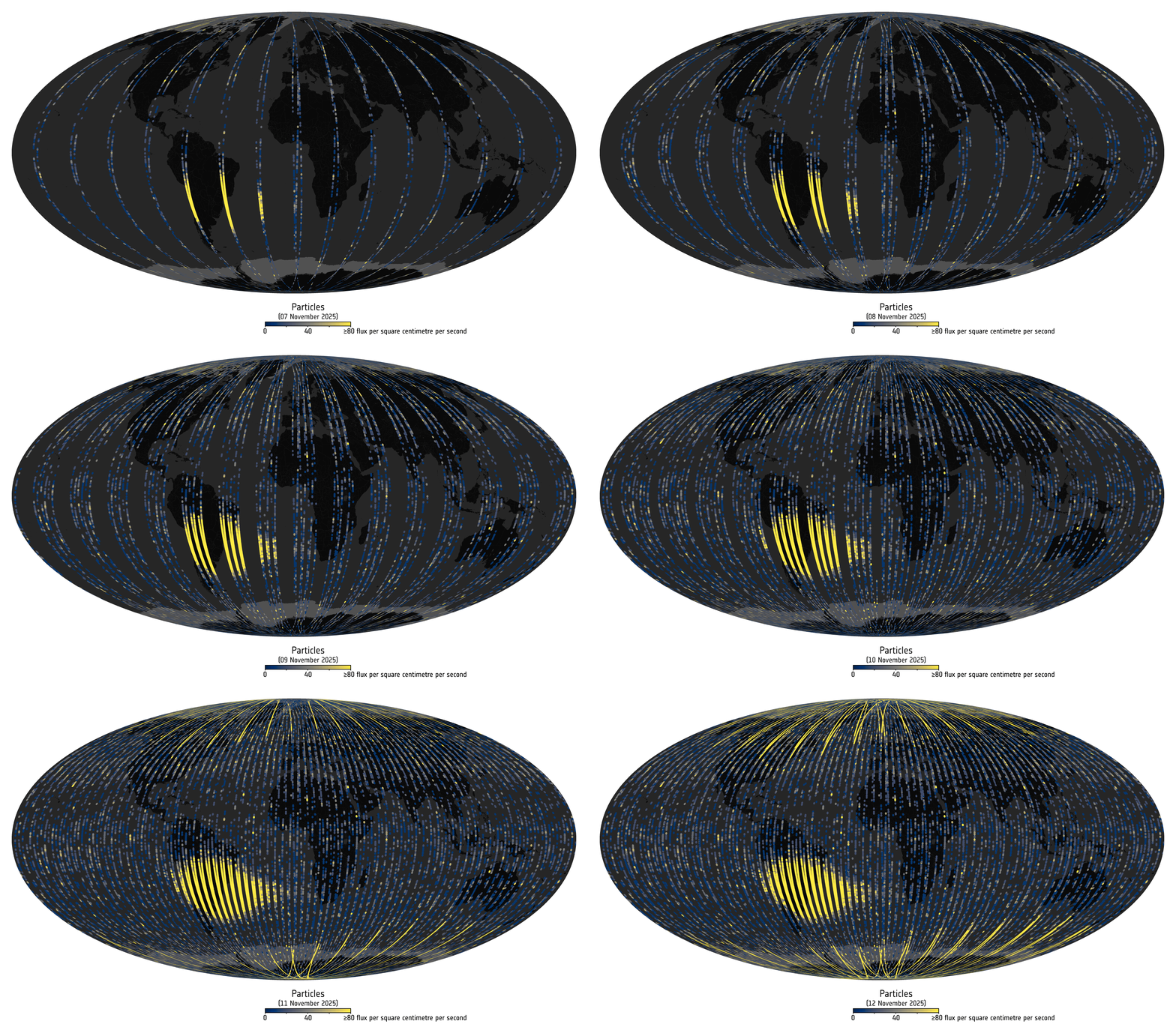 Swarm measurements of high-energy proton flux in Earth’s polar areas. Image Credit: ESAProton Burst Seen Through Navigation Sensors
Swarm flies three identical satellites at roughly 400–500 km altitude, placed to track how Earth’s magnetic environment responds to space weather. Each carries two types of magnetometer for field strength and direction, plus star trackers that identify star patterns to determine position and attitude.
During this event, the star tracker image sensors proved sensitive to the storm’s particle environment. High-energy protons striking the detector show up as bright specks on the images. What is usually treated as unwanted noise becomes a proxy measurement for proton flux, with ESA noting the effect reflects particles above about 100 MeV.
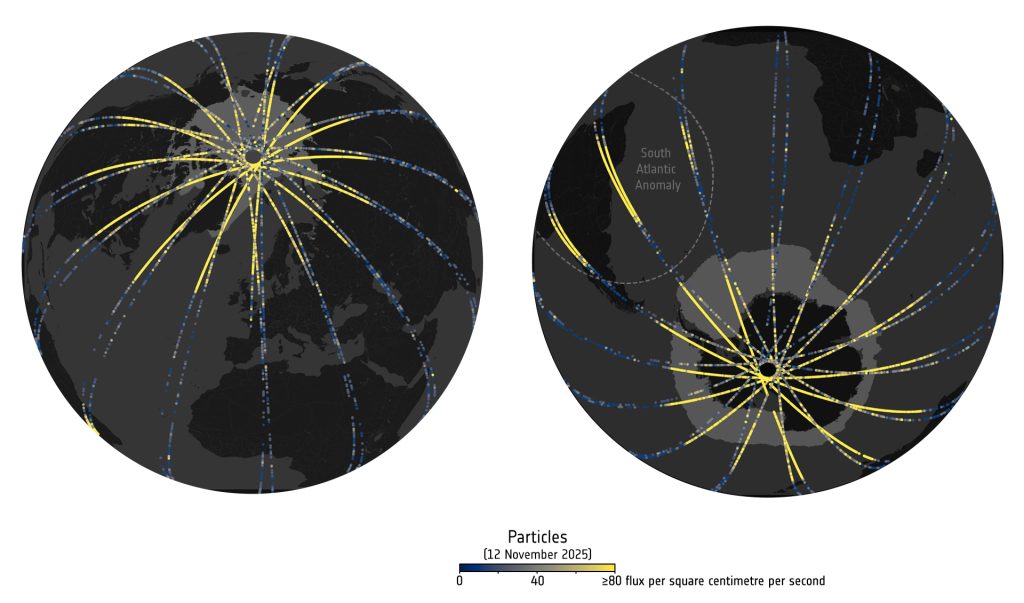 Image Credit: ESA
The storm itself was driven by three coronal mass ejections arriving within about 48 hours. ESA links the disturbance to “proton auroras”, a more diffuse glow that can appear at lower latitudes during strong storms, distinct from the rippled structure more often associated with electron-driven aurora.
The same particles can cause disruption closer to home. ESA says a short radio blackout was logged across parts of Europe, Africa and Asia, lasting around 30 to 60 minutes during the storm window.
The proton spike detected on 12 November is described as rare for Swarm. Mission manager Anja Strømme said it is the first case where a space weather event has been monitored this way on the mission, adding that a new “high-energy particle product” for Swarm is scheduled to be released operationally on 17 December.
High-energy protons are not a direct hazard to people on the ground, but they can damage spacecraft electronics and degrade solar cells, as well as being a concern for human spaceflight. Under quieter conditions, similar particles are more closely associated with the South Atlantic Anomaly, where Earth’s magnetic field is weaker. During strong storms, ESA says the disturbed magnetosphere can allow energetic particles to penetrate and become temporarily trapped, producing bursts over the poles like the one Swarm recorded.
Source: ESA – “Swarm detects rare proton spike during solar storm” (11 December 2025)
 Published by Ben Ward
Ben Ward studied English Literature and Language at the University of Bristol. With a background in analytical news writing and an interest in space exploration, his work focuses on the connection between science, history, and language. He has a measured approach to space journalism, always prioritising accuracy. He is interested in how the decisions of private industry, government agencies, and scientific institutions shape the future of space exploration. When not writing, He closely follows updates in Geopolitics, Aerospace and Planetary science, considering how humanity’s presence on earth has an influence far beyond it.