
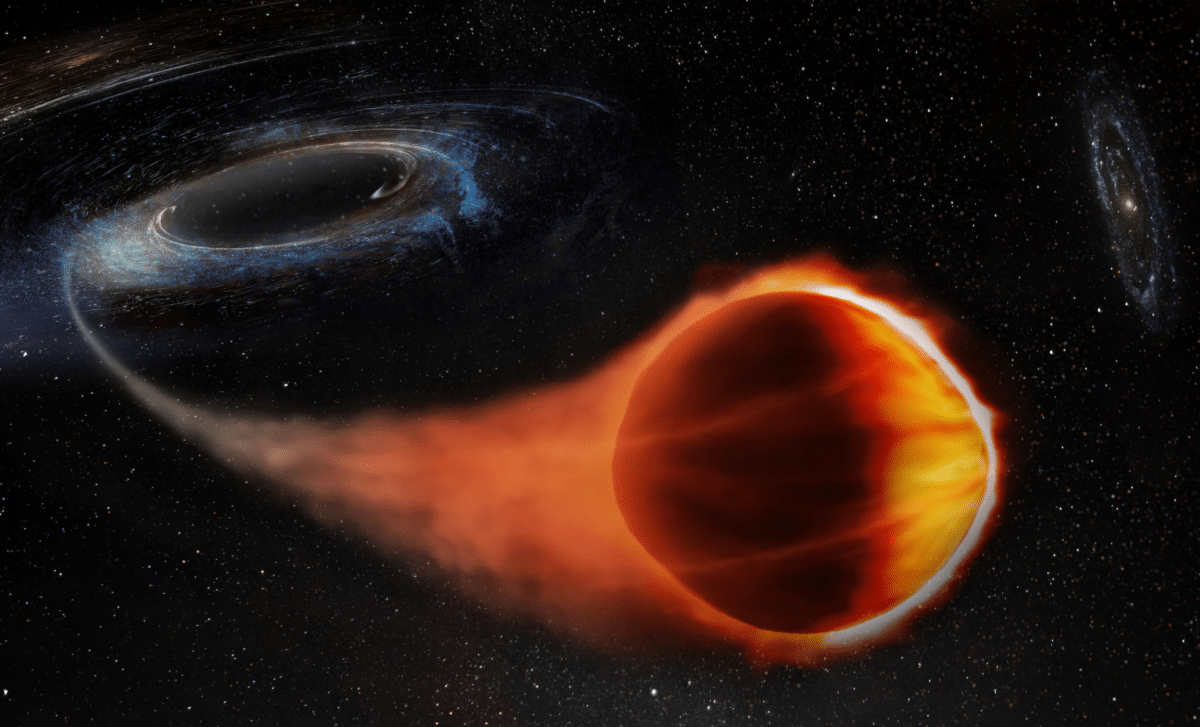
A groundbreaking study published in Science Advances has confirmed one of Albert Einstein’s predictions from over a century ago: spacetime vortices, also known as frame-dragging, have been directly observed in the vicinity of a supermassive black hole. This monumental discovery sheds new light on the mechanics of black holes and the way they influence the fabric of space and time.
The Power of a Spinning Black Hole
The concept of frame-dragging, which occurs when a massive spinning object twists spacetime as it rotates, was first theorized by Einstein in 1913 and later mathematically defined by Lense and Thirring in 1918. While scientists have observed this effect in smaller objects like Earth and Jupiter, confirming its existence around a supermassive black hole has been a far more elusive challenge.
This breakthrough came from studying a Tidal Disruption Event (TDE)—a violent stellar death where a black hole tears apart a nearby star. During such events, the black hole’s powerful gravity creates dramatic disturbances in the surrounding space. By examining the X-ray and radio wave emissions from one such event, known as AT2020afhd, researchers were able to detect a clear pattern of rhythmic changes in the signals, indicating the presence of frame-dragging. This was the first time such an effect had been measured on such a large scale.
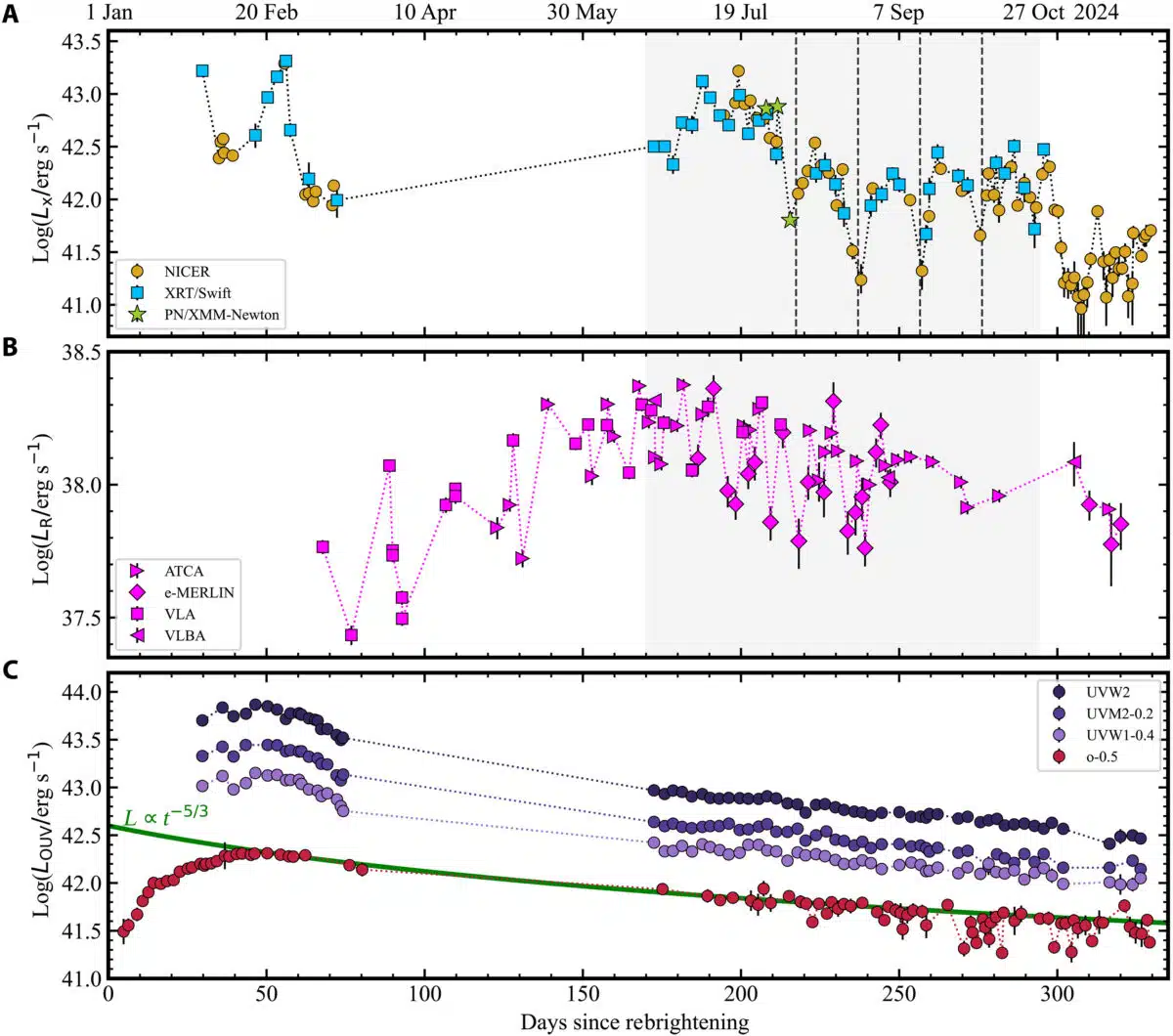 Temporal evolution of the multiwavelength luminosity of AT2020afhd since its optical rebrightening in 2024 (MJD 60310).
(A) The unabsorbed x-ray (0.3 to 2 keV) luminosity. (B) The radio (5 to 6 GHz) luminosity. The gray-shaded region represents the period used for calculating the cross-correlation function (CCF) between x-ray and radio data. (C) The ultraviolet (UV) and optical luminosities. The UltraViolet and Optical Telescope (UVOT) data were corrected for Galactic extinction and had the host contribution subtracted, while the ATLAS data were corrected for extinction. The light curves are offset as indicated in the legend for clarity. The green line indicates a power law of t−5/3. Uncertainties are quoted at the 1σ confidence level.
Credit: Science Advances
A New Method to Study Black Holes
Dr. Cosimo Inserra, co-author of the study from Cardiff University, explained, “By showing that a black hole can drag space time and create this frame-dragging effect, we are also beginning to understand the mechanics of the process.” The study, published in Science Advances, highlights a revolutionary new method for probing the behaviors of black holes by analyzing the distortions they cause in spacetime. The TDE gave scientists the rare opportunity to observe the immediate impact of a black hole’s rotation on its environment.
“So, in the same way a charged object creates a magnetic field when it rotates, we’re seeing how a massive spinning object – in this case a black hole – generates a gravitomagnetic field that influences the motion of stars and other cosmic objects nearby,” Inserra added.
This discovery not only opens a new frontier in black hole research but also offers a fresh perspective on how massive objects shape the universe.
Tidal Disruption Events: New Insights Into Stellar Destruction
Tidal Disruption Events have long been a subject of fascination for astronomers. These events occur when a star ventures too close to a black hole and is shredded by the intense gravitational forces. In the case of AT2020afhd, the star’s violent disintegration formed a plasma disk, and a jet of material was expelled from around the black hole. Unlike other TDEs, however, the signal from AT2020afhd showed short-term changes—an anomaly that could not be attributed to the black hole’s energy release alone.
“These short-term changes, which we were unable to attribute to the energy release from the black hole and its surrounding components, further confirmed the dragging effect in our minds,” Dr. Inserra noted.
This distinction offers scientists a powerful new method to study not just TDEs but also the fundamental mechanics of black holes themselves.
Frame-Dragging: The Key to Unlocking Black Hole Mysteries
Understanding the phenomenon of frame-dragging could be key to unlocking more secrets of the universe. When a massive object like a black hole spins, it drags the fabric of spacetime along with it, causing nearby objects to move in ways that would otherwise be impossible. This effect can influence the orbits of nearby stars and even impact the flow of material in the black hole’s accretion disk.
“This is a real gift for physicists as we confirm predictions made more than a century ago. Not only that, but these observations also tell us more about the nature of TDEs—when a star is shredded by the immense gravitational forces exerted by a black hole,” Dr. Inserra explained.
The ability to observe frame-dragging offers a new way to probe the behavior of black holes, opening new possibilities for understanding these enigmatic cosmic objects.