
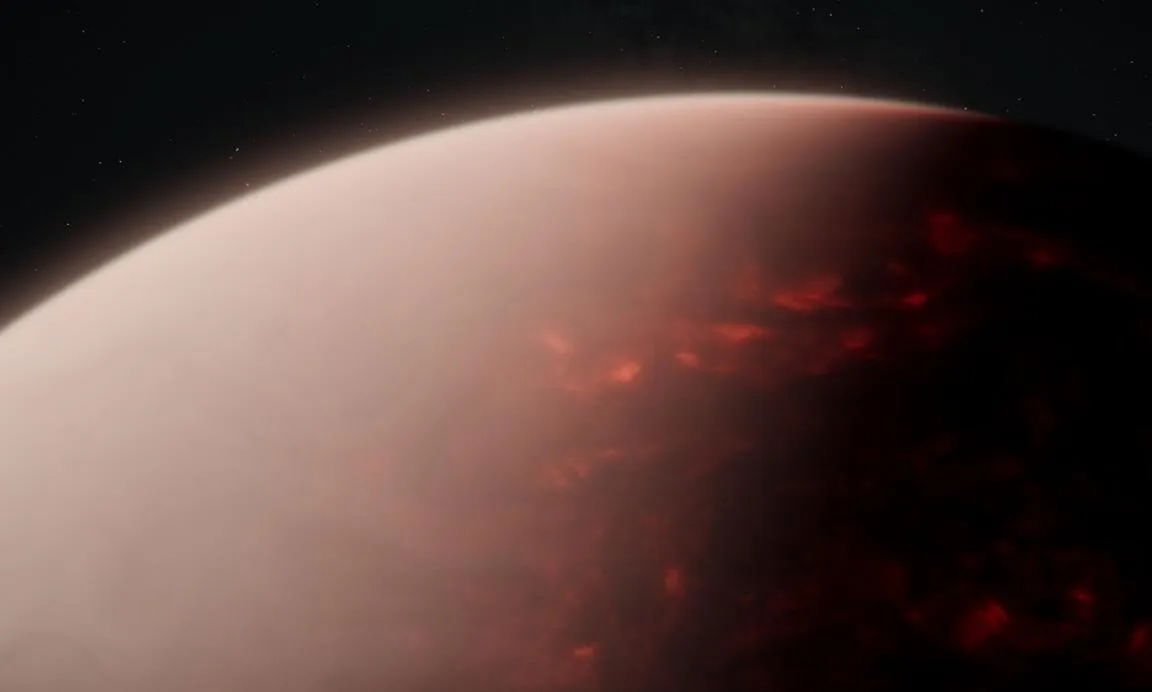
NASA’s James Webb Space Telescope has detected the best evidence ever recorded for an atmosphere on a rocky exoplanet, and this one defies all odds with its extreme environment.
Believed to be covered in a global magma ocean, data made possible by Webb suggests that the ultra-hot super-Earth TOI-561 b is covered in a thick atmosphere. The discovery, made by an international team of researchers, was reported in a recent paper in The Astrophysical Journal that challenges the idea that small, tightly orbiting planets are incapable of sustaining atmospheres.
Exoplanet TOI-561 b
The planet at the heart of the new study, TOI-561 b, is an outlier on a cosmic scale. Its density is abnormally low, which the team says their latest research helps explain, while its radius is 1.4 times Earth’s. Additionally, the planet is an “ultra-short period exoplanet,” a rare designation given to those with orbital periods of less than 11 Earth hours. TOI-561 b’s trip is brief on account of its proximity to its star, less than one million miles away. In our solar system, the closest planet to the host star, Mercury, is forty times that distance away.
Even with a smaller and cooler star than our own, such a close orbit generates tremendous surface temperatures. The international team suggests that TOI-561 b is tidally locked, with its day side well above the melting point for rock.
As an old planet, tightly orbiting its star for billions of years, cooking in a steady flow of solar radiation, TOI-561 b would not typically be expected to sustain an atmosphere. Yet, recent research suggests that such planets may be more than barren balls of rock and lava.
“We really need a thick volatile-rich atmosphere to explain all the observations. Strong winds would cool the dayside by transporting heat over to the nightside,” said co-author Dr Anjali Piette from the University of Birmingham.
“Gases like water vapour would absorb some wavelengths of near-infrared light emitted by the surface before they make it all the way up through the atmosphere,” Piette continued. “The planet would look colder because the telescope detects less light, but it’s also possible that there are bright silicate clouds that cool the atmosphere by reflecting starlight.”
Ancient Density
First, explaining the planet’s low density required the team to consider scenarios unlike those found on Earth. Instead, they suggest that TOI-561 b has only a small core of iron, while its rocky mantle is much less dense than that of Earth. They believe such a composition may once have been standard in the early universe.
“What really sets this planet apart is its anomalously low density,” said lead author Johanna Teske, staff scientist at Carnegie Science Earth and Planets Laboratory. “It is less dense than you would expect if it had an Earth-like composition.”
“TOI-561 b is distinct among ultra-short period planets in that it orbits a very old, iron-poor star – twice as old as our sun – in a region of the Milky Way known as the thick disk,” Teske added. “It must have formed in a very different chemical environment from planets in our own solar system.”
Searching for Exoplanet Atmosphere
To test their idea that TOI-561 b has an atmosphere, the researchers utilized the James Webb Space Telescope’s Near-Infrared Spectrograph (NIRSpec) instrument. During the telescope’s General Observers Program 3860, it spent over 37 hours observing four complete orbits.
Their technique has been widely used in recent years to investigate whether any planets in the TRAPPIST-1 system have atmospheres. It involves measuring the changes in the system’s infrared brightness as TOI-561 b moves behind its star, allowing scientists to infer a planet’s surface temperature. If TOI-561 b is a barren rock lacking an atmosphere, the dayside temperature should be approximately 4,900°F.
Instead, the reading revealed a temperature of 3,200°F—much cooler than expected, despite the extreme heat present. The researchers considered two scenarios that could potentially explain the discrepancy as possible alternatives to an atmosphere. One possibility is that a magma ocean could distribute heat throughout the planet, but such a scenario is unlikely because the nightside would remain solid, limiting the magma’s ability to flow and disperse heat. Another scenario is that a thin layer of rock vapor floating above the magma provides a cooling effect, yet this effect would be far weaker than the observed 1,700°F difference.
Sustaining an Atmosphere on TOI-561 b
The question now becomes one of how a planet holds such a thick atmosphere, yet under such unlikely conditions, an issue for which the team has developed a potential explanation.

“We think there is an equilibrium between the magma ocean and the atmosphere,” explained co-author Tim Lichtenberg from the University of Groningen, Netherlands. “While gases are coming out of the planet to feed the atmosphere, the magma ocean is sucking them back into the interior.”
“This planet must be much, much more volatile-rich than Earth to explain the observations,” Lichtenberg added. “It’s really like a wet lava ball.”
The team is currently conducting further research on TOI-561 b. A larger data set was collected during the James Webb Space Telescope observations, which the researchers are using to map temperatures across the entire planet’s surface. Additionally, they believe that continued analysis will enable them to determine the planet’s atmospheric composition.
The team’s continued work will test the limits of what scientists expect to find in their studies of exoplanets, potentially revealing that far different conditions may exist throughout regions of the cosmos than are presently known.
The paper, “A Thick Volatile Atmosphere on the Ultrahot Super-Earth TOI-561 b,” appeared in The Astrophysical Journal Letters on December 11, 2025.
Ryan Whalen covers science and technology for The Debrief. He holds an MA in History and a Master of Library and Information Science with a certificate in Data Science. He can be contacted at ryan@thedebrief.org, and follow him on Twitter @mdntwvlf.