
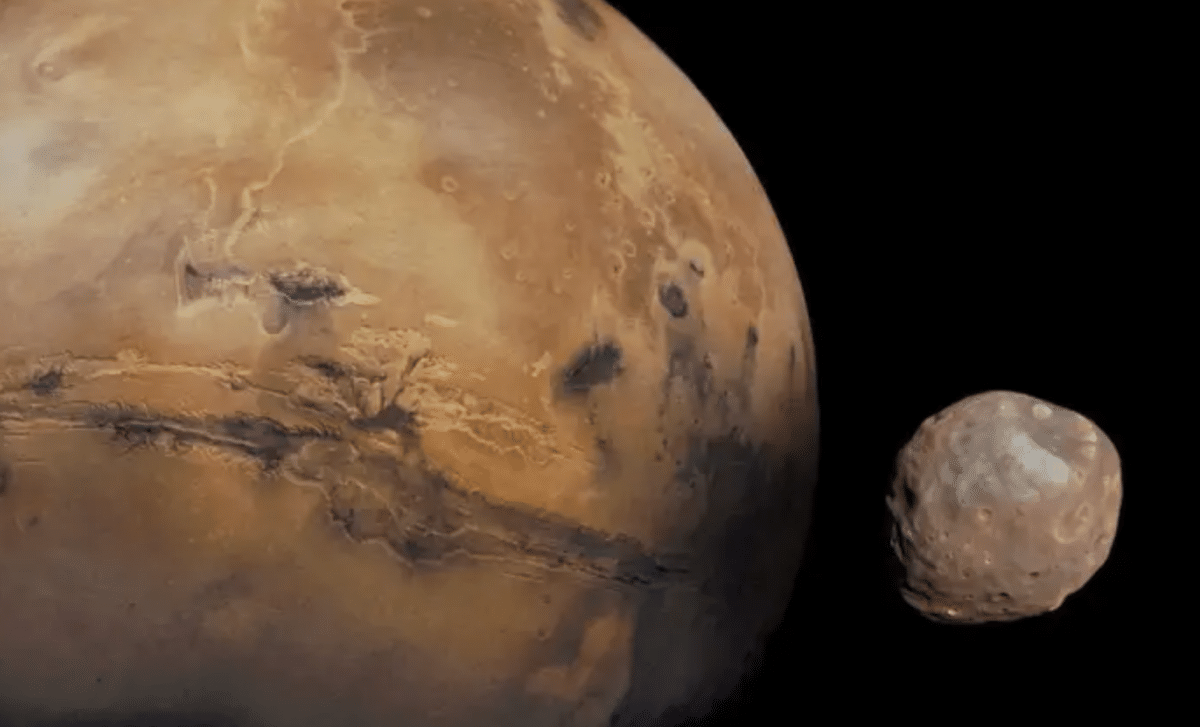
In a new study featured by New Scientist, researchers propose that Mars might have once had a much larger moon than it does today, capable of creating tidal effects on the Red Planet. This hypothesis arises from evidence of tidal activity found in sedimentary layers within the Gale Crater.
Understanding the Gale Crater Evidence
The Gale Crater, one of the most studied regions on Mars, has been central to recent research suggesting tidal influences. Traces of rhythmic layers within the sedimentary rocks suggest that tides could have once occurred in a Martian sea. These layers, called rhythmites, form under the influence of periodic tidal forces and can serve as proof of ancient marine conditions. As reported by New Scientist, Suniti Karunatillake and his team, based at Louisiana State University, have conducted thorough analysis of these layers. According to Karunatillake,
“The rhythmic layering, indicative of tidal action, is preserved in the crater’s sedimentary deposits, suggesting that a large body of water may have once existed there.”
This discovery challenges the current understanding of Mars, suggesting that the planet may have had a much more Earth-like climate in its early history. However, the small size of Mars’ current moons raises the question: how could such tidal forces have been generated?
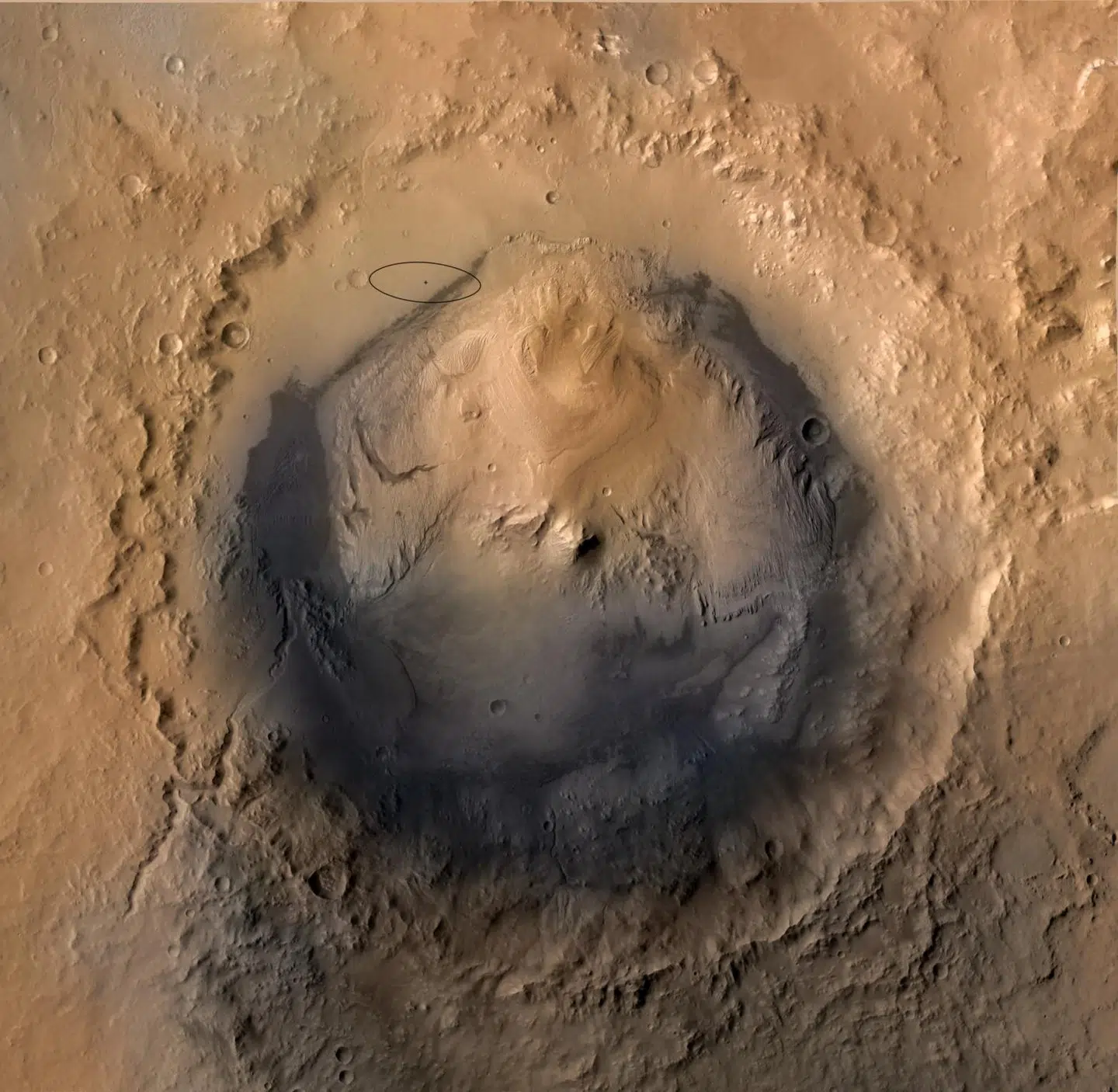 Gale Crater. Credit: NASA/JPL-Caltech/ESA/DLR/FU Berlin/MSSS
The Role of Mars’ Moon(s) in the Tidal Debate
Mars’ two small moons, Phobos and Deimos, are far too tiny to exert the gravitational pull necessary to create the tidal effects observed in the Gale Crater. This brings us to an intriguing possibility: that Mars once had a larger moon that was capable of influencing the planet’s tides. According to experts, this lost moon may have played a crucial role in shaping Mars’ early seas.
Mazumder, one of the leading researchers on this study, highlights the importance of rhythmic deposits in proving tidal activity.
Mazumder points out that, on Earth, finding such rhythmites ‘is a very robust proof of tidal activity. In other words: marine conditions.’”
This comparison to Earth suggests that similar conditions could have existed on ancient Mars, which opens up new avenues for understanding the planet’s potential habitability.
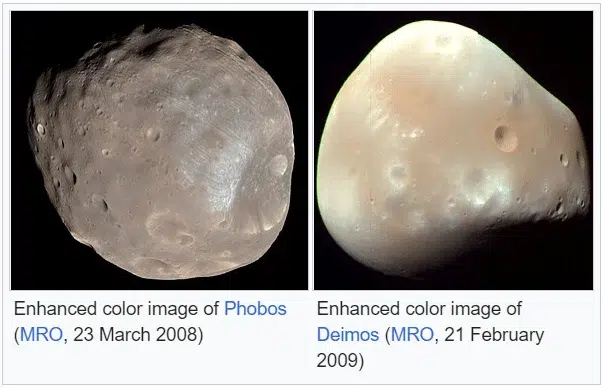 Phobos and Deimos. (MRO)
Debunking the Gale Crater as a Prime Location for Tidal Deposits
While the evidence for tidal effects in the Gale Crater is compelling, there are skeptics who argue that this location may not be the best example of ancient Martian tides. As noted by another expert,
“Thus, even with a larger moon in the past, I don’t think these two locations are the good ones to record tidal deposits.”
These comments suggest that other factors could be influencing the observed sedimentary layers, and that Gale Crater may not be the final word on the presence of tides on Mars.
Still, the possibility of a larger moon influencing the planet’s tides cannot be entirely dismissed. The search for additional sites with tidal deposits continues, as researchers look for more convincing evidence of the ancient Martian environment.
Alternative Explanations for the Evidence
One theory that could reconcile the tidal evidence in the Gale Crater with Mars’ current moon configuration comes from Sarkar, another researcher involved in the study. Sarkar posits,
“Maybe an ocean was hydrologically connected with Gale. Even subsurface porosity can connect bodies and cause tides.”
This theory suggests that Mars’ highly fractured and cratered surface might have allowed for tidal forces to be transmitted even without a large moon. In other words, subsurface channels or interconnected bodies of water could have allowed tidal forces to propagate, potentially explaining the rhythmic sedimentary layers found at Gale.
Despite the challenges to the tidal hypothesis, this idea raises exciting possibilities about Mars’ ancient hydrology. The planet’s surface, marked by craters and fractures, could have allowed for unique interactions between water bodies that might have caused tidal effects, even in the absence of a large moon.
The Bigger Picture: Mars’ Potential for Life
If Mars did indeed have a large moon capable of influencing tides, this would suggest that the planet’s early environment was far more dynamic than what we see today. The presence of large bodies of water and tidal movements could have created the kind of conditions necessary for the development of life. This is a tantalizing prospect, especially as scientists continue to search for signs of ancient life on Mars.
The discovery of tidal evidence in Gale Crater, coupled with the theory of a lost larger moon, opens up new possibilities for understanding Mars’ ancient climate. It suggests that, in its early history, Mars may have been much more similar to Earth than previously thought, with oceans and dynamic weather systems capable of supporting life.