
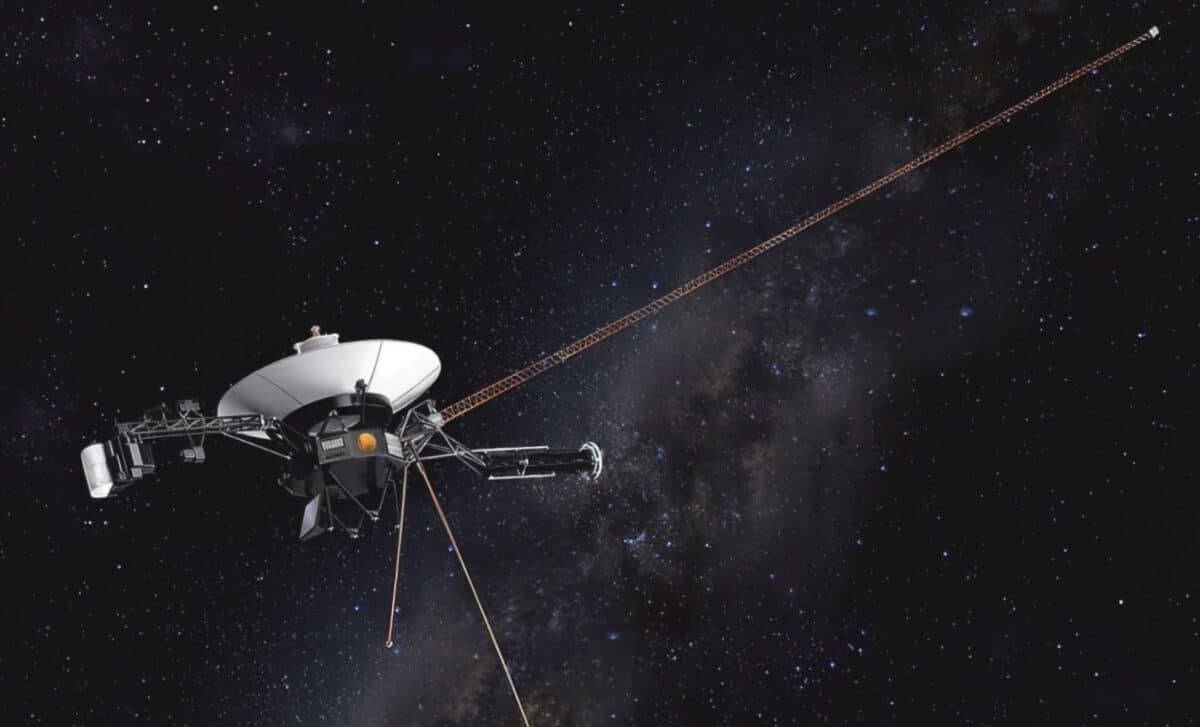
Nearly five decades after launch, Voyager 1 is still moving, further and deeper into space than any human-made object before it. From Earth, it now operates in total isolation—far beyond the orbit of Pluto, past the Sun’s protective boundary, and into a realm where space becomes silent and uncertain.
But it isn’t just distance that makes this spacecraft exceptional. What lies ahead is a moment that no other mission—robotic or crewed—has ever approached. A boundary is about to be crossed. Not physical, but symbolic. A moment that quietly redefines what it means to explore.
And somehow, this isn’t a story about cutting-edge technology. Voyager 1 is a machine from the 1970s, built with now-antique components, operating on minimal memory, and coded in a language few engineers still use. It has long outlived its mission, and yet its journey continues.
Soon, a new line will be drawn between everything we’ve ever built—and the rest of the galaxy.
Approaching a Boundary No Signal Has Ever Crossed
In November 2026, Voyager 1 will reach a distance of one light-day from Earth—roughly 25.9 billion kilometers. At that point, any signal sent from Earth will take exactly 24 hours to reach the spacecraft. Another 24 hours will be needed for a reply to arrive. It’s a purely physical milestone, but its implications are deep. No human-made object has ever operated this far from home.
Voyager 1 will soon break a space record.
By the end of 2026, Voyager 1 will become the first human-made object so distant from Earth that a radio signal will take 24 hours to reach it. Currently, the probe is 25.3 billion kilometers away, and it takes 23 hours and 33 minutes… pic.twitter.com/9XAkwLDmW4
— Black Hole (@konstructivizm) November 24, 2025
Currently traveling at about 56,000 kilometers per hour, the spacecraft left Earth in 1977 and exited the heliosphere—the edge of the Sun’s influence—in 2012. Since then, it’s been cruising through the interstellar medium, transmitting data about cosmic rays and magnetic fields from a part of space never before measured directly.
The upcoming light-day marker isn’t just a number. It’s a psychological shift. At this distance, even a simple software adjustment or diagnostic test involves a 48-hour delay between action and result.
The scale of this feat has captured wide attention. A visual shared on X illustrates the vastness of the distance, reminding us how long it now takes for our voice—through radio—to reach the spacecraft and return. In the age of instant communication, Voyager 1 operates on a two-day cycle of silence.
No Backups, No Rescue, Just Persistence
Voyager 1 wasn’t designed to last this long. Its original mission was intended to explore the outer planets over a span of five years. But mission extensions and smart engineering pushed it beyond Saturn, beyond Neptune, and eventually beyond the solar system itself.
Its onboard computer holds just 69 kilobytes of memory—less than a single email attachment. Communication is maintained through aging hardware that requires engineers to write and send commands in a decades-old assembly language. Each transmission must be crafted with extreme precision. A single error could permanently end the mission.
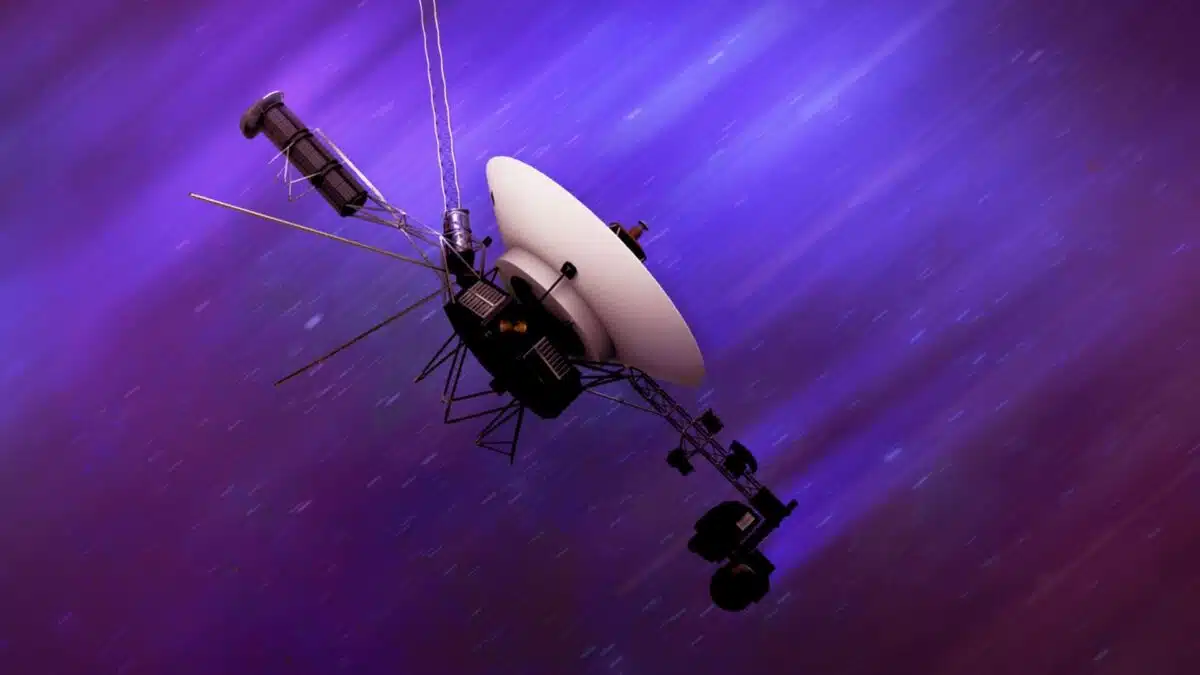 NASA’s Voyager Probe Speeds Through Space (Artist’s Concept). Credits: NASA/JPL-Caltech
In 2025, a critical failure nearly did. For weeks, the probe transmitted repeating, meaningless data. Engineers eventually traced the problem to corrupted memory and rerouted signals through a different, still-functioning section of the system—an improvised fix that restored science operations. It was another improbable success for a team working across 25 billion kilometers.
A Machine Drifting Into Deep Time
Power is fading. Sometime in the early 2030s, Voyager 1’s generators will no longer produce enough energy to operate its instruments. When that day comes, the spacecraft will fall silent. But it will not stop.
It is expected to reach the Oort Cloud, a distant halo of icy debris at the edge of the solar system, in around 300 years. It will take another 30,000 years to cross it. If it remains intact, Voyager 1 will pass within 1.6 light-years of a distant star in the constellation Ursa Minor—closer to that star than to our Sun.
Aboard is the Golden Record—a copper disc etched with greetings, images, and music from Earth. It was never meant to be practical. It’s a message in a bottle, drifting through an ocean of space no one can cross. But it remains one of the most ambitious gestures ever made by our species.