
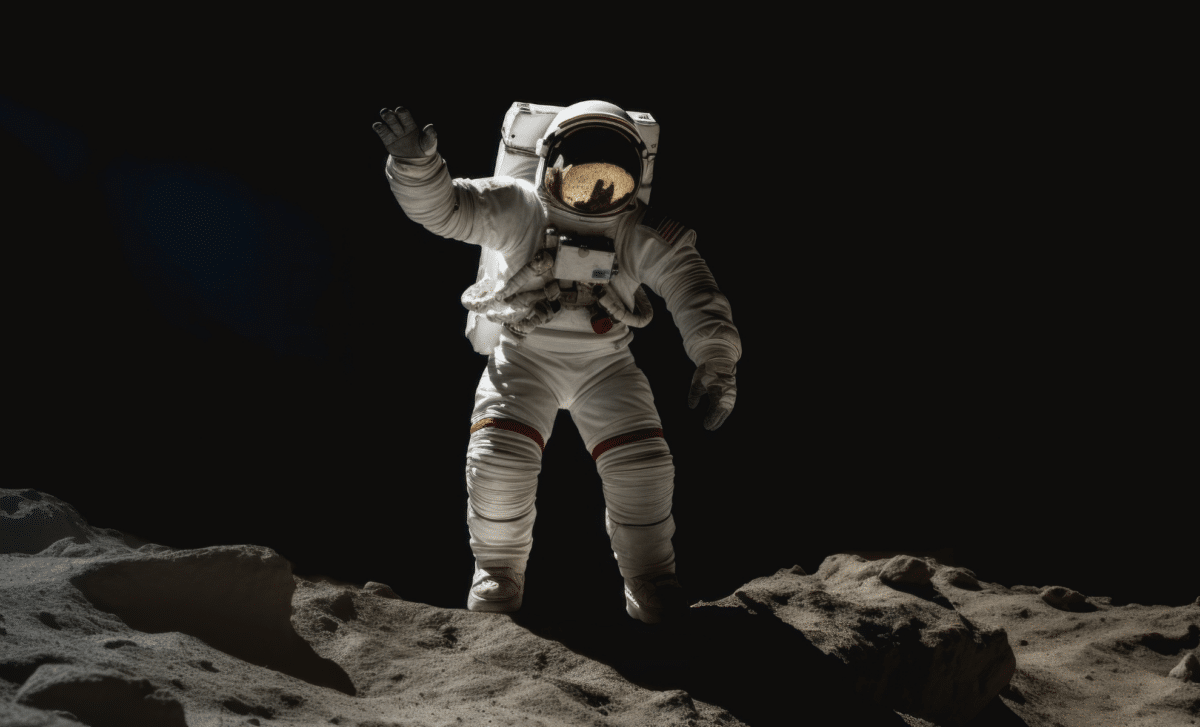
The moon’s surface has long been considered barren, but new research published in Communications Earth & Environment suggests that it could hold more potential than we thought for supporting human life. A study from the University of Rochester reveals that Earth’s atmosphere may have played a crucial role in enriching lunar soil with life-sustaining substances, offering exciting possibilities for future lunar missions.
Uncovering the Connection Between Earth’s Atmosphere and Lunar Soil
The moon has long been a subject of interest for scientists, particularly as humans look to expand beyond Earth and establish colonies on other celestial bodies. For years, scientists have assumed that the moon’s surface was barren, with little more than dust and debris scattered across its rocky terrain. However, recent research has challenged this view, suggesting that the moon might contain vital resources that could make it more hospitable to human life than previously thought.
The study, conducted by researchers at the University of Rochester, and published in Communications Earth & Environment, focused on the transfer of particles from Earth’s atmosphere to the moon. According to the researchers, tiny particles from Earth have been transported to the lunar surface over billions of years, potentially creating a source of life-sustaining materials. This discovery opens up the possibility that the moon could provide valuable resources for astronauts, such as water, nitrogen, and other gases, which would be crucial for sustaining long-term human missions or even permanent settlements on the moon.
“By combining data from particles preserved in lunar soil with computational modeling of how solar wind interacts with Earth’s atmosphere, we can trace the history of Earth’s atmosphere and its magnetic field,” says Eric Blackman, a professor in the Department of Physics and Astronomy and a distinguished scientist at the University of Rochester’s Laboratory for Laser Energetics (LLE).
This breakthrough was made possible through the use of advanced computer simulations that modeled the interaction between solar wind and Earth’s atmosphere.
How Earth’s Magnetic Field Guides Atmospheric Particles to the Moon
The key to this discovery lies in Earth’s magnetic field. The researchers found that instead of blocking particles from Earth’s atmosphere, Earth’s magnetic field might actually be guiding them into space. For years, it was believed that the Earth’s magnetic field would prevent particles from escaping into space, but new simulations show otherwise.
In the study, the team tested two different scenarios: one in which Earth had no magnetic field, and another in which the Earth’s magnetic field was present. The results of the simulations showed that in the modern Earth scenario, charged particles from Earth’s atmosphere are knocked loose by the solar wind and carried along Earth’s magnetic field lines. Some of these lines extend far enough into space, even reaching the moon. Over billions of years, this steady transfer of particles has resulted in tiny amounts of Earth’s atmosphere being deposited on the lunar surface.
This discovery suggests that lunar soil may contain a historical record of Earth’s atmosphere. By studying these particles, scientists could gain valuable insights into the evolution of Earth’s climate and the role of Earth’s magnetic field in shaping the planet’s habitability over time.
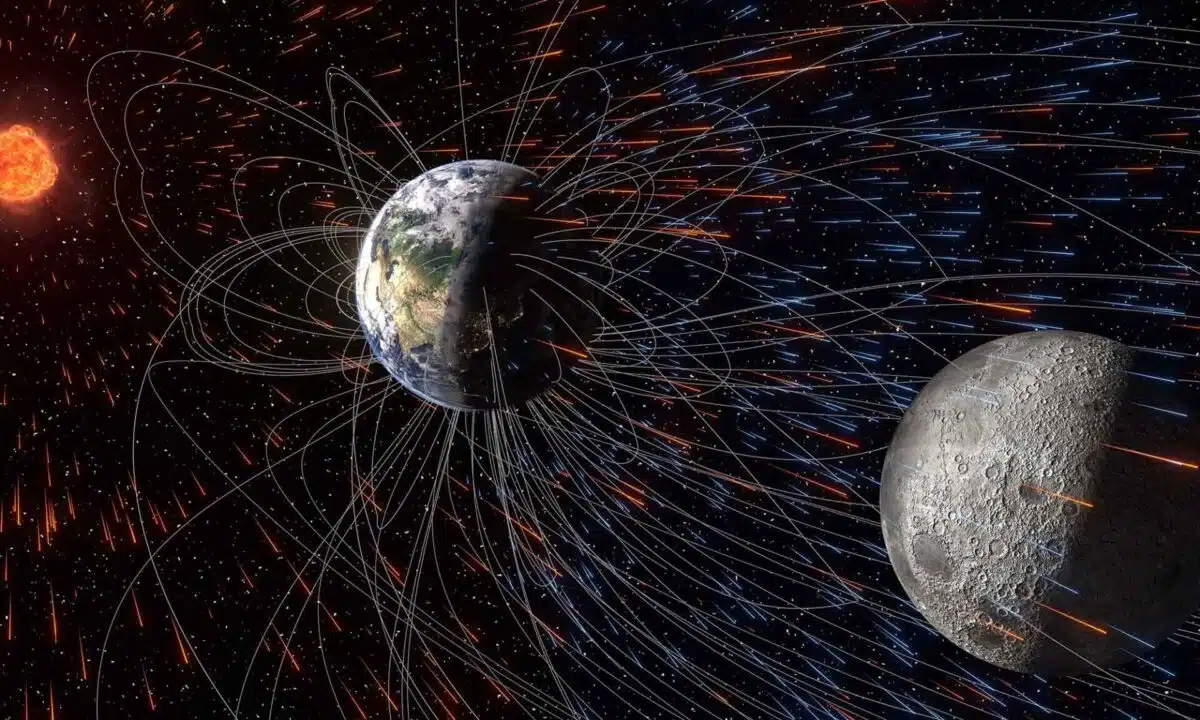 Solar wind (yellow-orange trails) strips ions from Earth’s upper atmosphere (sky-blue trails). Some of these particles travel along Earth’s magnetic field lines (solid white curves) and settle on the moon’s surface. This process may leave lunar soil with a record of Earth’s atmosphere. Credit: University of Rochester illustration / Shubhonkar Paramanick
Implications for Future Moon Missions and Lunar Exploration
The implications of this research are far-reaching, particularly when considering the potential for human habitation on the moon. While the idea of terraforming the moon remains far off, these findings suggest that the lunar soil might already contain some of the necessary ingredients for sustaining life. The presence of water, carbon dioxide, nitrogen, and other volatiles in lunar regolith could provide essential resources for astronauts, reducing the need to transport supplies from Earth.
“We now know that lunar soil could hold more volatiles than previously thought,
” said Shubhonkar Paramanick, a graduate student involved in the study. “This opens up the possibility of using lunar soil to support agriculture or to generate life-sustaining gases.”
Such resources would be critical for any long-term human presence on the moon, allowing astronauts to grow food, breathe air, and possibly even extract water without having to rely entirely on Earth.
Furthermore, the study could have broader implications for understanding planetary habitability beyond the moon.
“Our study may also have broader implications for understanding early atmospheric escape on planets like Mars, which lacks a global magnetic field today but had one similar to Earth in the past, along with a likely thicker atmosphere,” Paramanick explains.
By examining how particles escape from planetary atmospheres and interact with magnetic fields, scientists can gain insight into the conditions that might make a planet habitable or uninhabitable.
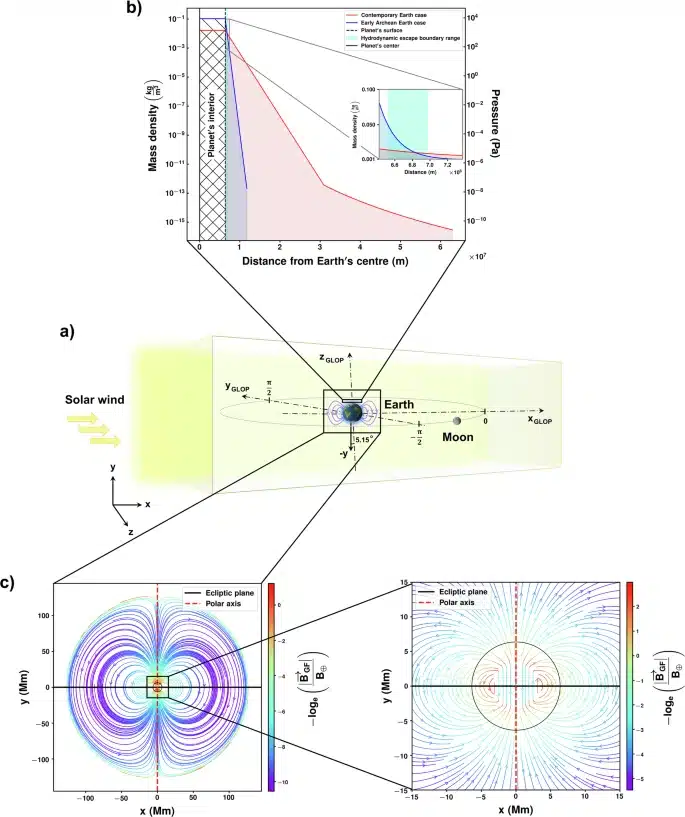 Schematic representation of the simulation framework for solar wind-Earth atmosphere interactions, incorporating terrestrial atmospheric profiles and the geodynamo model used in this study, along with the coordinate frames employed for analysis.
Credit: Communications Earth & Environment
A Historical Record of Earth’s Atmosphere in Lunar Soil
The moon’s regolith, or surface soil, may contain more than just dust and rocks; it could serve as a chemical time capsule, preserving a record of Earth’s atmospheric history. By analyzing particles found in the lunar soil, scientists can trace the evolution of Earth’s atmosphere and understand how it changed over billions of years. This record could be invaluable for future researchers seeking to understand Earth’s past and its climate history, as well as how planets evolve over time.
Moreover, the discovery that Earth’s magnetic field may have helped transfer particles to the moon suggests that this process has been ongoing for billions of years. This long-term exchange of particles between Earth and the moon could hold clues to the early history of our planet and provide important context for understanding planetary habitability across the solar system.