
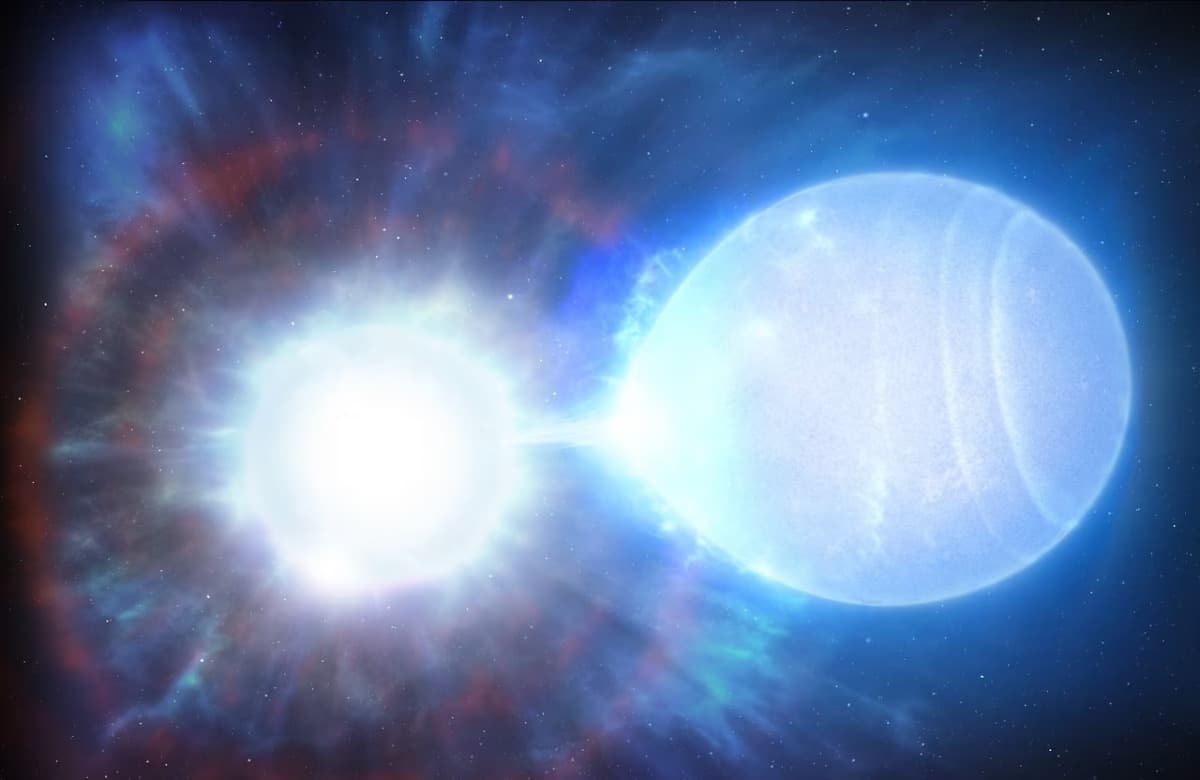
It’s the stuff of astronomy legends — when two white dwarf stars spiral toward each other, the result is a guaranteed supernova. For the first time ever, astronomers have spotted just such a system. And when it finally explodes, the show will be nothing short of spectacular.
Back in the late 16th century, Danish astronomer Tycho Brahe and his German counterpart Johannes Kepler became the first Western scientists to record “new stars” in the sky. Some shone brilliantly, and centuries later, the term supernova was coined — nova meaning “new” in Latin. Of course, we now know these aren’t new stars at all, but ancient ones meeting their explosive end.
When do stars reach that breaking point? There are two main routes. In one, a massive star — more than eight times the mass of our Sun — collapses under the weight of its own core, leading to a spectacular detonation known as a type II supernova. In the other, a white dwarf gathers too much material from a nearby companion until gravity wins out. That’s the type Ia, or thermonuclear, supernova — and theory has long suggested it can happen when two stars in a binary system collide.
Right #now Chandra is studying supernova remnant SNR 0509. The Type 1a supernova that resulted in this #space bubble occurred nearly 400 years ago for Earth viewers. The object is about 23 light years across and is expanding at more than 5,000 kilometers per second! pic.twitter.com/yhMa5BqWko
— Chandra Observatory (@chandraxray) May 15, 2020
Two White Dwarfs on a Collision Course
Now, for the first time, scientists from the University of Warwick in the UK have observed one of these ticking timebombs. Writing in Nature Astronomy, they describe a pair of white dwarfs orbiting each other inside the Milky Way, just 150 light-years from Earth. When they finally collide, the resulting explosion will blaze ten times brighter than the Moon.
At the moment, the pair — together weighing about 1.56 times the mass of the Sun — circle each other once every 14 hours. They’re already separated by only one-sixtieth of the Earth–Sun distance. Over time, they’ll spiral inward faster and faster until their orbit takes just 30 to 40 seconds — a dizzying cosmic dance before total destruction.
A Future Supernova (But Nothing to Worry About)
The good news? This won’t happen for another billion centuries or so — roughly 23 billion years. When it does, the sequence will unfold in four rapid-fire stages. First, the surface of the white dwarf that’s been gaining mass will erupt. That initial blast will ignite its core.
The expelled matter will then smash into its companion, triggering two more explosions — first the surface, then the core of the second star. All of it will be over in just seconds. “It’s an incredibly important find,” said Ingrid Pelisoli, a professor at the University of Warwick. “Spotting such a system so close to home suggests they’re more common than we thought. Otherwise, we’d have had to search much deeper into our galaxy to find one.”
When the event finally happens, it will wipe out the system completely. The released energy will be about a trillion times greater than the most powerful nuclear bomb ever built. In our sky, it would shine as an object 200,000 times brighter than Jupiter — though in 23 billion years, who knows what the night sky will even look like?

Nathalie Mayer
Journalist
Born in Lorraine on a freezing winter night, storytelling has always inspired me, first through my grandmother’s tales and later Stephen King’s imagination. A physicist turned science communicator, I’ve collaborated with institutions like CEA, Total, Engie, and Futura. Today, I focus on unraveling Earth’s complex environmental and energy challenges, blending science with storytelling to illuminate solutions.