
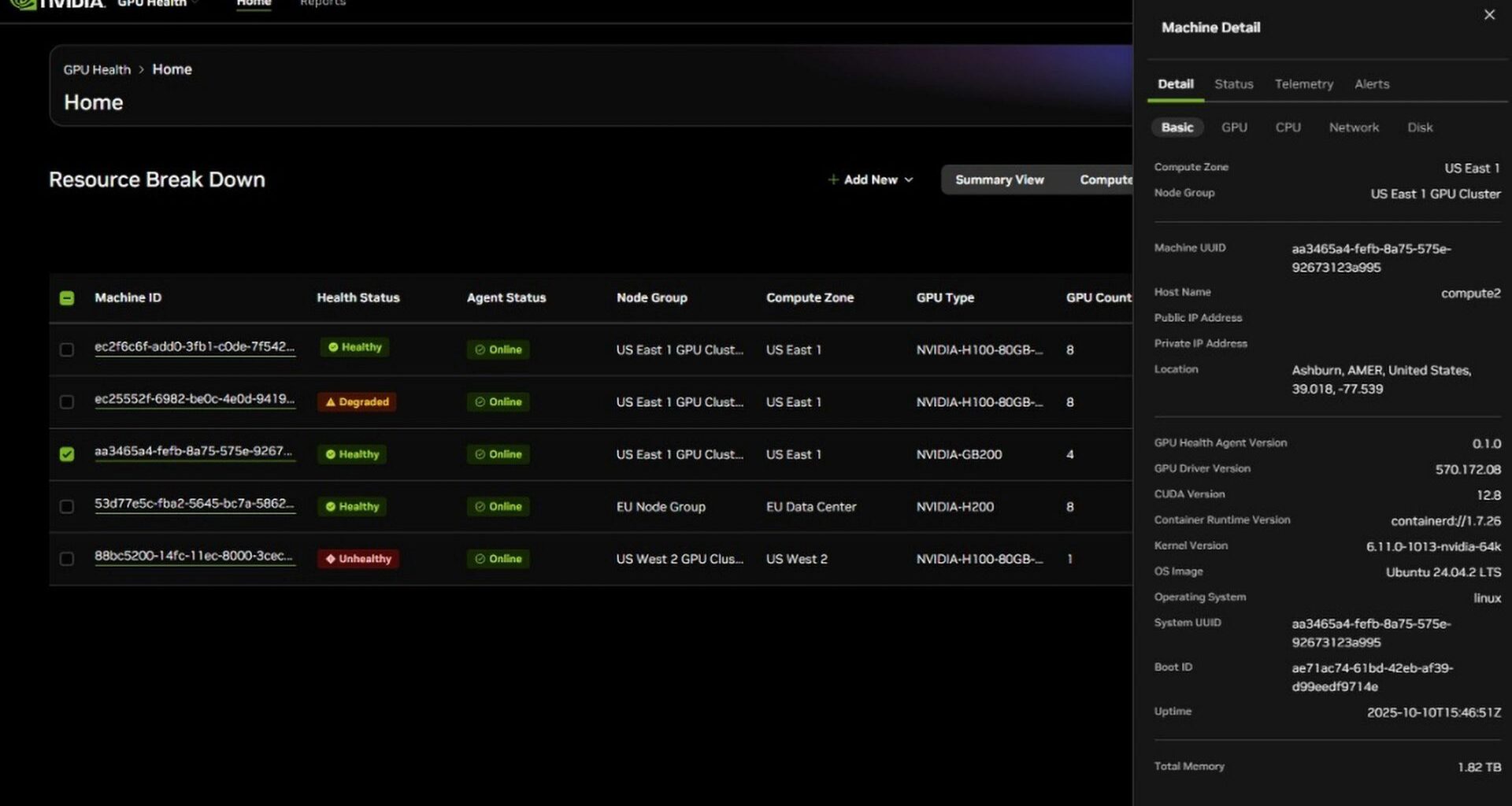
Following reports that Nvidia has developed a data fleet management software that can track physical locations of its GPUs, Nvidia on Thursday detailed its GPU fleet monitoring software. The software indeed enables data center operators to monitor various aspects of an AI GPU fleet. Among other things, it allows for detecting the physical location of these processors, a possible deterrent against smuggling chips. However, there is a catch: the software is opt-in rather than mandatory, which may limit its effectiveness as a tool to thwart smugglers, whether nation-state or otherwise.
The software collects extensive telemetry, which is then aggregated into a central dashboard hosted on Nvidia’s NGC platform. This interface lets customers visualize GPU status across their entire fleet, either globally or by compute zones representing specific physical or cloud locations, which means the software can detect the physical location of Nvidia hardware. Operators can view fleet-wide summaries, drill into individual clusters, and generate structured reports containing inventory data and system-wide health information.
You may like
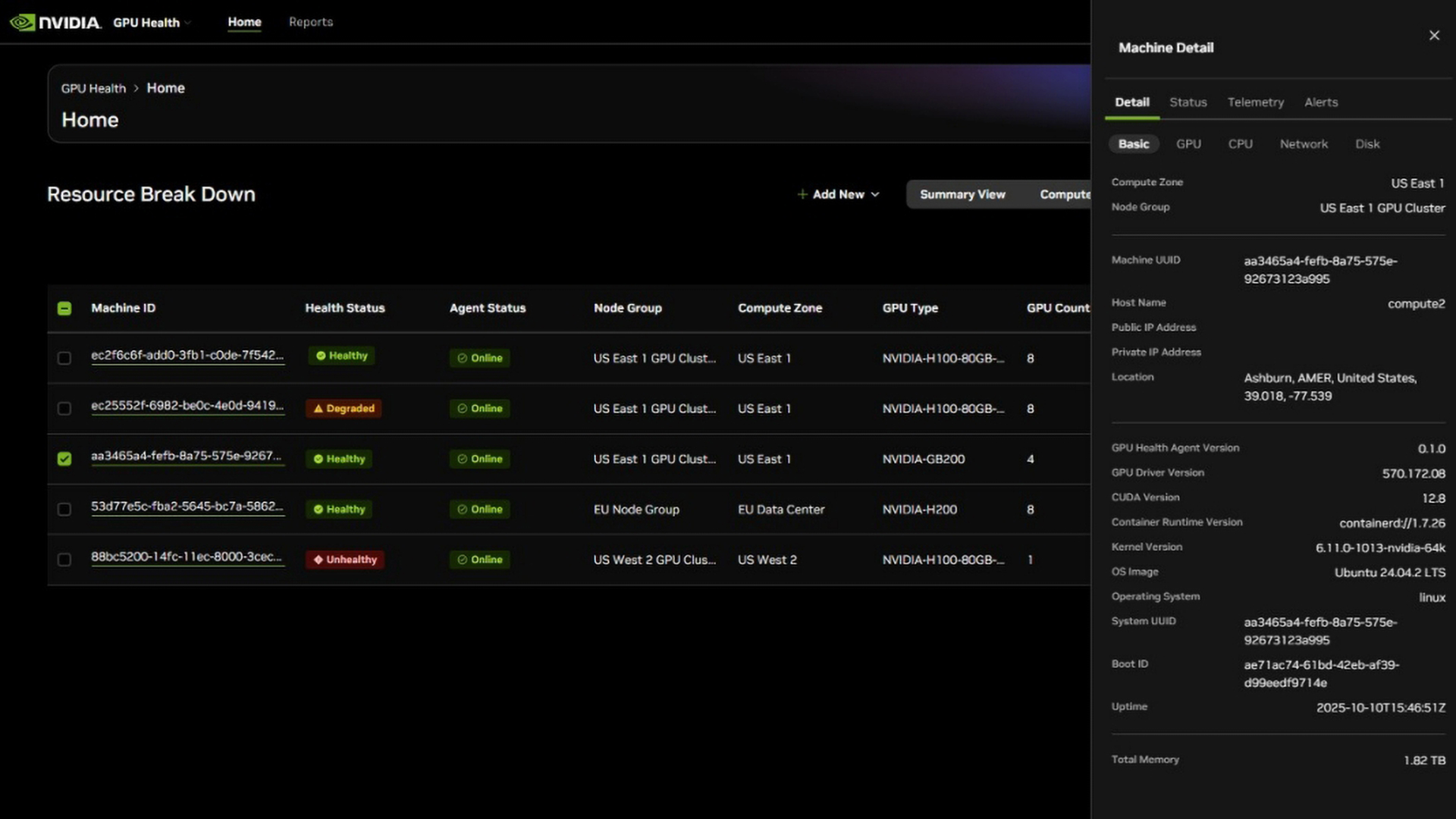
(Image credit: Nvidia)
Nvidia’s new fleet-management software gives data center operators a detailed, real-time view of how their GPU infrastructure behaves under load. It continuously collects telemetry on power behavior — including short-duration spikes — enabling operators to stay within power limits. In addition to power data, the system monitors utilization, memory bandwidth usage, and interconnection health across fleets, to enable operators to maximize utilization and performance per watt. These indicators help expose load imbalance, bandwidth saturation, and link-level issues that can quietly degrade performance across large AI clusters.
Another focus of the software is thermals and airflow conditions to avoid thermal throttling and premature component aging. By catching hotspots and insufficient airflow early, operators can avoid performance drops that typically accompany high-density compute environments and, in many cases, prevent premature aging of AI accelerators.
The system also verifies whether nodes share consistent software stacks and operational parameters, which is crucial for reproducible datasets and predictable training behavior. Any configuration divergence, such as mismatched drivers or settings, becomes visible in the platform.
It is important to note that Nvidia’s new fleet-management service is not the company’s only tool for remotely diagnosing and controlling GPU behavior, though it is the most advanced. For example, DCGM is a local diagnostic and monitoring toolkit that exposes raw GPU health data, but requires operators to build their own dashboards and aggregation pipelines, which greatly shrinks its usability, but enables operators to build the tools they need themselves. There is also Base Command, a workflow and orchestration environment designed for AI development, job scheduling, dataset management, and collaboration, not for in-depth hardware monitoring.
Meanwhile, all three tools represent a formidable set of knobs for data center operators. DCGM provides node-level probes, Base Command handles workloads, and the new service integrates them into a fleet-wide visibility platform that scales to geographically distributed GPU deployments.
Follow Tom’s Hardware on Google News, or add us as a preferred source, to get our latest news, analysis, & reviews in your feeds.