
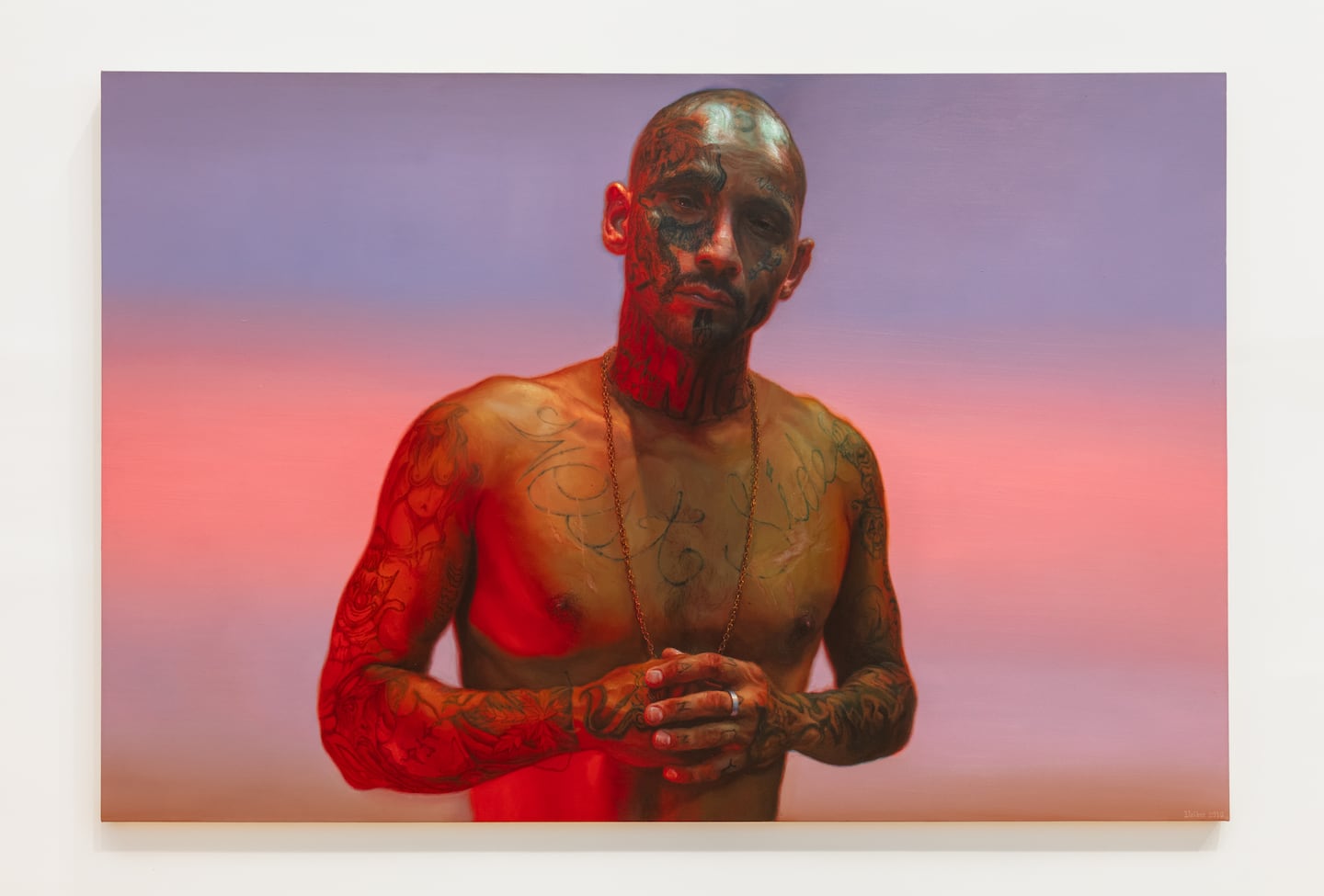
 Vincent Valdez, “So Long, MaryAnn,” 2019.
As installed in “Just a Dream…” at MASS MoCA until April 2026. Jon Verney
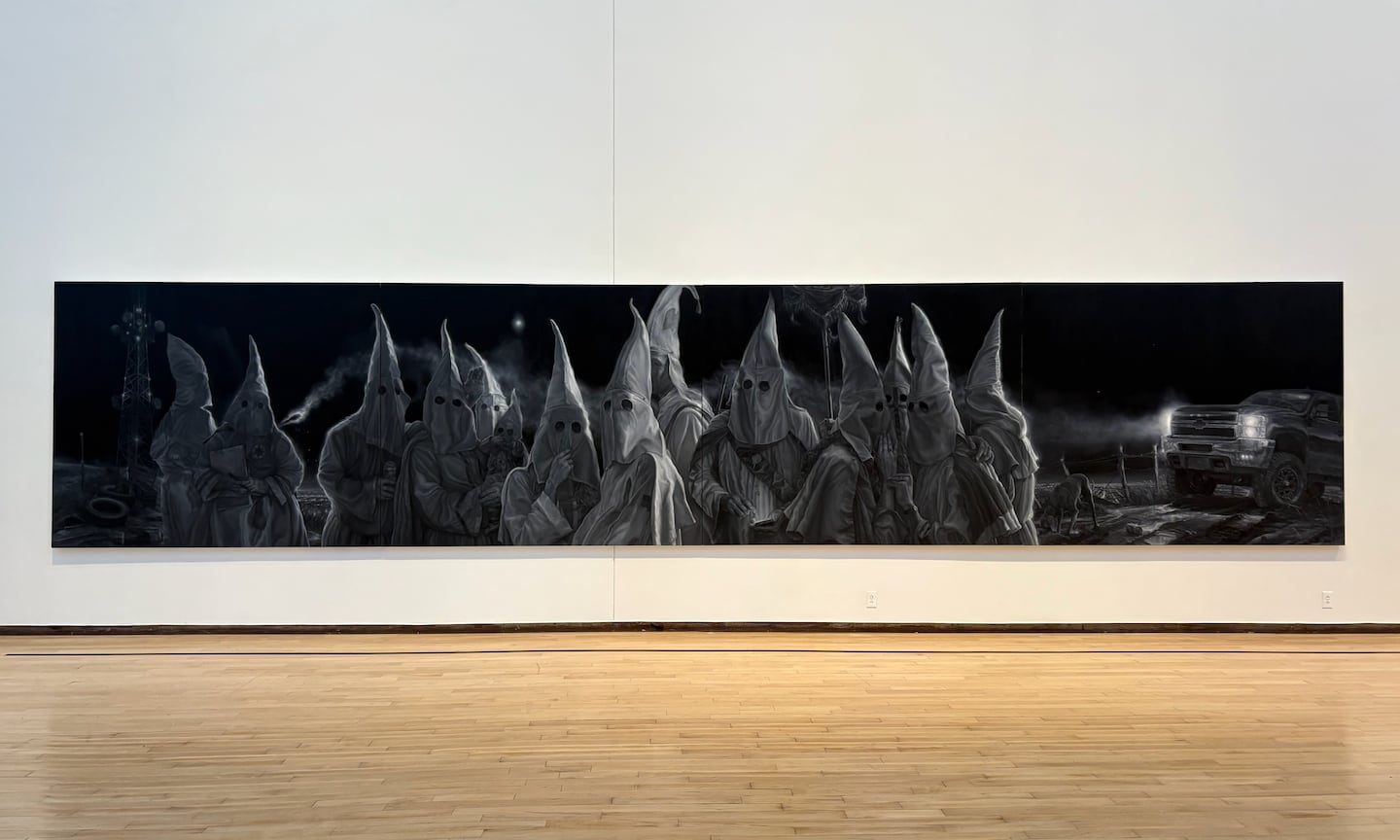
That said, he knows how to grab hold of fleeting attention — a tableau of klansmen takes care of that — but more importantly, knows what to do with it once he has it. And now that he has your attention, there is depth and subtlety to be found across a virtuosic oeuvre brimming with humanity and grace. Above all, Valdez insists that the unseen be seen, and he undermines the power structures that work to keep them invisible.
I’ll admit that that much certainly feels timely. In an era when immigration shock troops are tackling suspected illegal migrants on city streets and hustling them away in unmarked cars, the constant flow of hurried phone footage of this outrageous ad hoc brutality has helped transform what might otherwise register in the daily news as a statistic into the rough, inhuman practice it actually is. Valdez, in his way, completes the picture. Beyond the immediate shock, Valdez humanizes, deepens, and presents recent immigrants with nobility and grace.
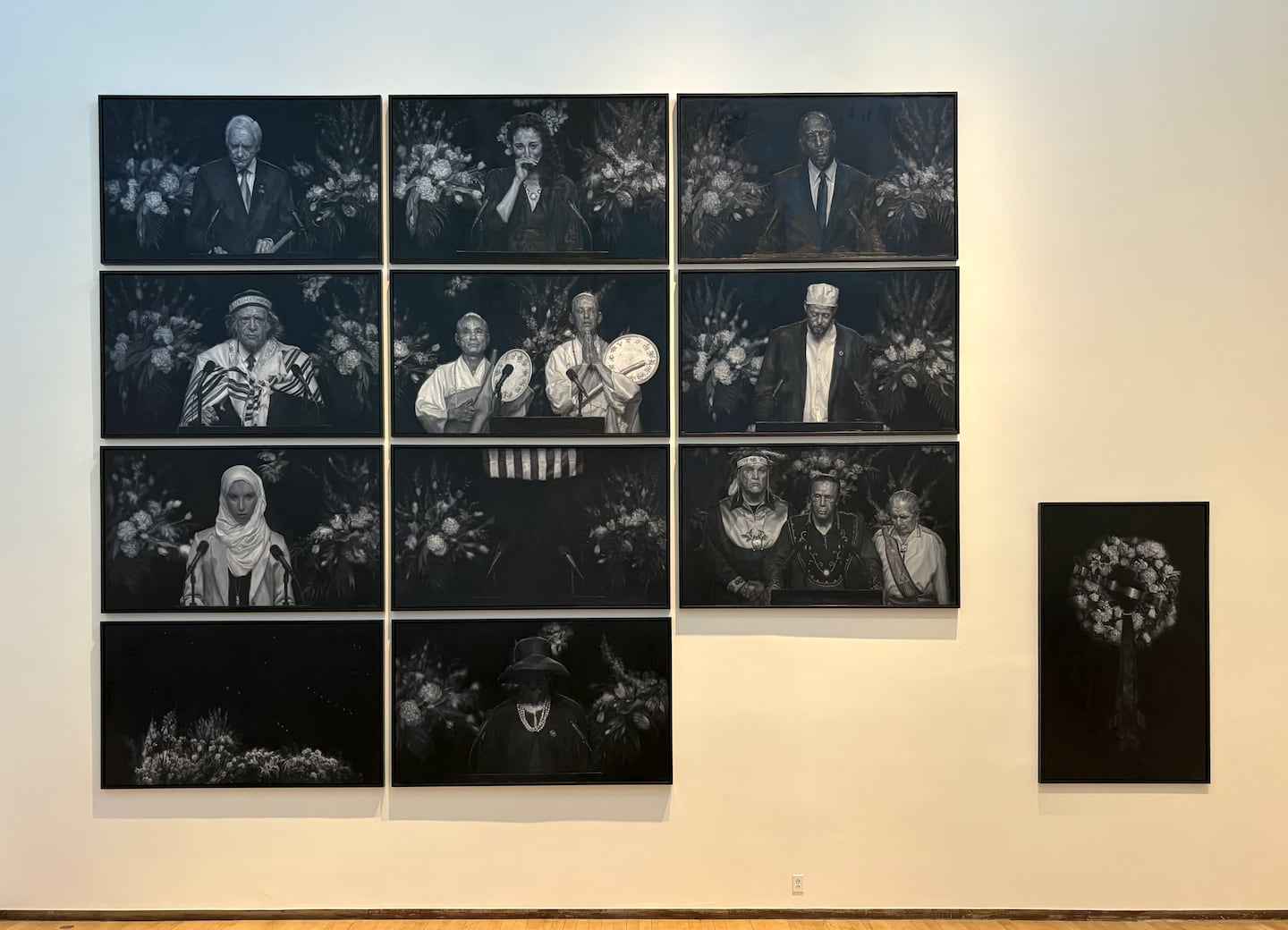 Vincent Valdez, “The Beginning is Near, An American Trilogy, Ch. 2: “Dream, Baby, Dream,” 2018. Installed at Mass MOCA in “Vincent Valdez: Just a Dream …”Murray Whyte/Globe Staff
A selection of life-sized portraits from his recent series “The Beginning Is Near: An American Trilogy, Ch. 3: The New Americans,” provides an understated but powerful counterpoint to the exhibition’s incipient shock. “Juan Cartegena,” 2021, portrays a balding middle-aged man in an urban alleyway. He wears a suit, his fingers are interlocked, and a graying fringe of neatly-trimmed beard and hair frame an expression of stoic, serene determination. “Mr. Checkpoint,” 2021, captures a young man with a skateboard at an intersection; a police car wails past, but he’s unperturbed. Both project an air of contemplative grace, a getting-on-with-it stance that fastens the immigrant experience to the quotidienne normalcy most of us aspire to.
This, of course, is “Chapter 3” for a reason. “The Beginning Is Near: An American Trilogy, Ch.1: The City” is the title of the painting of those klansmen, as grim a starting point to Valdez’s tale as you could imagine. Look closely: the crowd includes women, and a wide-eyed infant in a tiny hood and robe. There’s an echo here of Philip Guston’s infamous series of klansmen in mundane everyday chores — at the office, standing in line, or cruising aimlessly in a car through city streets. It was an unnerving portrait of the banality of evil — and of how hatred has festered not in full-throated rallies in the dead of night but woven through everyday America at its most otherwise normal.
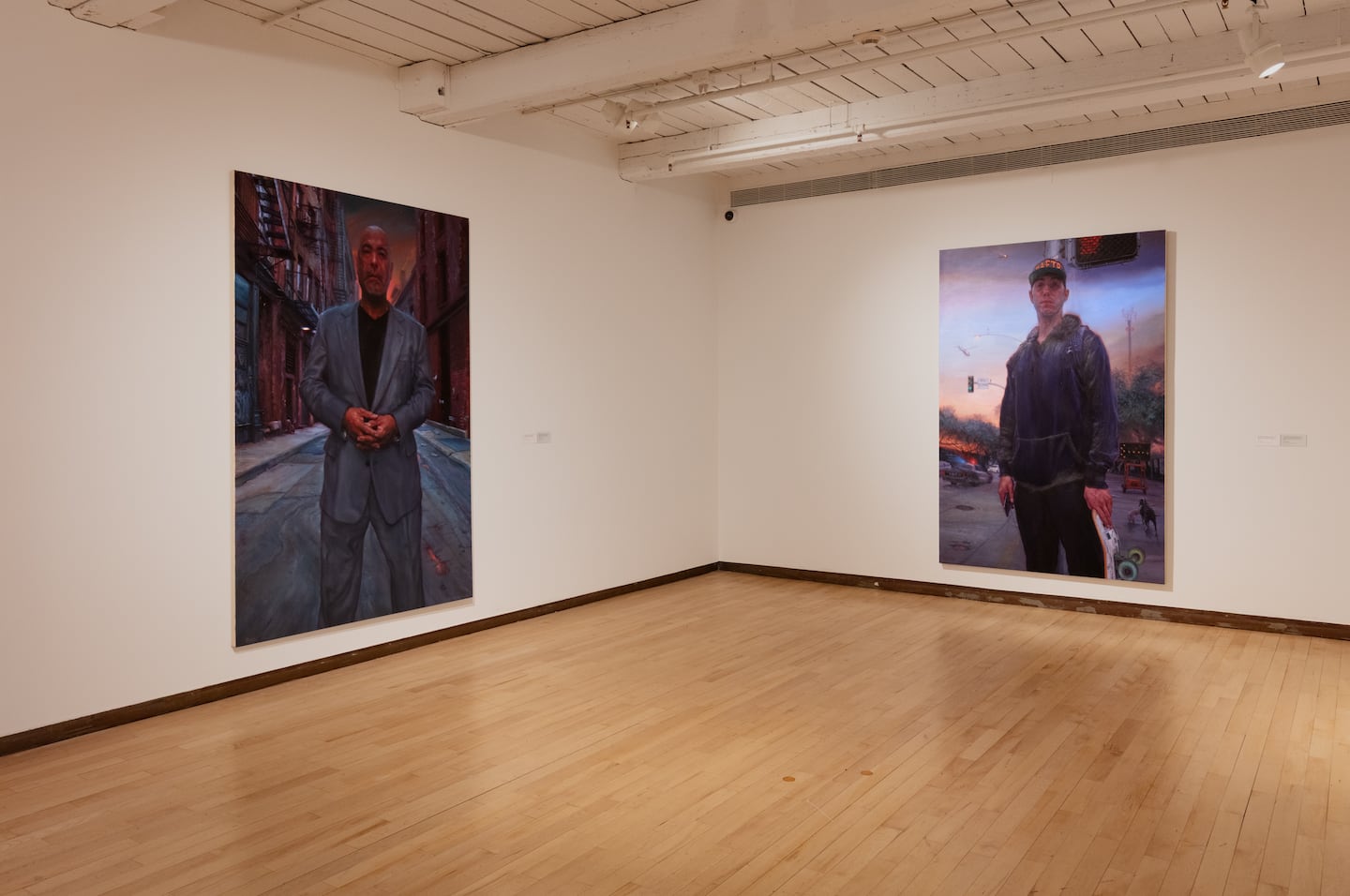 Vincent Valdez, “The Beginning Is Near: An American Trilogy, Ch. 3: The New Americans.” Left: “Juan Cartegena,” 2021; R: “Mr. Checkpoint,” 2021. Jon Verney
But in the broader arc of Valdez’s intent, it’s not impossible to read it as the scorched earth that allows hope to grow. Chapter 2, “Dream Baby Dream,” doesn’t inspire optimism either. A grid of portraits rendered in inky black and silver tones of a spectrum of figures — a woman in a hijab. a trio of Native American men, a pair of Tibetan monks, a wizened rabbi – speaking at a podium wreathed in flowers — it has the unmistakable sense of a funeral.
Made in 2018, amid the shock of vast social regression gripping the nation during Trump’s first term, you can read the piece as a requiem. In one frame, the stripes of the American flag dangle in the ombre, alone. The dream, clearly, is the American archetype: Of the limitless possibility of anyone from anywhere making the life they want here, then, as now, dangling by a thread. A painting of a black wreath, hung apart, makes space for renewal. “It’s the dream that keeps,” reads gothic script strung along a ribbon that binds it. It’s a reminder, at least to me, that America has found itself in darkness before, and made its way to the light.
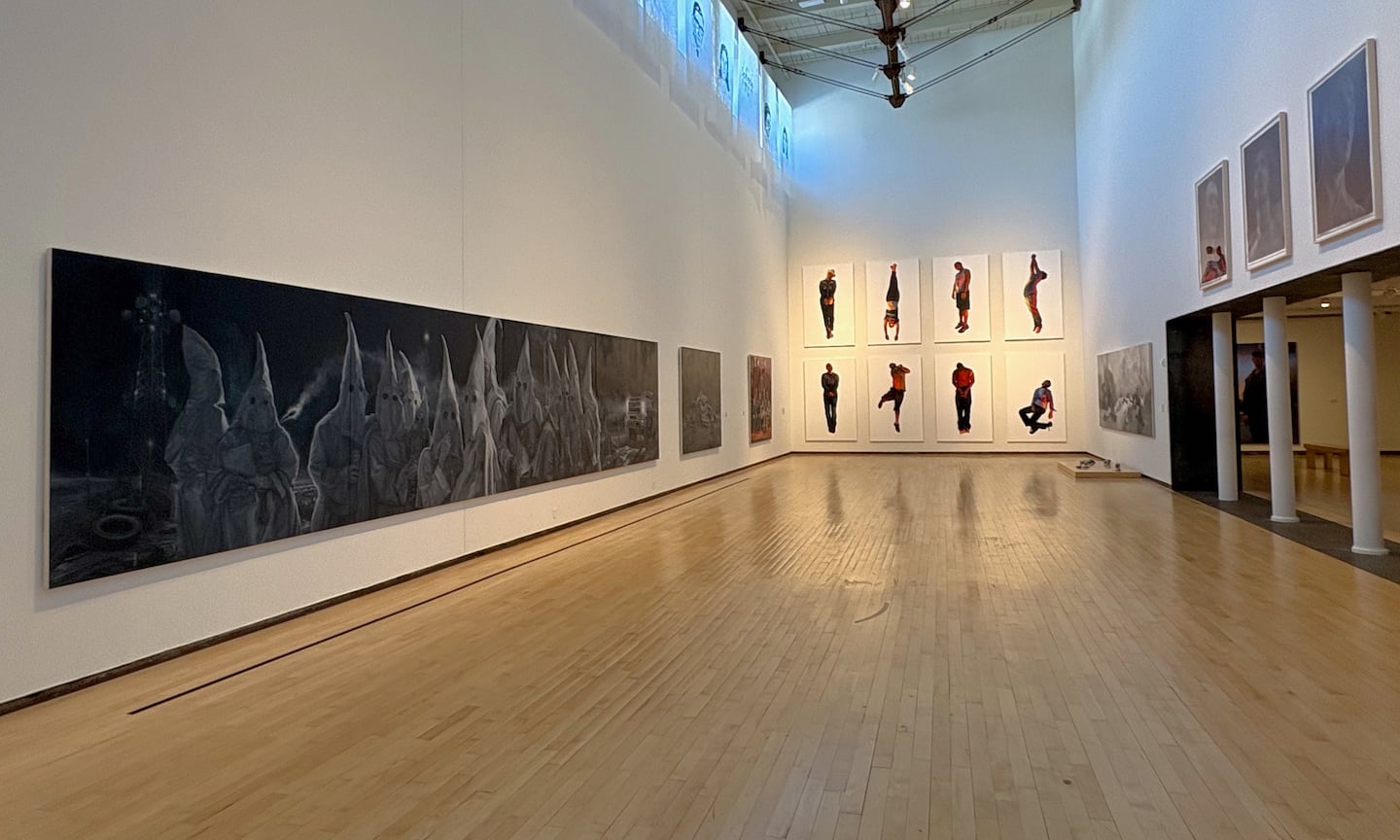 L to R: Vincent Valdez, “The Beginning is Near, An American Trilogy, Ch. 1: The City II,” 2016: “The Strangest Fruit,” 2013. Installed at Mass MOCA in “Vincent Valdez: Just a Dream …” until April 2026. (Murray Whyte/Globe Staff)
00mocaMurray Whyte/Globe Staff
L to R: Vincent Valdez, “The Beginning is Near, An American Trilogy, Ch. 1: The City II,” 2016: “The Strangest Fruit,” 2013. Installed at Mass MOCA in “Vincent Valdez: Just a Dream …” until April 2026. (Murray Whyte/Globe Staff)
00mocaMurray Whyte/Globe Staff
It was, in this moment, heavy with emotion, something I needed to see. One thing to understand about the exhibition: It is very much about seeing, almost entirely unencumbered with blocks of explanatory text and didactics, except for very practical purpose. I have to think this was Valdez’s doing as much as the work itself, making “Just a Dream …” as open a read as you’ll find. (If you dig deeper, you’ll learn “Dream Baby Dream” is in fact a depiction of the funeral of Muhammed Ali, but I’d almost rather not know; its lament is, and should — be, broader, whatever the impacts of Ali’s tireless war against injustice.) What you bring to it bears mightily on what you’ll get out of it. You might learn more about yourself than anything else, and there’s no greater purpose for art than that.
Even so, Valdez is hardly hands off, and he makes clear that any path, whether to darkness or enlightenment, is hardly straight. “The Strangest Fruit,” a series of 2013 full-length portraits of young men on stark white backgrounds as though in mid-air, has the obvious echo of the Billie Holiday tune about southern lynchings in the 1930s; a small sculptural piece recreates the front page of the Los Angeles Times in 1992, when the acquittal of the officers charged with beating Rodney King sparked widespread riots. “Bush Ordering Troops to L.A.,” the black line head, is heavy with foreshadows of the here and now.
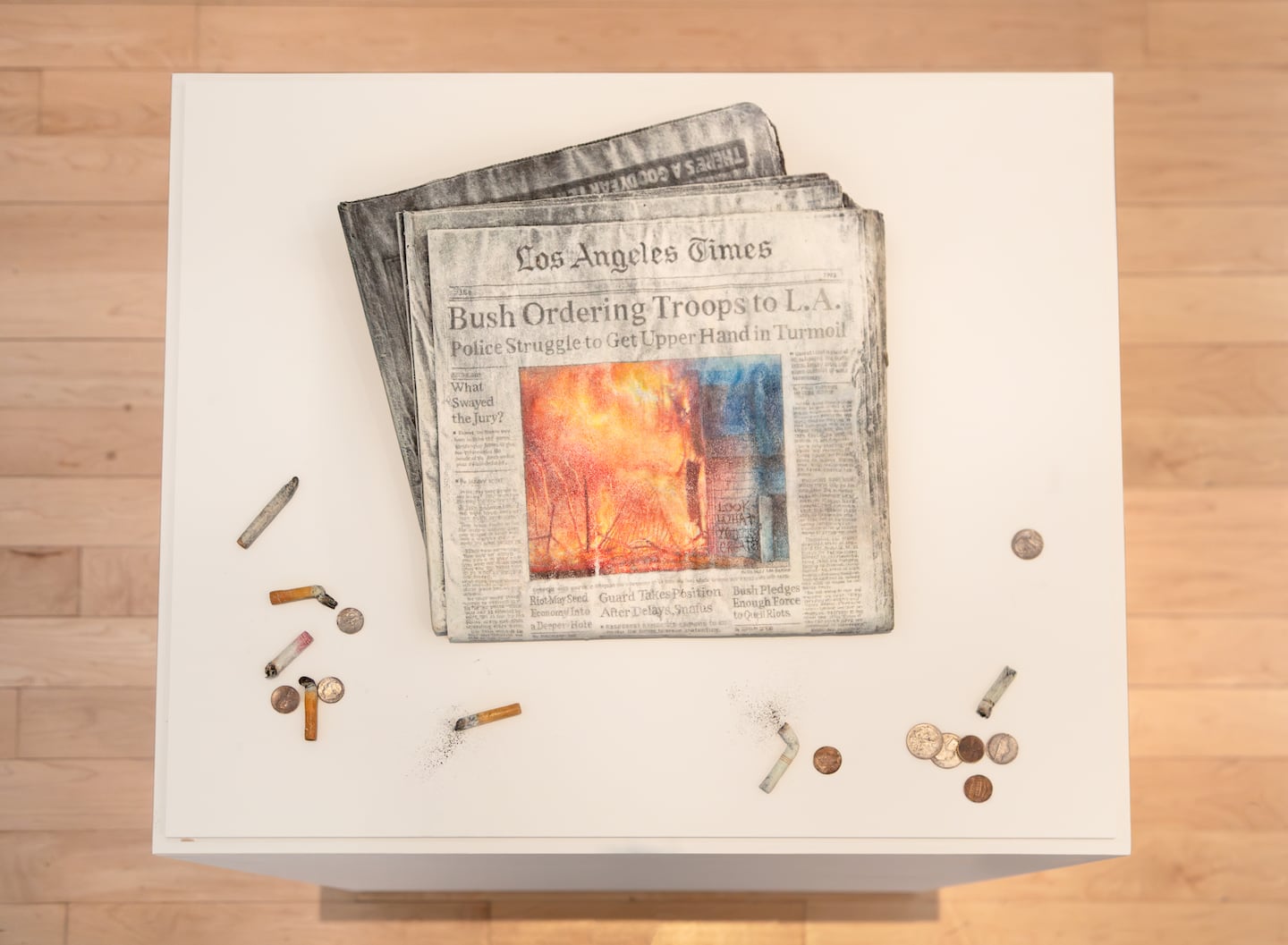 Installation view of “Vincent Valdez: Just a Dream…” at MASS MoCA. Jon Verney
And the most blunt piece here, “The Hole/In Memory (For Joe Campos Torres),” 2024, extracts a horror of racial injustice from Texas history: In 1977, Torres, a veteran, was arrested and then taken to Buffalo Bayou, where he was beaten and drowned by the arresting officers. In 2021, the Houston police department finally acknowledged and apologized for the murder. The piece pairs a portrait of Torres in miltary dress uniform by Valdez with a statue of the Virgin Mary by Adriana Corral, cast from the clay of Buffalo Bayou.
You get the idea. Valdez leans easily into activist territory, and doesn’t hesitate to use his ample gifts in blunt and righteous fashion. And they are ample. Don’t miss, because how could you, the fact that Valdez is an extraordinary painter. His old master-worthy images in “Dream Baby Dream” are particularly disarming; the furious seas of “Godspeed,” 2019, of a tallship struggling against a surge of rogue waves in a steel-gray ocean, is extraordinary.
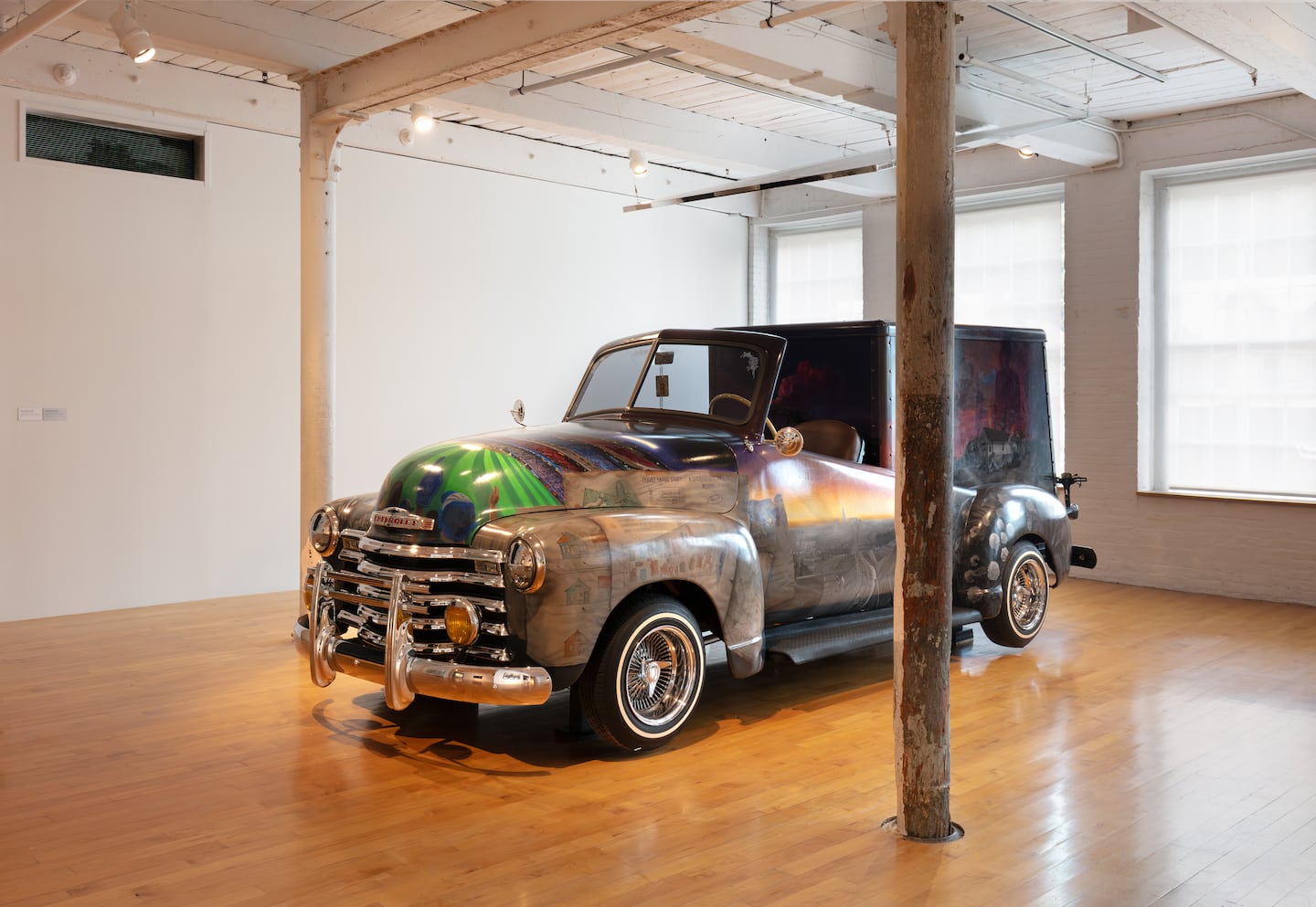 Vincent Valdez and Ry Cooder, ““El Chavez Ravine,” 2005-07. As installed in “Just a Dream…” at MASS MoCA, through April 2026. Jon Verney
But Valdez is also a reminder that, throughout history, some of the most powerful art has been the product of the worst circumstances. Recently in Madrid, I was able to stand in front of Picasso’s “Guernica,” his 1939 epic lament for the carnage of the onset of Spanish fascism, a convulsion of violent inhumanity at its most extreme. An eruption of grief at the wholesale bombing of the town of Guernica by Franco-allied Nazi forces, it’s perhaps his most powerful work.
Valdez less favors grand individual gestures than a long view. His work reads as a steady accretion of oppression interwoven with the the occasional triumph of resistance and justice. In 2005, Valdez teamed up with the musician Ry Cooder to make “El Chavez Ravine,” a 1953 Good Humor ice cream truck that Valdez emblazoned with an epic narrative oil painting that captured the story of the forcible eviction of the Mexican American community in El Chavez to make way for the construction of Dodger Stadium (Cooder made an album, “Chavez Ravine,” about the story). A real world emblem of innocent youth festooned with a shameful chapter of gentrification, discrimination, and displacement – all elements in urban America right now, suffering the worst housing crisis maybe in its history – it coalesces Valdez’s long view, where art and activism meet. It all adds up, and Valdez is profoundly invested in the tally.
VINCENT VALDEZ: JUST A DREAM …
Through April 5. Massachusetts Museum of Contemporary Art, 1040 Mass MoCA Way, North Adams. 413-662-2111, www.massmoca.org.
Murray Whyte can be reached at murray.whyte@globe.com. Follow him @TheMurrayWhyte.